CBSE Class 5 > Class 5 Notes > Mathematics > Let's Learn: Fractions
Let's Learn: Fractions

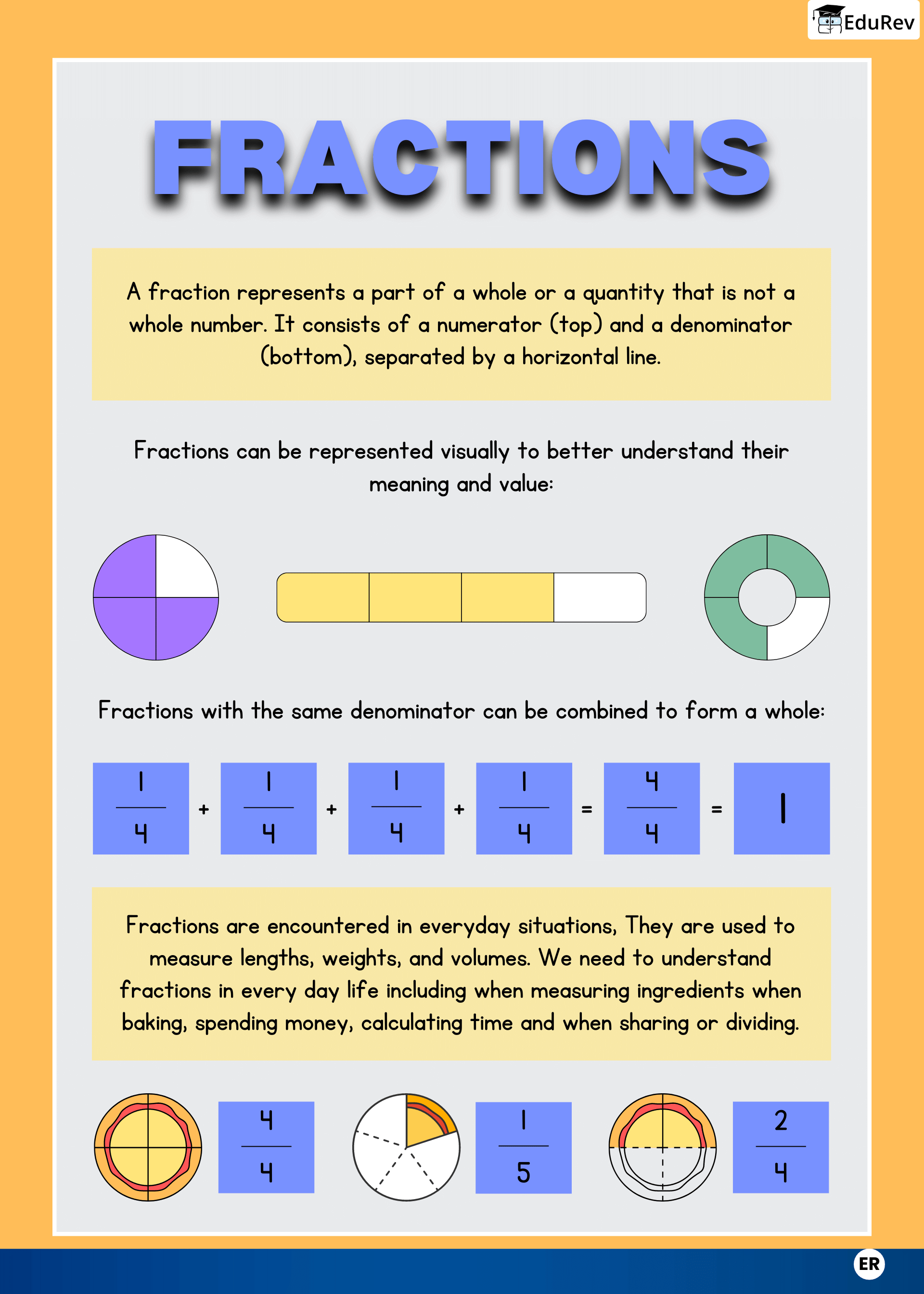
The document Let's Learn: Fractions is a part of the Class 5 Course Mathematics for Class 5.
All you need of Class 5 at this link: Class 5
FAQs on Let's Learn: Fractions
| 1. What is a fraction and how is it represented? |  |
Ans. A fraction is a mathematical expression that represents the division of one quantity by another. It consists of two parts: the numerator (the top number) and the denominator (the bottom number). For example, in the fraction ¾, 3 is the numerator, and 4 is the denominator, indicating that 3 parts of a whole are being considered out of 4 equal parts.
| 2. How do you add fractions with different denominators? | |
Ans. To add fractions with different denominators, you first need to find a common denominator. This is typically the least common multiple (LCM) of the denominators. Once you have a common denominator, convert each fraction to an equivalent fraction with this denominator. Then, add the numerators while keeping the denominator the same. For example, to add ⅓ and ¼, the LCM of 3 and 4 is 12. So, convert ⅓ to ⁴⁄₁₂ and ¼ to ³⁄₁₂, then add them to get ⁷⁄₁₂.
| 3. What is the difference between proper and improper fractions? | |
Ans. A proper fraction is a fraction where the numerator is less than the denominator, such as ⅖. An improper fraction, on the other hand, is where the numerator is greater than or equal to the denominator, like ⁵⁄₄. Improper fractions can also be expressed as mixed numbers, which combine a whole number with a proper fraction, such as 1⅓ for ⁴⁄₃.
| 4. How do you convert a fraction to a decimal? | |
Ans. To convert a fraction to a decimal, divide the numerator by the denominator. For example, to convert ¾ to a decimal, you would perform the division 3 ÷ 4, which equals 0.75. This method allows you to express the fraction in decimal form accurately.
| 5. What are equivalent fractions and how can you find them? | |
Ans. Equivalent fractions are different fractions that represent the same value or proportion of a whole. To find equivalent fractions, you can multiply or divide the numerator and denominator of a fraction by the same non-zero number. For instance, ½ is equivalent to ²⁄₄ because both represent the same portion of a whole when simplified.
About this Document

1.5K Views

4.69/5 Rating

Apr 20, 2026 Last updated
Document Description: Let's Learn: Fractions for Class 5 2026 is part of Mathematics for Class 5 preparation. The notes and questions for Let's Learn: Fractions have been prepared according to the Class 5 exam syllabus. Information about Let's Learn: Fractions covers topics like and Let's Learn: Fractions Example, for Class 5 2026 Exam. Find important definitions, questions, notes, meanings, examples, exercises and tests below for Let's Learn: Fractions.
Introduction of Let's Learn: Fractions in English is available as part of our Mathematics for Class 5 for Class 5 & Let's Learn: Fractions in Hindi for Mathematics for Class 5 course. Download more important topics related with notes, lectures and mock test series for Class 5 Exam by signing up for free. Class 5: Let's Learn: Fractions
Description
Let's Learn: Fractions of Mathematics covers all the important topics, helping you prepare for the Class 5 exam on EduRev. Start for free!
Information about Let's Learn: Fractions
In this doc you can find the meaning of Let's Learn: Fractions defined & explained in the simplest way possible. Besides explaining types of Let's Learn: Fractions theory, EduRev gives you an ample number of questions to practice Let's Learn: Fractions tests, examples and also practice Class 5 tests



Related Searches
ppt, Viva Questions, Summary, Sample Paper, Let's Learn: Fractions, Extra Questions, practice quizzes, pdf , Exam, video lectures, Semester Notes, Objective type Questions, shortcuts and tricks, Let's Learn: Fractions, Let's Learn: Fractions, Previous Year Questions with Solutions, MCQs, Free, mock tests for examination, study material, past year papers, Important questions;