CBSE Class 5 > Class 5 Notes > Science > Learn at a Glance: Layers of Earth
Learn at a Glance: Layers of Earth

The Earth is made of several layers, one inside another, each with different materials and properties. Understanding these layers helps us know why earthquakes and volcanoes happen, where minerals come from, and how the surface we live on is supported. Read the sections below to learn about the structure of the Earth simply and clearly.
What are the main layers of the Earth?
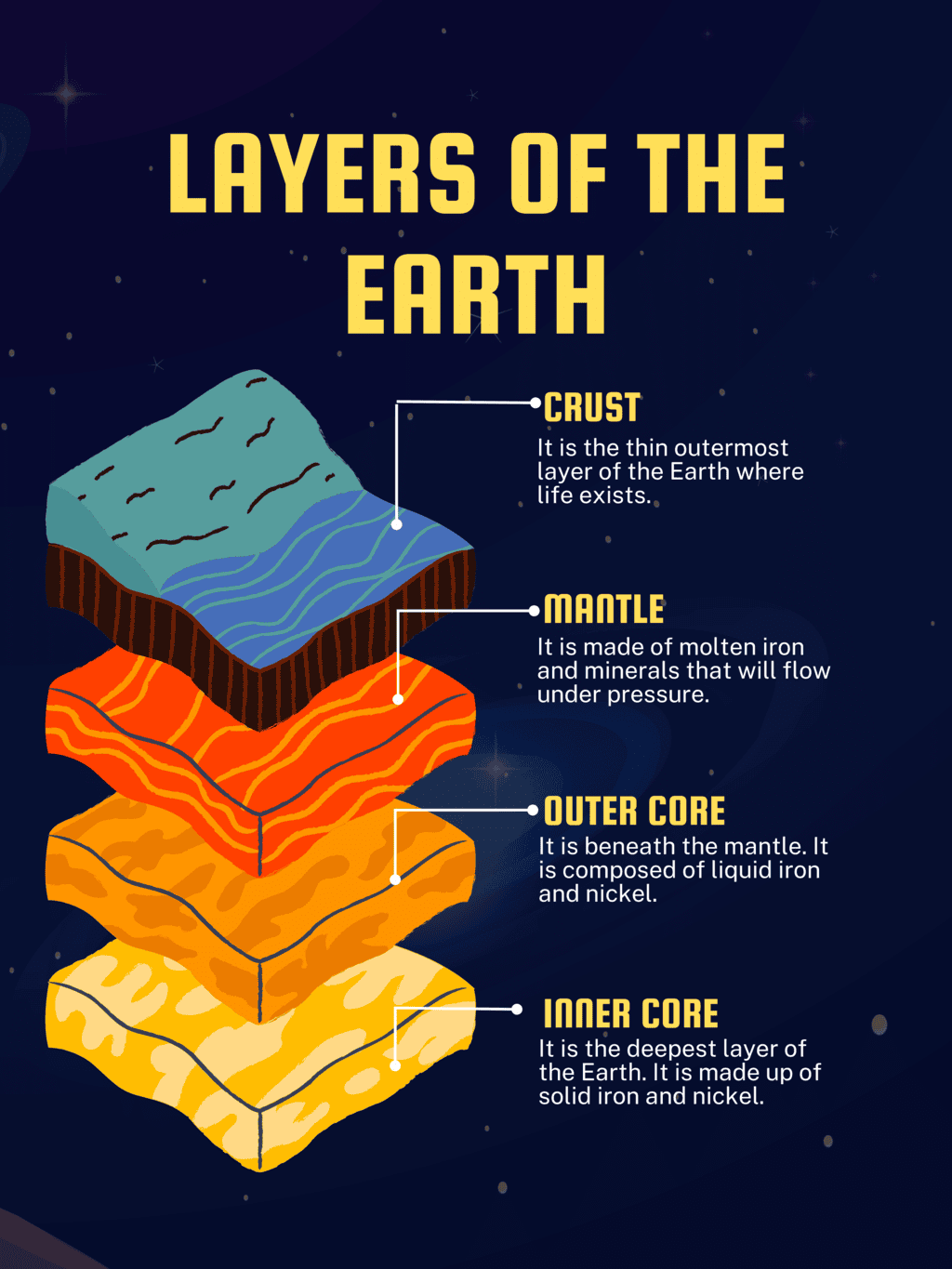
The Earth has three main layers arranged like the layers of an onion. These are the crust, the mantle, and the core. Each layer differs in composition, thickness and temperature.
1. The Crust
- The crust is the outermost thin layer where we live. It contains soil, rocks, mountains and the oceans.
- There are two types of crust: continental crust (under continents) and oceanic crust (under the oceans).
- The continental crust is thicker (about 30-70 km) and made mainly of lighter rocks such as granite.
- The oceanic crust is thinner (about 5-10 km) and made mainly of denser rocks such as basalt.
- The crust is broken into large pieces called tectonic plates. The movement of these plates causes earthquakes and forms mountains.
2. The Mantle
- The mantle lies below the crust and is the thickest layer of the Earth, extending to a depth of about 2,900 km.
- The mantle is made of hot, solid rock that can slowly flow like very thick syrup; parts of it are partially molten.
- Heat inside the mantle causes convection currents. These currents slowly move the tectonic plates on the crust.
- The uppermost part of the mantle together with the crust forms the lithosphere, a rigid layer that makes up tectonic plates.
- Just below the lithosphere is the asthenosphere, a weaker and slightly softer layer that allows plates to move.
3. The Core
- The core is at the centre of the Earth and is made mainly of iron and nickel.
- The core has two parts: the outer core and the inner core.
- The outer core is liquid and lies beneath the mantle; its movement helps create the Earth's magnetic field.
- The inner core is solid because the pressure there is extremely high, even though temperatures are very hot.
- The temperature increases with depth and can reach several thousand degrees Celsius in the core.
Diagram of the Earth's layers
How do scientists know about the layers?
- Scientists study how earthquake waves (seismic waves) travel through the Earth. Different layers change the speed and direction of these waves.
- Some waves cannot pass through liquids; using this, scientists discovered the outer core is liquid while the inner core is solid.
- Studies of volcanic rocks and meteorites also give clues about the materials that make up the Earth.
Why the layers matter - examples and everyday effects
- Movement of the mantle (convection currents) causes tectonic plates to move, which leads to earthquakes, volcanoes and the formation of mountains.
- The crust supplies soil and rocks used for building and farming, and holds mineral resources like coal, iron, copper and gemstones.
- The Earth's magnetic field, produced by the outer core, protects living things from harmful solar radiation.
Key terms
- Crust - the thin, outermost layer of the Earth where life exists.
- Mantle - the thick layer of hot rock below the crust; it moves slowly and drives plate motion.
- Core - the central part of the Earth made mainly of iron and nickel; includes outer (liquid) and inner (solid) core.
- Lithosphere - the rigid outer shell made of crust plus the uppermost mantle; it forms tectonic plates.
- Asthenosphere - the softer layer of the upper mantle below the lithosphere that allows plate movement.
- Seismic waves - vibrations produced by earthquakes; used by scientists to study Earth's interior.
The document Learn at a Glance: Layers of Earth is a part of the Class 5 Course Science Class 5.
All you need of Class 5 at this link: Class 5
FAQs on Learn at a Glance: Layers of Earth
| 1. What are the main layers of the Earth? |  |
Ans. The Earth is composed of three main layers: the crust, the mantle, and the core. The crust is the outermost layer, where we live, and is relatively thin. Below the crust is the mantle, which is much thicker and consists of semi-solid rock. The core is divided into two parts: the outer core, which is liquid, and the inner core, which is solid and primarily made of iron and nickel.
| 2. How do scientists know about the layers of the Earth? | |
Ans. Scientists have learned about the Earth's layers through various methods, including the study of seismic waves generated by earthquakes. These waves travel through the Earth and change speed and direction depending on the materials they pass through. By analysing how these waves behave, scientists can infer the properties and composition of the different layers.
| 3. Why do the Earth's layers matter? | |
Ans. The layers of the Earth are crucial for understanding geological processes and phenomena. For example, the movement of tectonic plates, which occurs in the mantle, causes earthquakes and volcanic eruptions. Additionally, the Earth's core generates the magnetic field, which protects the planet from harmful solar radiation, making it essential for life.
| 4. What are some everyday effects of the Earth's layers? | |
Ans. Everyday effects of the Earth's layers include the formation of natural resources such as minerals and fossil fuels found in the crust. The mantle's convection currents drive plate tectonics, influencing the landscape and climate. Furthermore, the magnetic field generated by the core affects navigation systems and protects our technology from solar storms.
| 5. What are some key terms related to the layers of the Earth? | |
Ans. Key terms related to the layers of the Earth include "crust," "mantle," "core," "tectonic plates," "seismic waves," and "magnetic field." Understanding these terms is essential for grasping how the Earth's structure influences various geological and environmental processes.
About this Document

4.78/5 Rating

Apr 21, 2026 Last updated
Related Exams
Document Description: Learn at a Glance: Layers of Earth for Class 5 2026 is part of Science Class 5 preparation. The notes and questions for Learn at a Glance: Layers of Earth have been prepared according to the Class 5 exam syllabus. Information about Learn at a Glance: Layers of Earth covers topics like and Learn at a Glance: Layers of Earth Example, for Class 5 2026 Exam. Find important definitions, questions, notes, meanings, examples, exercises and tests below for Learn at a Glance: Layers of Earth.
Introduction of Learn at a Glance: Layers of Earth in English is available as part of our Science Class 5 for Class 5 & Learn at a Glance: Layers of Earth in Hindi for Science Class 5 course. Download more important topics related with notes, lectures and mock test series for Class 5 Exam by signing up for free. Class 5: Learn at a Glance: Layers of Earth
Description
Learn at a Glance: Layers of Earth of Science Class 5 covers all the important topics, helping you prepare for the Class 5 exam on EduRev. Start for free!
Information about Learn at a Glance: Layers of Earth
In this doc you can find the meaning of Learn at a Glance: Layers of Earth defined & explained in the simplest way possible. Besides explaining types of Learn at a Glance: Layers of Earth theory, EduRev gives you an ample number of questions to practice Learn at a Glance: Layers of Earth tests, examples and also practice Class 5 tests



Related Searches
Previous Year Questions with Solutions, Free, ppt, Important questions, Summary, Exam, Viva Questions, pdf , practice quizzes, Learn at a Glance: Layers of Earth, mock tests for examination, past year papers, Sample Paper, study material, Learn at a Glance: Layers of Earth, Objective type Questions, Extra Questions, shortcuts and tricks, video lectures, MCQs, Learn at a Glance: Layers of Earth, Semester Notes;