Overview: Number Series, Letter Series, Alpha-Numeric Series


Importance in CSAT
The chapter 'Series' carries immense importance for CSAT exam. Questions are asked frequently from this chapter. Based on the analysis of previous years' papers, it has been concluded that in the year 2025, three questions and in the year 2024 one question was asked. In the years 2021-2018, almost every year one question was asked from this chapter. Basically, the questions that are asked from this topic are based on finding the missing term or wrong term of a number, letter or mixed series.
Introduction
A series is a systematic arrangement of letters, words, numbers, objects, etc., in a definite order or sequence. A series follows a certain pattern, which may be numerical, alphabetical, or a combination of both. Identifying the rule that generates the sequence is the key to solving missing-term and wrong-term questions.
Broadly, series encountered in competitive exams are classified as Number Series, Letter Series and Alpha-Numeric Series. Below we treat them in detail with examples and solution methods used in CSAT/UPSC style questions.
Type I Number Series
Number series are sequences of numbers that follow a predefined pattern. The pattern may involve arithmetic operations (addition, subtraction, multiplication, division), properties of numbers (prime, square, cube), alternation of different sub-patterns, factorials, or combinations of these.
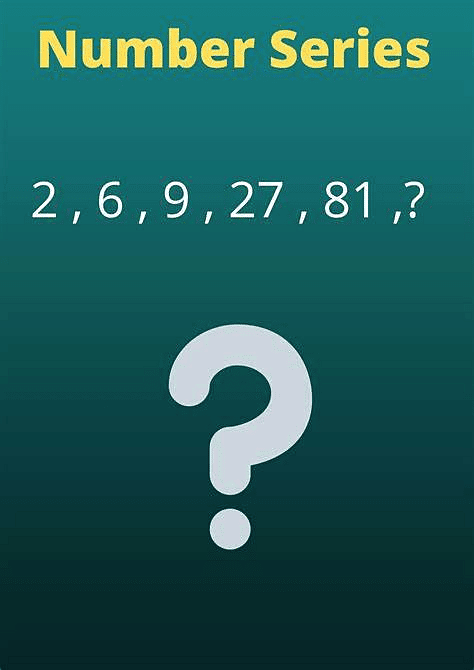
- Finding the Missing Term: Find the next term or a term missing in between. Example: 4, 8, ?, 32, 64. Here the pattern is multiplication by 2, so the missing term is 16 (8 × 2 = 16).
- Finding the Wrong Term: Identify the term that does not conform to the pattern. Example: 5, 10, 15, 19, 25. This should be multiples of 5, so 19 is wrong and must be 20 instead.
Prime Number Series
Series formed using prime numbers or operations on prime numbers. They may consist of consecutive primes, alternate primes, or functions of primes.
Example: Find the wrong term in the series:
7, 11, 13, 15, 19, 23
(a) 13
(b) 15
(c) 19
(d) 23
Ans: (b)
Sol: The sequence is supposed to be consecutive primes. After 13 the next prime is 17, so 15 is wrong and must be 17.
Addition Series
A fixed number (or a sequence of numbers) is added to successive terms to form the next term.
Example: Find the missing term in the series: 3, 6, 9, 12, 15, ..., 21.
(a) 16
(b) 17
(c) 20
(d) 18
Ans: (d)
Sol:
Each term increases by 3, therefore the missing term is 15 + 3 = 18.
Subtraction Series
A fixed number (or sequence) is subtracted from successive terms to obtain the next term.
Example: Find the missing term in the series: 105, 104, 101, 96, ?, 80.
(a) 81
(b) 91
(c) 89
(d) 88
Ans: (c)
Sol:
The differences are -1, -3, -5, -7, ..., i.e., consecutive odd numbers subtracted.
So the missing term is 96 - 7 = 89.
Multiplication Series
Each term is obtained by multiplying the previous term by a number (this multiplier may vary following a pattern).
Example: Find the value of \\(x\\) in the series: 2, 6, 30, 210, \\(x\\), 30030, ... UPSC (CSAT) PYQ
(a) 2310
(b) 1890
(c) 2520
(d) 2730
Ans: (a)
Sol:

Division Series
Each term is obtained by dividing the previous term by a number following a pattern.
Example: Find the missing term in the series: 5040, 720, 120, 24, ..., 2, 1.
(a) 8
(b) 7
(c) 6
(d) 5
Ans: (c)
Sol:
The successive divisors are 7, 6, 5, 4, 3, 2.
5040/7 = 720
720/6 = 120
120/5 = 24
24/4 = 6
6/3 = 2
2/2 = 1
Mixed Series
Series formed by combining two or more operations or containing functions such as squares, cubes, square roots, factorials, alternating patterns, etc. These can be trickier as different positions may follow different sub-rules.
Example: Find the missing term in the series (UPSC CSAT 2012):
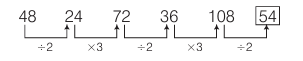
48, 24, 72, 36, 108, ?
(a) 115
(b) 216
(c) 121
(d) 54
Ans: (d)
Sol:
The pattern alternates: divide by 2, multiply by 3, divide by 2, multiply by 3, ...
Series of Series
Here the sequence of differences (or the sequence of multipliers) itself forms another series. Recognising the higher-order pattern is the key; such questions are comparatively more difficult.
Example: Find the missing term of the given series
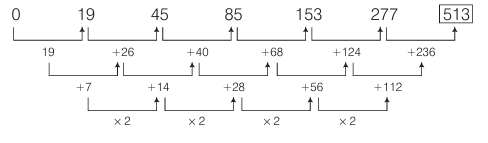
0, 19, 45, 85, 153, 277, ?
(a) 433
(b) 513
(c) 497
(d) 555
Ans: (b)
Sol:
Observe the differences between terms and further differences; the pattern of differences will lead to the missing value.
Type II Letter Series
Letter series use the English alphabet and follow patterns such as skipping fixed numbers of letters, repeating blocks, pairing opposite letters (A-Z, B-Y), shifting by positions, or mixing forward and backward motions. Questions typically ask for the next letter(s), a missing block, or the wrong term.
Single Letter or Group of Letters Series
Letters may be listed singly or in grouped blocks. The skip count between letters may be constant or follow a pattern.
Example: Find the next term in the series.
A, D, G, J, ?
(a) K
(b) L
(c) M
(d) N
Ans: (c)
Sol:
Each term is the letter 3 positions ahead of the previous: A → D → G → J → M.
Continuous Series
Small letters or blocks repeat in a steady pattern. The candidate must find the repeating block and fit it into the blanks.
Example: In the following series, some letters are missing. From the choices, select the choice that gives the letters that can fill the blanks in the given sequence.
a_c_b_ab_a_ca_c
(a) b a c b a
(b) c b a c b
(c) a b c a b
(d) b c a b c
Ans: (d)
Sol:
We look for a choice whose insertion creates a repeating block. Option (d) produces the repeating sequence 'abcabcabcabcabc', which fits.
Important Points
- Count total given letters and blanks to determine the length of the repeating block(s).
- Try to see if the total length is a multiple of a small integer (2, 3, 4, 5...) suggesting repeated blocks; e.g., 15 = 5 × 3 suggests a block of 3 letters repeated 5 times.
- Try candidate options by inserting them into blanks and check if a clear repetition or pattern emerges.
Opposite Letter Series
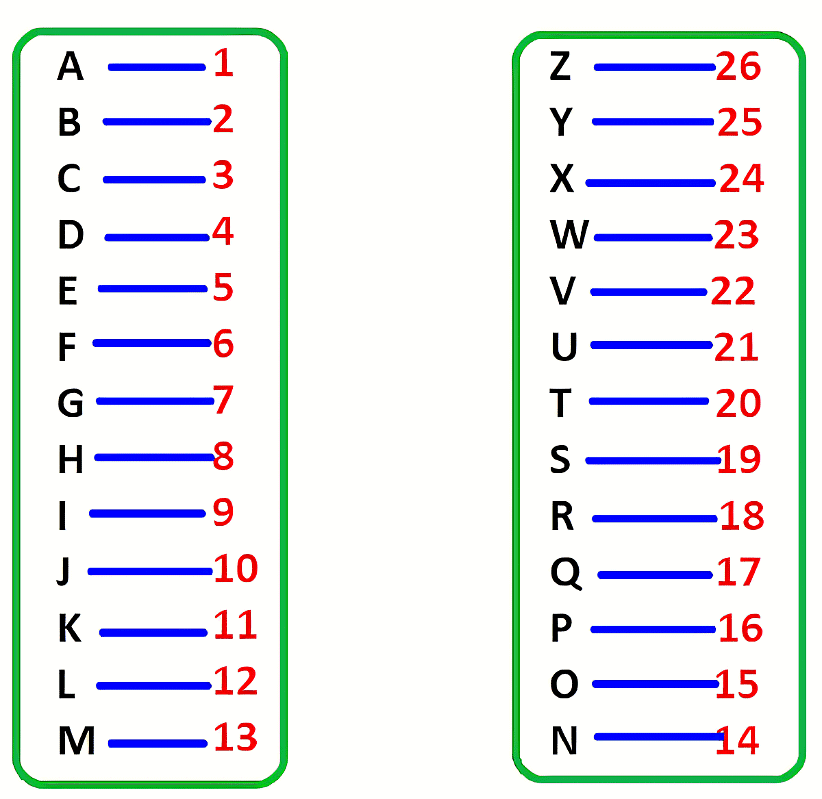
Terms are formed using alphabet pairs that are opposites (A-Z, B-Y, C-X, ...), where the numerical positions of opposite letters sum to 27. The sequence may skip such opposite pairs according to a rule.
Example: Find the missing term in the series:
LO, TG, ..., MN, BY, UF.
(a) QJ
(b) RK
(c) SJ
(d) PL
Ans: (c)
Sol:
Each element is a pair of opposite letters whose positions add to 27. Choose the option that forms such a pair and fits the skip pattern.
Type III Alpha-Numeric Series
Alpha-numeric series combine letters and numbers in each term. Each component (the number and the letter) may follow its own independent rule, or the entire block may follow a combined rule.
Example: Find the missing term in the series.
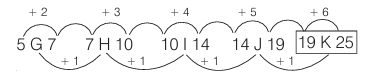
5 G 7, 7 H 10, 10 I 14, 14 J 19, ?
(a) 16 K 20
(b) 17 K 21
(c) 18 K 21
(d) 19 K 25
Ans: (d)
Sol:
Observe separate patterns for the first number, the letter and the last number. Apply each pattern to find the next trio.
CSAT Solved Examples
Directions (Question 1 and 2): In the given mixed series, find the value of the missing term.
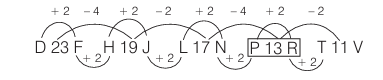
1. D23F, H19J, L17N, ..., T11V
(a) P15R
(b) P14R
(c) P13R
(d) P12R
Ans: (c)
Sol:
2. Z70B, D65F, H60J, ..., P50R
(a) K55L
(b) L55M
(c) L55N
(d) L55P
Ans: (c)
Sol:
Break down the pattern:
First letters: Z → D → H → ? → P advance by 4 positions each time (wrapping after Z). So after H comes L.
Middle numbers: 70 → 65 → 60 → ? → 50 decrease by 5 each time, so next is 55.
Last letters: B → F → J → ? → R increase by 4 positions each time: B + 4 = F, F + 4 = J, J + 4 = N.
Therefore the missing term is L55N.
3. In the series AABABCABCDABCDE... which letter occupies the 100th position? UPSC (Civil Services) PYQ
(a) H
(b) I
(c) J
(d) K
Ans: (b)
Sol:
The series is constructed by concatenating blocks that are successive initial segments of the alphabet:
Block 1: A (length 1)
Block 2: AB (length 2)
Block 3: ABC (length 3)
Block 4: ABCD (length 4)
... and so on.
Compute cumulative letters up to block n:
\\[1 + 2 + 3 + \dots + 13 = 91\\]
Therefore after 13 blocks we have 91 letters. The 14th block will have 14 letters (A to N). The 100th letter is the (100 - 91) = 9th letter of the 14th block, which is the 9th letter of the alphabet: I.
4. Which number is not suitable in the following series? 1 9 36 81 99 121 (CGPSC PYQ)
(a) 1
(b) 121
(c) 36
(d) 99
Ans: (d)
Sol:
The series is of square numbers: 1 = 1², 9 = 3², 36 = 6², 81 = 9², 121 = 11².
99 is not a perfect square, hence it is not suitable in the series.
5. What is the missing number 'X' of the series.
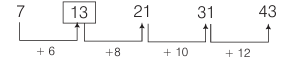
7, X, 21, 31, 43, ? UPSC (CSAT) 2015
(a) 11
(b) 12
(c) 13
(d) 14
Ans: (c)
Sol:
Analyse gaps between given numbers:
The sequence of differences shows an increasing odd pattern; determine the pattern of increments and fill in the missing term accordingly.
Summary and Strategy
- Always look for separate sub-patterns when a term contains more than one element (e.g., alpha-numeric terms). Treat each component separately.
- Check for simple arithmetic patterns first (constant addition/subtraction, constant multiplication/division). If none, check for alternating or mixed patterns.
- When stuck, compute first differences and second differences to expose hidden polynomial or series-of-series behaviour.
- Practice previous years' CSAT/UPSC questions to become familiar with common constructions: prime multipliers, factorials, opposite letter pairs, repeating blocks, and mixed patterns.
FAQs on Overview: Number Series, Letter Series, Alpha-Numeric Series
| 1. What is a Number Series? |  |
| 2. How can one solve a Letter Series? | |
| 3. What is an Alpha-Numeric Series? | |
| 4. How can one approach solving a Type I Number Series question in a competitive exam like CSAT? | |
| 5. What are some tips for improving performance in solving Alpha-Numeric Series questions in CSAT? | |





