Overview: Puzzles

CSAT Angle
From the analysis of Previous Years Papers, it has been observed that this chapter carries significant weight: each year a considerable number of questions are asked from puzzles.
In the year 2024, two questions were asked from this chapter; in other previous years approximately four to five questions were asked directly from this chapter every year.
From the exam point of view, it is therefore important to cover this chapter with a thorough understanding.
Puzzles
A puzzle is a problem or enigma that tests the ingenuity of the solver. In basic puzzles, the solver must put pieces of information together in a logical way to arrive at the correct solution.
- In a puzzle, information is often presented in a jumbled or haphazard format. It checks the candidate's mental and analytical ability to decipher, sequence and analyse the given facts into a meaningful form so as to reach a final conclusion by systematically linking one or more pieces of information.
- These puzzles typically contain a paragraph of information in jumbled format. Candidates are required to unjumble statements and deduce the correct relationships to answer the questions. Conditions regarding the selection or non-selection of persons, items or positions are common; from these, a team selection or order can be deduced.
- Puzzles may be set in different contexts, for example: people liking different games, seating or standing arrangements, scheduling, matching tasks to persons, and so on.
- Practice and familiarity with common logical structures-mutual exclusions, dependencies, pairs that must be together, ordering constraints-make solving such puzzles systematic and quicker.
- You will become clearer on how to approach them through the following illustration and worked examples.
Illustration
The music director of a film wants to select four persons to work on different aspects of the composition of a piece of music. Seven persons are available for this work, they are Rohit, Tanya, Shobha, Kaushal, Kunal, Mukesh and Jaswant. Rohit and Tanya will not work together. Kunal and Shobha will not work together. Mukesh and Kunal want to work together.
Which of the following is the most acceptable group of people that can be selected by the music director? UPSC (CSAT)
(a) Rohit, Shobha, Kunal and Kaushal
(b) Tanya, Kaushal, Shobha and Rohit
(c) Tanya, Mukesh, Kunal and Jaswant
(d) Shobha, Tanya, Rohit and Mukesh
Sol: (c) Rohit and Tanya cannot work together, so options (b) and (d) are out. Kunal and Shobha will not work together, so option (a) is out. Hence the right answer is (c), where no one has a conflict with another person in the group and Mukesh and Kunal can work together.
Some examples are given below:
Example 1: Which number will replace the question mark ?
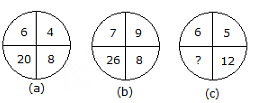
Solution:
From fig. a:
\(6 + 4 + 8 = 18\)
\(18 + 2 = 20\)
From fig. b:
\(7 + 9 + 8 = 24\)
\(24 + 2 = 26\)
From fig. c:
\(6 + 5 + 12 = 23\)
\(23 + 2 = 25\)
Hence the number 25 will replace the question mark.
Example 2: Which number will replace the question mark ?
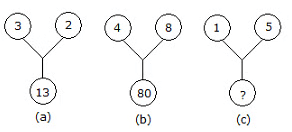
Solution:
From fig. a:
\(3^2 + 2^2 = 13\)
From fig. b:
\(4^2 + 8^2 = 80\)
From fig. c:
\(? = 1^2 + 5^2\)
\(? = 1 + 25\)
\(? = 26\)
Hence the number 26 will replace the question mark.
Example 3: Which number will replace the question mark?
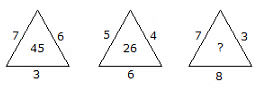
Solution:
From fig. a:
\(7 \times 6 + 3 = 45\)
From fig. b:
\(5 \times 4 + 6 = 26\)
From fig. c:
\(7 \times 3 + 8 = 29\)
Hence the number 29 will replace the question mark.
Example 4: Which number will replace the question mark ?
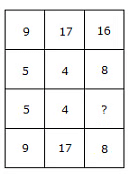
Solution:
From column I:
\((9 \times 5) \div 5 = 9\)
From column II:
\((17 \times 4) \div 4 = 17\)
From column III:
\((16 \times ? ) \div 8 = 8\)
\(16 \times ? = 64\)
\(? = 4\)
Hence the number 4 will replace the question mark.
Example 5: Which number will replace the question mark ?
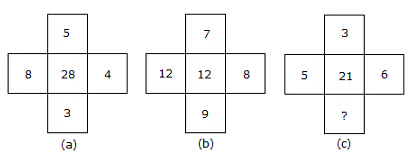
Solution:
From fig. a:
\((8 \times 5) - (4 \times 3) = 28\)
From fig. b:
\((12 \times 7) - (8 \times 9) = 12\)
From fig. c:
\((5 \times 3) - (6 \times ?) = 21\)
\(15 - 6? = 21\)
\(6? = -6\)
\(? = -1\)
Hence the number -1 will replace the question mark.
Example 6: Which number will replace the question mark ?
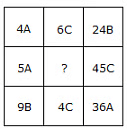
Solution:
In each row there are the symbols A, B and C.
In the second row A and C are already present, so the missing symbol is B.
From the first row:
\(4A \times 6C = 24B\)
From the third row:
\(9B \times 4C = 36A\)
From the second row:
\(5A \times ? = 45C\)
\(? = \dfrac{45C}{5A}\)
\(? = 9B\)
Hence the entry in place of the question mark is 9B.
Example 7: Which number will replace the question mark?
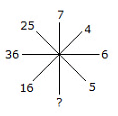
Solution:
\(5^2 = 25\)
\(6^2 = 36\)
\(4^2 = 16\)
\(7^2 = 49\)
Hence the number 49 will replace the question mark.
Example 8: Which one will replace the question mark?
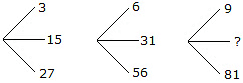
Solution:
\((15 \times 2) - 3 = 27\)
\((31 \times 2) - 6 = 56\)
\((45 \times 2) - 9 = 81\)
Thus the required pattern gives the final result accordingly.
FAQs on Overview: Puzzles
| 1. What are some common types of puzzles encountered in CSAT exams? |  |
| 2. How can I improve my puzzle-solving skills for the CSAT exam? | |
| 3. Are there any specific strategies for tackling seating arrangement puzzles? | |
| 4. How much time should I allocate for solving puzzles during the CSAT exam? | |
| 5. Where can I find practice materials for CSAT puzzles? | |




