Food Chains and Webs

Introduction
- All living beings in an ecosystem rely on one another for survival.
- Food chains illustrate the transfer of energy from one organism to another.
- Food chains demonstrate the feeding relationships among organisms.
- Food webs depict the interconnectedness of all food chains within an ecosystem.
The Science of Ecology
- Ecology involves the examination of living organisms and their respective habitats.
- An ecologist observes the population and arrangement of organisms within an ecosystem, encompassing both the community and the specific environment where these organisms reside.
- Understanding these dynamics is crucial for safeguarding vulnerable species that require assistance to endure.
Trophic Levels
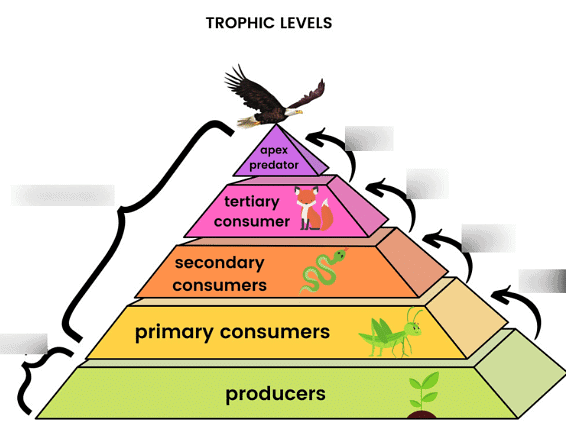
A food chain represents the feeding relationships among organisms in a specific habitat, illustrating what consumes what. These relationships are depicted using arrows to show the flow of energy between different organisms. Each stage in a food chain is known as a trophic level.
- Habitat: Refers to the specific place where an organism resides.
- Example: In a food chain with grass at the base, followed by a rabbit and then a fox, grass serves as the producer initiating the chain.
- Energy Flow: Food chains always commence with a producer, typically a green plant or algae capable of photosynthesis.
- Photosynthesis: This vital process occurs in plant chloroplasts, converting light energy into glucose, which acts as a key energy source for most life forms.
- Consumers: Primary consumers feed on producers, like rabbits in the chain, while secondary consumers prey on primary consumers, such as foxes.
Illustrative Example
In a food chain starting with grass, then a rabbit, and finally a fox:
- Grass (Producer)
- Rabbit (Primary Consumer)
- Fox (Secondary Consumer)
Importance of Photosynthesis
Photosynthesis is a crucial process that enables the storage of solar energy in plants and algae as glucose, providing the foundation of energy for various ecosystems.
Food Chain
- In ecosystems, energy flows through a sequence of organisms in a food chain.
- Producers, like plants, begin the chain by converting sunlight into energy through photosynthesis.
- Consumers come next, categorized into primary, secondary, and tertiary based on their feeding levels.
- Prey are animals hunted and eaten, while predators consume them.
- The top predator, also known as the apex predator, sits at the peak of the chain and is not preyed upon by others.
Volcanic Vents
- At the bottom of the oceans, there are volcanic vents where it is too dark for plants or algae to survive. These unique environments are the only food chains on Earth that do not begin with photosynthesis.
- Instead, the producers are bacteria that feed directly on the chemicals released from the vents. They use various chemical reactions to produce glucose through a process called chemosynthesis.
Food webs
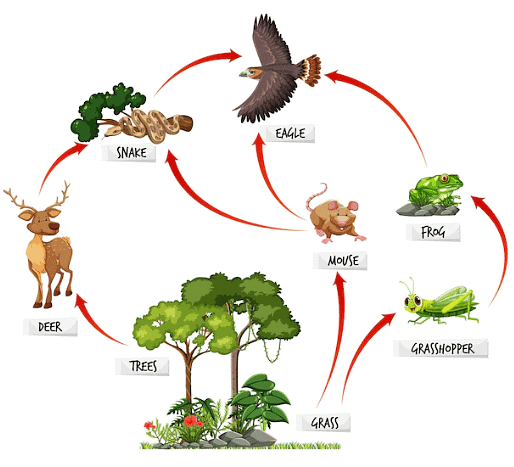
- Organisms in a habitat usually have multiple food sources, forming interconnected food chains that create a food web.
- Each species in a habitat consumes organisms from the trophic level below, leading to a complex network of feeding relationships.
- A food web illustrates the transfer of energy between organisms, showcasing various interconnected food chains.
- For example, in a grassland ecosystem, a food chain could involve grass being eaten by insects, which are then consumed by voles, and ultimately by hawks.
- Similarly, another chain might show grass being consumed by insects, then frogs, and finally foxes.
- These chains demonstrate how energy flows through different species within an ecosystem.
Toxic materials in the food chain
- Toxins in the environment can be either transient, breaking down quickly, or persistent, remaining in the environment without degradation.
- Persistent toxins tend to accumulate in the food chain, especially affecting the top predators due to their inability to excrete these compounds.
Impact of Accumulating Toxins
- Accumulating toxins can have detrimental effects on organisms, particularly predators at the end of the food chain.
- These compounds can disrupt ecosystems and bioaccumulate, leading to increased concentration levels in specific areas.
Examples of Accumulating Toxins
- Historically, mercury compounds were utilized in insecticides to combat crop-damaging insects and in marine paints to prevent barnacle growth on ships' hulls.
Impact of Mercury on Food Chain
- Mercury poses a significant threat to the nervous system, which encompasses the brain, spinal cord, and nerves. When introduced into a food chain, it can cause severe damage to these vital components of the body.
- Additionally, mercury adversely affects the reproductive system, which comprises the organs and tissues involved in the production of offspring.
- An illustration demonstrates how mercury can progressively accumulate within a food chain, impacting various organisms at different trophic levels.
Mercury Accumulation in Food Chain
- Within the marine ecosystem, tiny organisms known as plankton absorb mercury compounds present in their surroundings.
- As small fish consume these contaminated plankton, the mercury content gets transferred and retained within their bodies.
- Due to the bioaccumulation process, where fish consume numerous plankton, the concentration of mercury in fish surpasses that found in the original plankton.
Impact of Mercury Pollution
Larger fish consume smaller fish, with top predators like tuna accumulating high levels of mercury. Consumption of contaminated tuna can lead to mercury poisoning. Mercury has been banned from numerous products and its industrial use is strictly regulated.
Details and Examples:
- Larger fish, including tuna, have a bioaccumulation of mercury due to their diet.
- People who frequently eat mercury-contaminated tuna risk mercury poisoning.
- Mercury, once prevalent in various products, is now restricted in many due to its toxicity.
FAQs on Food Chains and Webs
| 1. What are trophic levels in a food chain? |  |
| 2. How do volcanic vents contribute to food webs in the ocean? | |
| 3. How do toxic materials enter the food chain? | |
| 4. What is the difference between a food chain and a food web? | |
| 5. How do organisms at different trophic levels interact in a food web? | |




