Year 7 Exam > Year 7 Notes > Pyramids of Number and Biomass
Pyramids of Number and Biomass

Introduction
- Pyramids of number illustrate the number of organisms at each stage in a food chain.
- Pyramids of biomass depict the mass of organisms at each stage in a food chain.
Food chains
- A food chain demonstrates the various species of organisms in an environment and the predator-prey relationships. For instance:
- Grass → Grasshopper → Frog
- The directional arrows in a food chain signify the transfer of energy from one organism to another. The initial organism, known as a producer, typically a green plant or alga, converts sunlight energy into glucose during photosynthesis.
- The subsequent stage comprises primary consumers, which feed on producers and are typically herbivores.
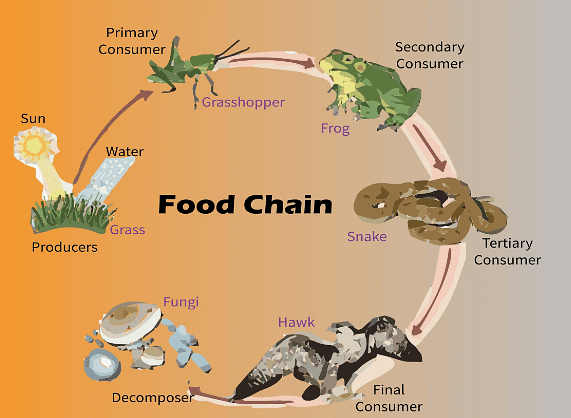
The Role of Consumers in an Ecosystem
- Herbivore: An organism that primarily feeds on plants for sustenance.
- Consumer: An organism, typically an animal or fungus, that acquires energy by consuming other organisms.
- Primary Consumers: Also known as herbivores, they feed directly on plants.
- Secondary Consumers: These organisms, such as carnivores or omnivores, prey on primary consumers.
- Tertiary Consumers: Further up the food chain, these consumers feed on secondary consumers.
- Apex Predator: The top predator in an ecosystem, which has no natural predators of its own.
- Carnivore: An animal that exclusively consumes meat.
- Omnivore: An organism that consumes both plants and meat.
Additional Information
- Food Chains: Networks that represent the flow of energy within an ecosystem, showing the transfer of nutrients from one organism to another.
MULTIPLE CHOICE QUESTIONTry yourself: What is the role of primary consumers in an ecosystem?
Pyramids of number
- The bars are drawn to scale - the more organisms it represents, the wider the bar.
- It is important that pyramids are drawn with steps, not smooth sides.
- The producer in the food chain always goes at the bottom of the pyramid of numbers and the apex predator at the top.
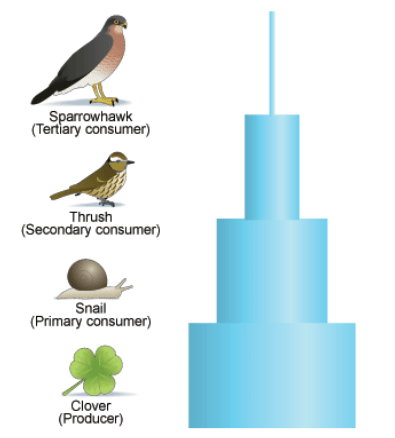
Understanding Pyramids of Number
- Pyramids of number depict the population of organisms at each trophic level in a food chain.
- Each bar's width in the pyramid corresponds to the number of organisms it represents.
- These pyramids should have distinct steps to represent different trophic levels clearly.
- The base of the pyramid always represents the producers, while the top signifies the apex predators.
Importance of Pyramids of Number
- They provide a visual representation of the relative population sizes at different trophic levels.
- Help in understanding the structure and dynamics of ecosystems.
- Illustrate the concept of energy transfer and population distribution within a food chain.
- Facilitate the identification of key roles played by various organisms in an ecosystem.
Other Pyramid of Number Shapes
Sometimes, the pyramid of numbers may not resemble a traditional pyramid. This occurs when a producer is a large entity like a tree or when one species is notably small. Here are two illustrations:
Pyramids of Biomass
- Food chains do not illustrate the number of organisms at each trophic level. Pyramids of number may not resemble perfect pyramids due to the presence of large organisms at the base and smaller ones at the top.
- Definition of Biomass: Biomass refers to living or recently deceased organic matter. This includes cut down trees, animal dung used as fuel, and all living organisms within an ecosystem.
- A pyramid of biomass quantifies the mass, typically in grams or kilograms, of the population within each trophic level in a food chain.
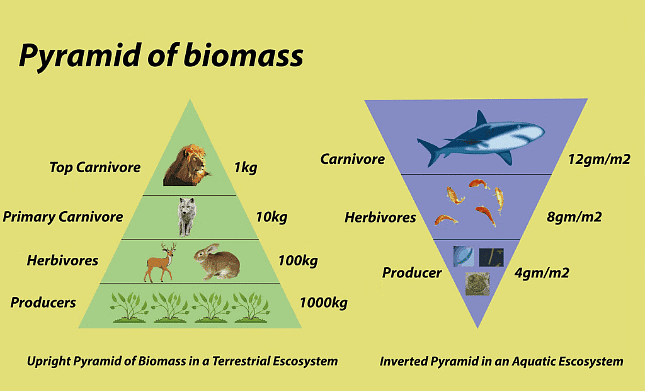
FAQs on Pyramids of Number and Biomass
| 1. What is the significance of food chains in an ecosystem? |  |
Ans. Food chains in an ecosystem demonstrate the flow of energy and nutrients from one organism to another. They show how organisms are interconnected and dependent on each other for survival.
| 2. How do consumers play a role in maintaining balance in an ecosystem? | |
Ans. Consumers regulate the population of other organisms in an ecosystem by feeding on them. This helps prevent any one species from becoming dominant and disrupting the balance of the ecosystem.
| 3. What is the difference between a pyramid of numbers and a pyramid of biomass? | |
Ans. A pyramid of numbers represents the number of organisms at each trophic level in an ecosystem, while a pyramid of biomass shows the total mass of organisms at each trophic level.
| 4. How can the concept of pyramids of number and biomass be applied in real-life ecosystems? | |
Ans. Pyramids of number and biomass can be used to study the structure and dynamics of different ecosystems, helping researchers understand the relationships between organisms and the flow of energy and nutrients.
| 5. Why is it important to understand the pyramids of number and biomass in the context of an ecosystem? | |
Ans. Understanding pyramids of number and biomass is crucial for conservation efforts and managing ecosystems effectively. It helps in identifying key species and understanding the overall health and stability of an ecosystem.
About this Document

Apr 21, 2026 Last updated
Related Exams
Document Description: Pyramids of Number and Biomass for Year 7 2026 is part of Year 7 preparation. The notes and questions for Pyramids of Number and Biomass have been prepared according to the Year 7 exam syllabus. Information about Pyramids of Number and Biomass covers topics like and Pyramids of Number and Biomass Example, for Year 7 2026 Exam. Find important definitions, questions, notes, meanings, examples, exercises and tests below for Pyramids of Number and Biomass.
Introduction of Pyramids of Number and Biomass in English is available as part of our Year 7 preparation & Pyramids of Number and Biomass in Hindi for Year 7 courses. Download more important topics, notes, lectures and mock test series for Year 7 Exam by signing up for free. Year 7: Pyramids of Number and Biomass
Description
Pyramids of Number & Biomass of covers all the important topics, helping you prepare for the Year 7 exam on EduRev. Start for free!
Information about Pyramids of Number and Biomass
In this doc you can find the meaning of Pyramids of Number and Biomass defined & explained in the simplest way possible. Besides explaining types of Pyramids of Number and Biomass theory, EduRev gives you an ample number of questions to practice Pyramids of Number and Biomass tests, examples and also practice Year 7 tests.
Related Searches
Important questions, practice quizzes, pdf , Sample Paper, past year papers, Pyramids of Number and Biomass, Previous Year Questions with Solutions, Pyramids of Number and Biomass, shortcuts and tricks, Extra Questions, Free, video lectures, Summary, mock tests for examination, ppt, Viva Questions, Semester Notes, study material, MCQs, Exam, Pyramids of Number and Biomass, Objective type Questions;