Year 7 Exam > Year 7 Notes > Thermal Decomposition
Thermal Decomposition

Introduction
- Thermal refers to heat.
- Decomposing entails the process of breaking down.
- Thermal decomposition is a chemical reaction that occurs when a compound breaks down upon heating.
What is Thermal Decomposition?
- Definition: Thermal decomposition refers to a chemical process where a compound breaks down upon heating, resulting in the formation of new substances.
- Explanation: When a compound is subjected to heat, its chemical bonds are broken and reformed, leading to the creation of different substances, which can be either compounds or elements.
- Example: For instance, when calcium carbonate (CaCO3) is heated, it decomposes into calcium oxide (CaO) and carbon dioxide (CO2).
Characteristics of Thermal Decomposition
- High Temperatures: Thermal decomposition reactions typically occur at elevated temperatures where the reactants absorb significant amounts of energy.
- Product Formation: The reactants transform into products, which are the substances resulting from the chemical reaction.
- Energy Absorption: The process involves the absorption of energy by the reactants as they break down into new substances.
- Example: When mercuric oxide (HgO) is heated, it decomposes into mercury (Hg) and oxygen gas (O2).
Reactants and Products in Thermal Decomposition
- Reactant Definition: The starting compound in a thermal decomposition reaction, located on the left side of a chemical equation.
- Product Formation: The products are the new substances formed as a result of thermal decomposition, appearing on the right side of a chemical equation.
- Example: When potassium chlorate (KClO3) is heated, it decomposes into potassium chloride (KCl) and oxygen gas (O2).
Chemical Concepts
- Compound: A compound is a pure substance formed by chemically bonding two or more elements in a fixed ratio.
- Reactant: Reactants are chemicals present at the start of a reaction, listed on the left side of a chemical equation before the arrow.
- Element: An element is a pure substance composed of only one type of atom, as indicated on the periodic table.
Thermal Decomposition Reactions
- Thermal decomposition reactions involve absorbing energy from the surroundings.
- These reactions are categorized as endothermic, requiring energy input.
- They find applications in cooking and baking, such as in the preparation of cakes.
MULTIPLE CHOICE QUESTIONTry yourself: What is thermal decomposition?
Equations for Thermal Decomposition
- In a thermal decomposition reaction, there is typically one reactant and two or more products.
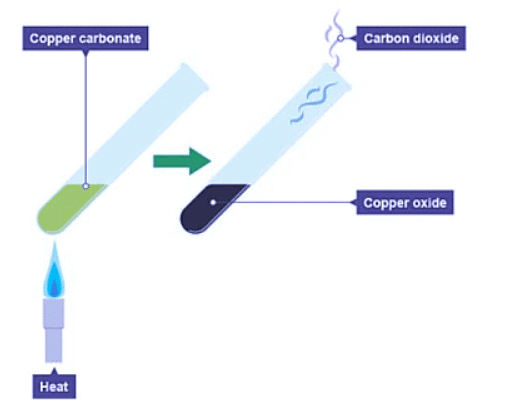
- For instance, heating copper carbonate results in the formation of copper oxide and carbon dioxide.
- Copper carbonate is initially green, while copper oxide is black, illustrating a color change during the reaction. The production of carbon dioxide can be observed using limewater, which turns cloudy.
- Word equation: copper carbonate → copper oxide + carbon dioxide
- Symbol equation: CuCO3(s) → CuO(s) + CO2(g)
Thermal Decomposition without Color Change
- Not all thermal decomposition reactions exhibit a color change. For example, heating magnesium carbonate leads to the production of magnesium oxide and carbon dioxide.
- There is no observable color change as both magnesium carbonate and magnesium oxide are white solids.
- Word equation: magnesium carbonate → magnesium oxide + carbon dioxide
- Symbol equation: MgCO3(s) → MgO(s) + CO2(g)
FAQs on Thermal Decomposition
| 1. What is thermal decomposition? |  |
Ans. Thermal decomposition is a chemical reaction where a compound is broken down into simpler substances by heating it.
| 2. What are some common examples of thermal decomposition? | |
Ans. Some common examples of thermal decomposition include the breakdown of calcium carbonate into calcium oxide and carbon dioxide, and the decomposition of hydrogen peroxide into water and oxygen.
| 3. How does temperature affect thermal decomposition reactions? | |
Ans. Increasing the temperature typically increases the rate of thermal decomposition reactions as it provides more energy for the bonds in the compound to break.
| 4. What is the importance of understanding thermal decomposition in industries? | |
Ans. Understanding thermal decomposition is important in industries as it can help in designing efficient processes for the production of desired products and in the safe handling of chemicals during manufacturing.
| 5. How can thermal decomposition be used in waste management? | |
Ans. Thermal decomposition can be used in waste management to break down organic waste materials into simpler compounds, reducing the volume of waste and potentially generating useful by-products such as energy.
About this Document

4.9/5 Rating

Apr 19, 2026 Last updated
Related Exams
Document Description: Thermal Decomposition for Year 7 2026 is part of Year 7 preparation. The notes and questions for Thermal Decomposition have been prepared according to the Year 7 exam syllabus. Information about Thermal Decomposition covers topics like and Thermal Decomposition Example, for Year 7 2026 Exam. Find important definitions, questions, notes, meanings, examples, exercises and tests below for Thermal Decomposition.
Description
Thermal Decomposition of covers all the important topics, helping you prepare for the Year 7 exam on EduRev. Start for free!
Information about Thermal Decomposition
In this doc you can find the meaning of Thermal Decomposition defined & explained in the simplest way possible. Besides explaining types of Thermal Decomposition theory, EduRev gives you an ample number of questions to practice Thermal Decomposition tests, examples and also practice Year 7 tests.
Related Searches
Thermal Decomposition, mock tests for examination, Important questions, Sample Paper, past year papers, Thermal Decomposition, Previous Year Questions with Solutions, MCQs, Thermal Decomposition, pdf , Free, Exam, video lectures, Objective type Questions, ppt, Viva Questions, Semester Notes, shortcuts and tricks, Summary, practice quizzes, study material, Extra Questions;