Year 7 Exam > Year 7 Notes > Indian migration and indentured labour
Indian migration and indentured labour

Introduction
- After slavery was abolished in the British Empire, the British government turned to Indian indentured workers as a cost-effective labor solution.
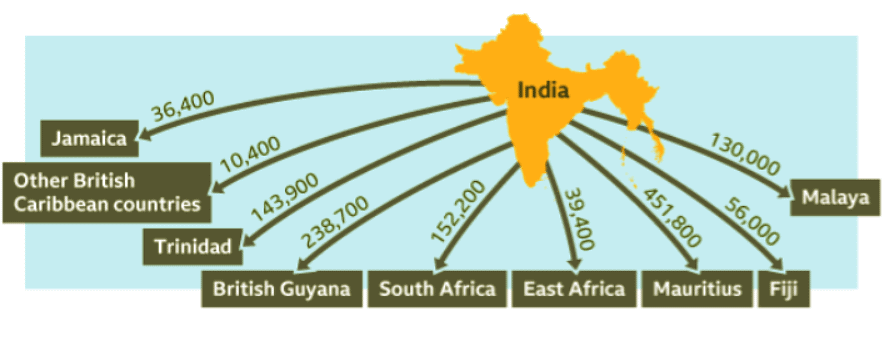
- From 1838 to 1917, a significant number of Indian individuals made the journey from India to places such as the Caribbean, South Africa, Mauritius, and Fiji, where they undertook labor on sugar plantations. The repercussions of this movement are still observable today, with substantial populations of Indian descent in these regions.
- While a considerable portion of laborers chose to migrate willingly, enticed by the promise of better opportunities, some were compelled to move to other colonies against their will.
From abolition to indentured labour
- The British government officially abolished slavery throughout the British Empire in 1833, transitioning enslaved individuals into an apprenticeship system from 1834 to 1838.
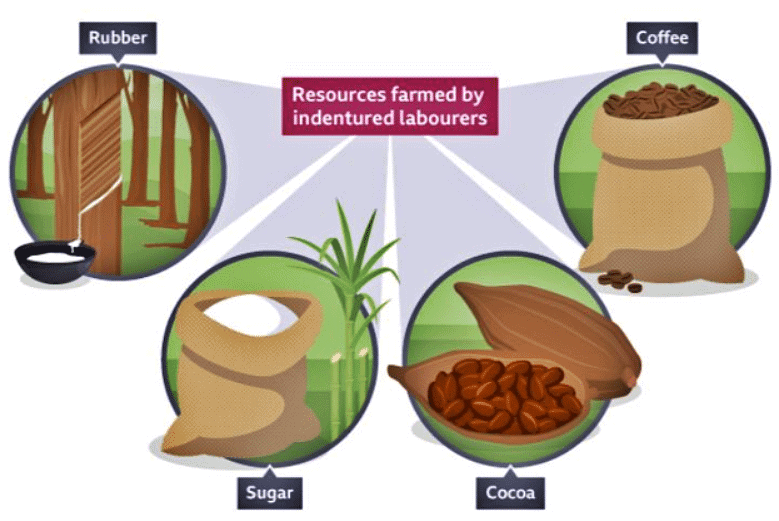
- Despite the abolition of slavery, many formerly enslaved individuals refused to continue working on British plantations after 1838, prompting the British government to seek alternative sources of cheap labor for harvesting cotton, sugar, cocoa, and tea.
- To address this labor shortage, Britain turned to its colonies in India, where between 1834 and 1917, over 1 million Indian indentured laborers were recruited and transported to 19 British colonies.
- Indentured laborers typically signed contracts committing to five years of service, although many were illiterate and signed agreements with a thumbprint, often without fully understanding the terms and conditions.
- Despite the intended duration of five years, many laborers ended up working for much longer periods, unable to afford the journey back home, effectively becoming bound to the colony where they were taken.
- Additionally, some individuals were forcibly kidnapped and trafficked abroad to work as laborers, further exacerbating the exploitation and abuse experienced by indentured workers.
MULTIPLE CHOICE QUESTIONTry yourself: What was the primary reason why the British government turned to Indian indentured workers after the abolition of slavery in the British Empire?
Indentured Labourers outside of the Caribbean
- Moving to Other Colonies: While a majority of indentured labourers were sent to the Caribbean, a significant number were also directed to other British Empire colonies like Mauritius, Uganda, and South Africa.
- Uganda Railway Project: 32,000 Indian labourers were sent to Uganda as indentured workers to contribute to the construction of the railway from Mombasa, Kenya to Lake Victoria in Uganda.
- Impact of the Railway: Building the railway had severe consequences, with around 2,500 labourers losing their lives and 6,500 sustaining injuries. Most of the Indian workers returned home upon completion of the project.
- Ugandan Asian Community: Despite many returning to India, a significant number of labourers stayed back in Uganda, eventually forming the Ugandan Asian community.
- Indian Migration and Plantation Work: In addition to railway construction, thousands of other Indians migrated to Uganda to work for British settlers on plantations producing sugar, rubber, cocoa, and coffee.
Why did Indians agree to become indentured labourers?
- Under British rule, many Indians faced famine and poverty due to high taxes and inadequate job opportunities.
- The Bengal famine of 1770 resulted in the deaths of approximately 10 million people due to a severe crop shortage, and similar famines occurred throughout the 1800s.
- The prospect of working as an indentured laborer held appeal for several reasons:
- Laborers were assured that the commitment would be temporary, typically lasting five years.
- They were promised relatively decent wages.
- Some believed they would only be relocating to different regions within India.
- It offered an escape from famine and destitution.
- Many were assured that the cost of their return journey would be covered, although this assurance was not always fulfilled.
The impact across the world today
- In 1917, the practice of indentured laborers was officially discontinued by the British government, yet its repercussions persist in the present day. Despite the return of many indentured laborers to India, a significant number chose to remain in the lands they were relocated to. Some individuals secured new employment opportunities, while others were able to purchase the land they had toiled on.
- Consequently, there exist substantial populations of individuals of Indian heritage, denoting those who were not born in India but whose forebears originated from the country.
These communities are prevalent in:- The Caribbean
- South Africa
- Uganda
- Kenya
- Malaysia
- Mauritius
- These communities frequently uphold traditional Indian cultural customs, evident in their names, religious festivities, culinary traditions, and languages.
- Yet, despite their Indian origins, many of these communities have assimilated the traditional cultures of their new countries. For instance, in Mauritius, approximately 65 percent of the population is of Indian descent. While Mauritian Creole is widely spoken, it's also typical for Indo-Mauritians to converse in languages such as Hindi, Gujarati, and other native Indian languages.
FAQs on Indian migration and indentured labour
| 1. What is the history of Indian migration and indentured labour? |  |
Ans. Indian migration and indentured labour began after the abolition of slavery in the 19th century, with Indians being recruited to work on plantations in various parts of the world as indentured labourers.
| 2. How did Indians end up becoming indentured labourers outside of the Caribbean? | |
Ans. Indians were recruited by European colonial powers to work on plantations in countries such as Fiji, Mauritius, South Africa, and Malaysia as indentured labourers, following the end of slavery.
| 3. Why did Indians agree to become indentured labourers? | |
Ans. Indians agreed to become indentured labourers due to various factors such as poverty, lack of opportunities in their own country, promises of a better life abroad, and sometimes coercion or deception by recruiters.
| 4. What impact does Indian migration and indentured labour have across the world today? | |
Ans. The impact of Indian migration and indentured labour can still be seen today in the cultural diversity, cuisine, and traditions of countries where Indians were brought as indentured labourers.
| 5. How did the system of indentured labour differ from slavery? | |
Ans. Indentured labourers were contracted to work for a specific period of time in exchange for passage, housing, and sometimes wages, whereas slaves were considered property and had no rights or freedom.
About this Document

Apr 22, 2026 Last updated
Related Exams
Document Description: Indian migration and indentured labour for Year 7 2026 is part of Year 7 preparation. The notes and questions for Indian migration and indentured labour have been prepared according to the Year 7 exam syllabus. Information about Indian migration and indentured labour covers topics like and Indian migration and indentured labour Example, for Year 7 2026 Exam. Find important definitions, questions, notes, meanings, examples, exercises and tests below for Indian migration and indentured labour.
Introduction of Indian migration and indentured labour in English is available as part of our Year 7 preparation & Indian migration and indentured labour in Hindi for Year 7 courses. Download more important topics, notes, lectures and mock test series for Year 7 Exam by signing up for free. Year 7: Indian migration and indentured labour
Description
Indian migration & indentured labour of covers all the important topics, helping you prepare for the Year 7 exam on EduRev. Start for free!
Information about Indian migration and indentured labour
In this doc you can find the meaning of Indian migration and indentured labour defined & explained in the simplest way possible. Besides explaining types of Indian migration and indentured labour theory, EduRev gives you an ample number of questions to practice Indian migration and indentured labour tests, examples and also practice Year 7 tests.
Related Searches
Free, Important questions, pdf , practice quizzes, Indian migration and indentured labour, MCQs, Semester Notes, Summary, Extra Questions, Exam, Previous Year Questions with Solutions, shortcuts and tricks, study material, mock tests for examination, Sample Paper, Objective type Questions, past year papers, ppt, Indian migration and indentured labour, Indian migration and indentured labour, video lectures, Viva Questions;