Year 7 Exam > Year 7 Notes > Rewrite expressions by taking out common factors
Rewrite expressions by taking out common factors

Introduction
- Essential knowledge for factorising includes understanding factors and highest common factors (HCF), as well as having a solid grasp of divisibility rules.
- An expression rewritten by extracting common factors is considered factorised.
- Factorising is the reverse process of expanding brackets.
- A factorised expression is equivalent to the original expression, making them identities. The identity symbol (≡) is used to link the original expression and its equivalent factorised expression.
- Proper understanding and use of algebraic notation are necessary to accurately complete the factorising process.
Finding the Highest Common Factors (HCF) in an Expression
When the expression includes a constant, the highest common factor (HCF) will be a number:
- Find the HCF of the coefficients and the constant, which is the greatest factor common to all the numbers in the expression.
- The HCF for the expression is a number.
When the expression has no constants:
- Find the HCF of the coefficients, the greatest factor common to all the coefficients in the expression.
- Identify common variable factors in each term, which can be a single variable or a combination of variables.
- The HCF of the expression is the product of the number and variable HCFs.
Example
Example: Find the HCF of this expression. Sol:
Sol: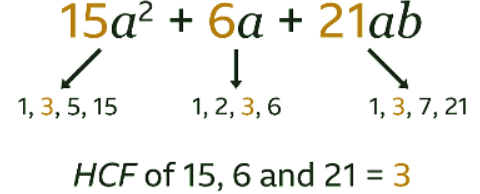
- The expression has no constants. The HCF of the coefficients is the greatest factor that is common to all the numbers in the expression. The coefficients are 15, 6 and 21. The factors of 15 are 1, 3, 5 and 15. The factors of 6 are 1, 2, 3 and 6. The factors of 21 are 1, 3, 7 and 21. The HCF of 15, 6 and 21 is 3
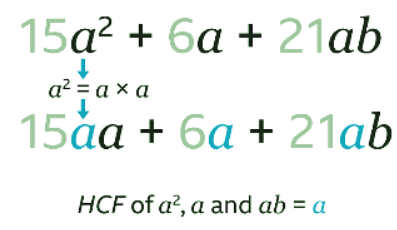
- The common variable in 15𝒂² + 6𝒂 + 21𝒂𝒃 is 𝒂. The variable HCF is 𝒂
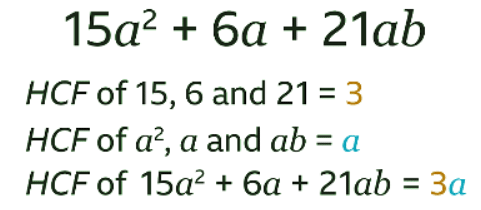
- The HCF of the expression is the number HCF (3) multiplied by the variable HCF (𝒂). 3 × 𝒂 = 3𝒂. The HCF of the expression is 3𝒂
Factorizing Simple Expressions
- When the expression includes a constant, the highest common factor (HCF) is a number.
- When the expression does not include a constant, the HCF can be a number, a variable, or a combination of both.
- To factorise an expression:
- Find the HCF of the numbers in the expression.
- Find the HCF of the variables in the expression.
- Multiply the number and variable HCFs, and write this term in front of the bracket.
- Determine the terms inside the bracket by completing the factor pair for each of the original terms in the expression.
- The identity symbol (≡) is used to link the original expression and its equivalent factorised expression.
Example
Example: Factorise 12𝒂𝒃 - 3𝒂
Sol: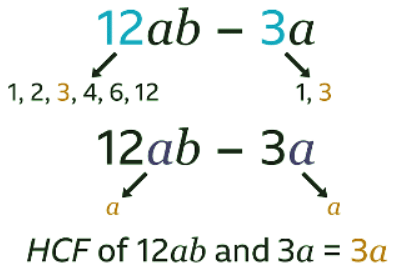
- The highest common factor of 12 and 3 is 3. The HCF of the variable terms 𝒂𝒃 and 𝒂 is 𝒂. The HCF of 12𝒂𝒃 and 3𝒂 is the product of 3 and 𝒂 (3𝒂).
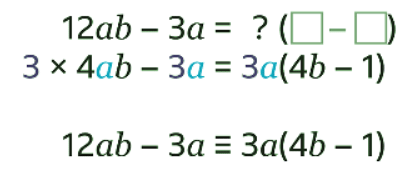
- 3𝒂 is the HCF of 12𝒂𝒃 and 3𝒂. 3 is the highest common factor of 12 and 3. 𝒂 is the highest common factor of 𝒂𝒃 and 𝒂. 3𝒂 is written in front of the bracket. The first term in the bracket is 4𝒃 because 3𝒂 × 4𝒃 = 12𝒂𝒃. The second term in the bracket is -1 because 3𝒂 × -1 = -3. 12𝒂𝒃-3𝒂 is factorised as the equivalent expression 3𝒂(4𝒃-1).
FAQs on Rewrite expressions by taking out common factors
| 1. How do you find the Highest Common Factor (HCF) in an expression? |  |
Ans. To find the HCF in an expression, first factorize each term completely. Then, identify the common factors present in all terms and determine the highest common factor among them.
| 2. Why is it important to use algebraic notation in factorising expressions? | |
Ans. Algebraic notation helps in clearly representing the variables and constants in an expression, making it easier to identify common factors and factorize the expression accurately.
| 3. What are some common divisibility rules that can be helpful in factorizing expressions? | |
Ans. Some common divisibility rules include rules for 2 (even numbers), 3 (sum of digits divisible by 3), 5 (ends in 0 or 5), and 9 (sum of digits divisible by 9). These rules can help in identifying factors quickly.
| 4. How can you rewrite expressions by taking out common factors? | |
Ans. To rewrite expressions by taking out common factors, identify the highest common factor among all terms and divide each term by this factor. The resulting expression will have the common factor factored out.
| 5. What are factorised expressions and identities, and how are they useful in algebra? | |
Ans. Factorised expressions are those where common factors have been factored out, making the expression simpler and easier to work with. Identities are expressions that are true for all values of variables, and they serve as foundational principles in algebraic manipulations.
About this Document

Apr 20, 2026 Last updated
Related Exams
Document Description: Rewrite expressions by taking out common factors for Year 7 2026 is part of Year 7 preparation. The notes and questions for Rewrite expressions by taking out common factors have been prepared according to the Year 7 exam syllabus. Information about Rewrite expressions by taking out common factors covers topics like and Rewrite expressions by taking out common factors Example, for Year 7 2026 Exam. Find important definitions, questions, notes, meanings, examples, exercises and tests below for Rewrite expressions by taking out common factors.
Introduction of Rewrite expressions by taking out common factors in English is available as part of our Year 7 preparation & Rewrite expressions by taking out common factors in Hindi for Year 7 courses. Download more important topics, notes, lectures and mock test series for Year 7 Exam by signing up for free. Year 7: Rewrite expressions by taking out common factors
Description
Rewrite expressions by taking out common factors of covers all the important topics, helping you prepare for the Year 7 exam on EduRev. Start for free!
Information about Rewrite expressions by taking out common factors
In this doc you can find the meaning of Rewrite expressions by taking out common factors defined & explained in the simplest way possible. Besides explaining types of Rewrite expressions by taking out common factors theory, EduRev gives you an ample number of questions to practice Rewrite expressions by taking out common factors tests, examples and also practice Year 7 tests.
Related Searches
practice quizzes, ppt, Objective type Questions, Sample Paper, Important questions, Extra Questions, Previous Year Questions with Solutions, study material, Summary, shortcuts and tricks, MCQs, video lectures, Rewrite expressions by taking out common factors, Viva Questions, Semester Notes, Free, mock tests for examination, Rewrite expressions by taking out common factors, pdf , Rewrite expressions by taking out common factors, past year papers, Exam;