Congruent and Similar Shapes


Key points
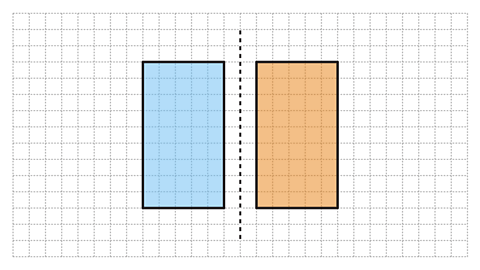 Image caption
- When a shape is transformed through translation, reflection, or rotation, it creates a congruent shape. Enlargements result in similar shapes.
- Shapes that are identical in shape and size are termed congruent, while shapes that are different in size but proportionally the same shape are considered similar. One shape can be an enlargement of another. This similarity is determined by the equality of angles and the proportional equality of side lengths. All squares and circles are mathematically similar shapes.
- To comprehend congruence and similarity, a solid grasp of polygon properties, including triangles and quadrilaterals, can be beneficial.
Understanding Congruence and Similarity
Two fundamental concepts in geometry are congruence and similarity. Let's delve into these concepts to understand their significance.
Congruence
Congruence refers to shapes that are identical in every aspect. When two shapes are congruent, it means that they have the same size and shape.
- For example, two congruent triangles have the same angles and side lengths, ensuring that they completely overlap when placed on top of each other.
Similarity
Similarity, on the other hand, involves shapes that are proportional to each other. In similar shapes, corresponding angles are equal, and corresponding side lengths are in proportion.
- For instance, when you scale up or down a shape while maintaining the same angles, you are dealing with similar figures.
Relevance to Polygon Properties
To comprehend congruence and similarity better, it is essential to grasp the properties of polygons, especially triangles and quadrilaterals.
- Understanding these properties aids in recognizing congruent or similar shapes and applying these concepts effectively in geometric problems.
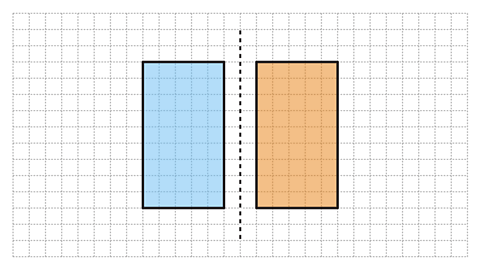 Image caption, Back to top
 Congruent shapes
Two shapes are described as congruent if they are identical.
Two shapes that are identical. Two shapes that are identical. Two shapes that are identical. Two shapes that are identical. Two shapes that are identical. Two shapes that are identical. Identical- The lengths of sides (edges) and sizes of angles must be equal between the two shapes for them to be congruent.
- A reflection is a mirror image of the shape. An image will reflect through a line, known as the line of reflection, or rotation, which changes the orientation of a shape but keeps it congruent to the original shape.
- A great way to check if two shapes are congruent is to place one on top of the other. If they match without overlaps, they are congruent.
Paraphrased Content
Examples
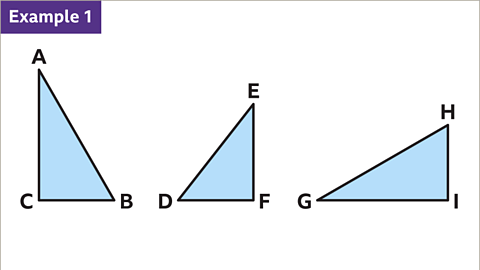
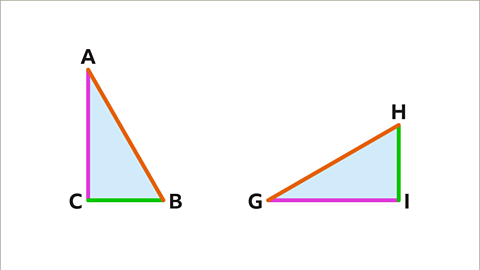
- Two of these triangles are congruent, indicating they are identical in shape and size.
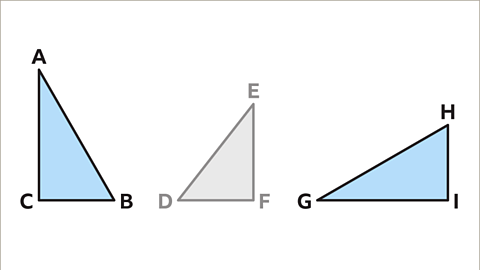
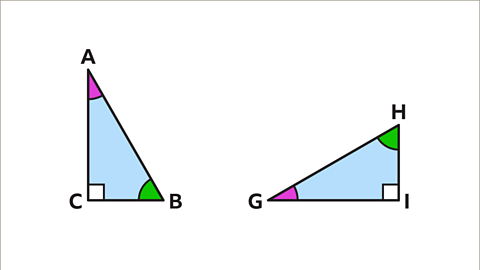
- Triangles ABC and GHI are congruent. Triangle GHI is a rotation of ABC by 90 degrees anticlockwise. Triangle DEF is a different size.
- Line segments AB and GH are equal, BC and HI are equal, AC and GI are equal.
- Angle A is equal to angle G, angle B is equal to angle H, angle C and I are both right angles.
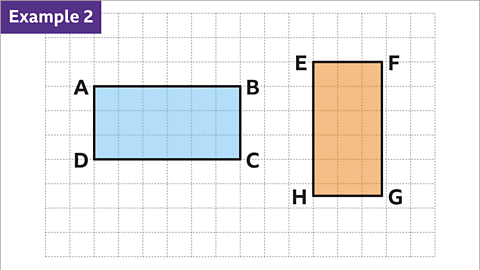
- These two rectangles are not congruent.
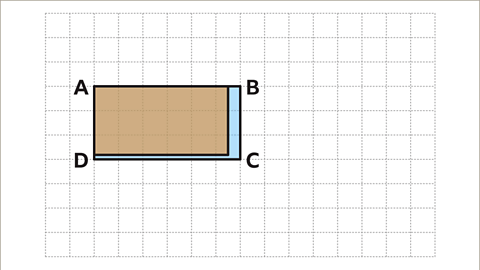
- Rotating rectangle EFGH and placing it on top of rectangle ABCD illustrates they are not the same size.
Image Gallery
- Image caption: Two of these triangles are congruent, indicating they are identical in shape and size.
- Image caption: Triangles ABC and GHI are congruent. Triangle GHI is a rotation of ABC by 90 degrees anticlockwise. Triangle DEF is a different size.
- Image caption: Line segments AB and GH are equal, BC and HI are equal, AC and GI are equal.
- Image caption: Angle A is equal to angle G, angle B is equal to angle H, angle C and I are both right angles.
- Image caption: These two rectangles are not congruent.
- Image caption: Rotating rectangle EFGH and placing it on top of rectangle ABCD illustrates they are not the same size.
| Image 1 | Image 2 | Image 3 |
|---|---|---|
 |  |  |
| Image 4 | Image 5 | Image 6 |
 |  |  |
Quadrilaterals and Their Reflections
- Two Quadrilaterals Congruence:
These two quadrilaterals are congruent.
- EFGH Reflection of ABCD:
EFGH is a reflection of ABCD on a vertical mirror line. Line segments AB and EH are the same length. They correspond to each other, which means they are in the same place in two different shapes. BC and GH are the same length. CD and FG are the same length. AD and EF are the same length.
- Angles in Congruent Shapes:
Angles in congruent shapes are equal. Angle A and angle E are equal. They correspond to each other. Angle B and angle H are equal. Angle C and G are equal. Angle D and F are equal.
Image Descriptions
- Image 1:
These two quadrilaterals are congruent.
- Image 2:
EFGH is a reflection of ABCD on a vertical mirror line. Line segments AB and EH are the same length. They correspond to each other, which means they are in the same place in two different shapes. BC and GH are the same length. CD and FG are the same length. AD and EF are the same length.
- Image 3:
Angles in congruent shapes are equal. Angle A and angle E are equal. They correspond to each other. Angle B and angle H are equal. Angle C and G are equal. Angle D and F are equal.
Slide Description
| Slide Number | Content |
|---|---|
| 1 of 9 | Example one. A series of three images. Each image shows a right angled triangle. The first triangle has vertices labelled A, B, and C. The right angle is at vertex C. The second triangle has vertices labelled D, E, and F. The right angle is at vertex F. The third triangle has vertices labelled G, H, and I. The right angle is at vertex I. The triangles are colored blue. Two of these triangles are congruent, which means they are identical in shape and size. |
Question
Back to topSimilar shapes
- Similar shapes are described as one shape being an enlargement of another, where the angles in each shape are the same, and the side lengths are in the same proportion. This means that if one shape is a transformation of another resulting in a change in size, they are considered similar. The orientation of the shapes does not necessarily have to be the same.
- All squares and circles are examples of mathematically similar shapes due to their properties.
- Enlargement is a transformation that causes a shape to either increase or decrease in size.
- Orientation refers to the position of a shape concerning a coordinate system, indicating the angle at which an object is positioned.
Understanding Similarity in Shapes
- The Importance of Angle Equality:
- Proportional Shapes:
- Considering Rotation:
It is crucial that the angles in two shapes being compared are equal. This ensures a fundamental similarity criterion.
For shapes to be similar, they not only need equal angles but also proportional sides. When enlarging a shape, if one side is doubled, all sides must follow suit. This concept is known as the scale factor.
Proportional sides maintain a fixed relationship in size, crucial for shape similarity.Scale Factor:The scale factor represents the ratio between corresponding sides in an enlargement, indicating how much larger or smaller one shape is compared to another.Rotating shapes might be necessary to determine their similarity. This transformation can help align shapes for comparison.
Geometric Transformations
A transformation is a change in the position, size, or shape of a figure. One such transformation is rotation, which involves a turning effect on a shape.
- Definition of Rotation: Rotation is a transformation of a shape resulting in a turning effect on the shape.
- Calculating Missing Lengths on Similar Shapes: It is possible to determine missing lengths on similar shapes when provided with the scale factor or adequate information to compute it.
Examples
Below are examples illustrating the concept of rotation and calculating missing lengths on similar shapes:
Example 1: Image Gallery
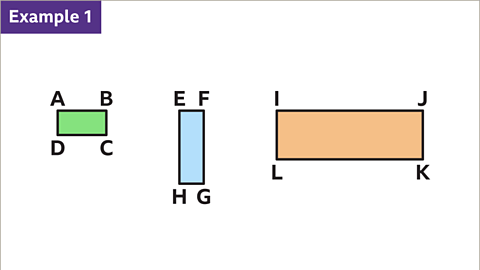
- Image caption: All of these rectangles are different sizes, but two are proportionally the same and similar.
Example 2: Rotating Rectangles for Visualization
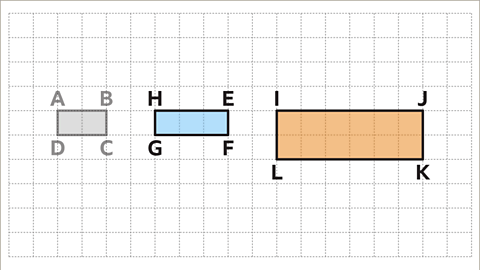
- Image caption: Rotating rectangle EFGH helps visualize which shapes are similar. Rectangles EFGH and IJKL are similar with lengths three times their widths, while ABCD is too short to be similar.
Enlargements and Similarity
- Enlarged Rectangles
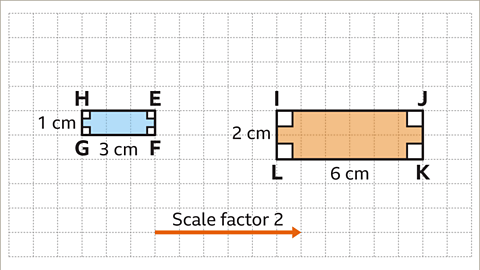
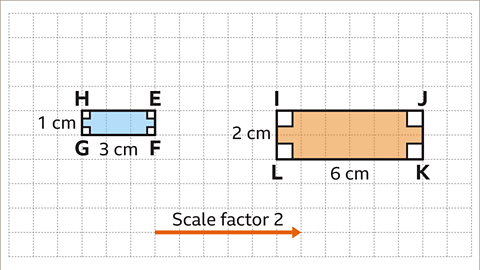
- When a rectangle is enlarged by a scale factor of two, all dimensions double in length. For instance, if Line EF is 1 cm in the original rectangle IJKL, in the enlarged rectangle EFGH, it becomes 2 cm. Likewise, Line EH becomes 3 cm from 1. Line IL, originally 2 cm, becomes 4 cm in the enlarged version.
- The smaller rectangle, EFGH, is half the scale of the larger one, IJKL, maintaining the same 90-degree angles.
- Non-Similar Isosceles Triangles
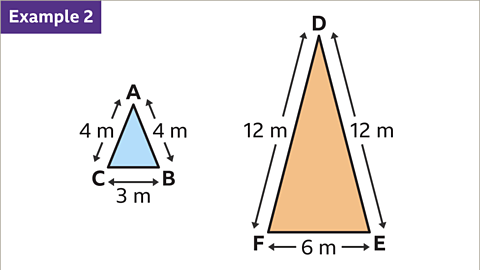
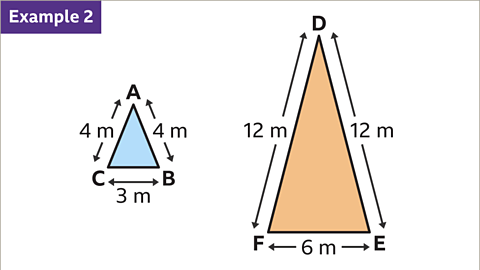
- Comparing isosceles triangles ABC and DEF, their proportions differ. For example, the base in EF is twice the size of BC, leading to a ratio of 6:3. Additionally, sides DE and DF are three times the length of AB and AC, resulting in a ratio of 12:4.
- These discrepancies indicate that triangles ABC and DEF are not similar due to the unequal proportions.
- Similar Triangles
- For triangles ABC and DEF to be similar, there must be sufficient information available to determine the scale factor between corresponding sides.
- Calculating Scale Factor
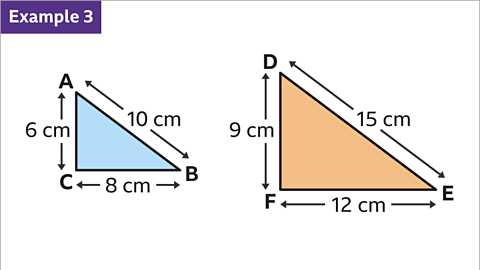
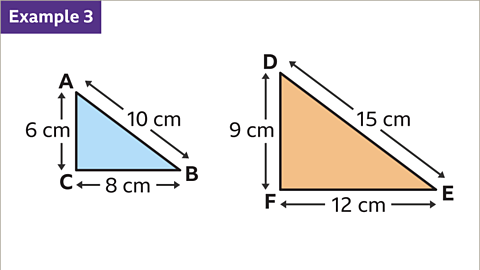
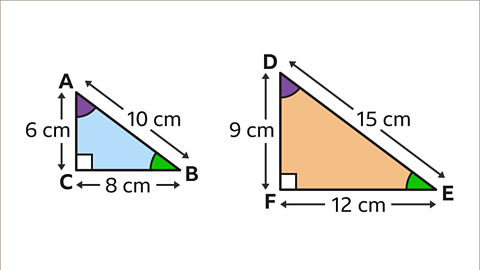
- By comparing corresponding sides like DE and AB, we can calculate the scale factor as DE/AB. For instance, if DE measures 15 units and AB measures 10 units, the scale factor is 1.5.
- Triangle DEF is an enlargement by a scale factor of 1.5 compared to triangle ABC.
Illustrative Examples
 |  |
 |  |
 |  |
Understanding Geometric Concepts
- Image caption, Angle A and angle D are equal. Angle B and angle E are equal. Angle C and F are equal and are both right angles.
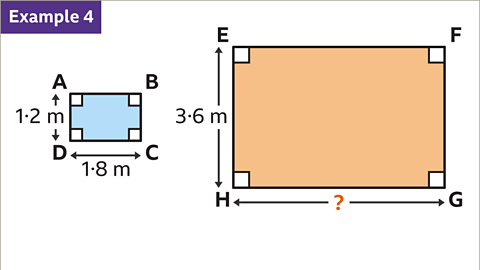
- Image caption, Rectangles ABCD and EFGH are similar. Rectangle EFGH is an enlargement scale factor 3. Calculate the length of GH.
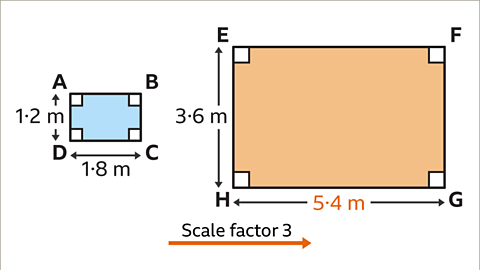
- Image caption, All dimensions have multiplied by 3. GH = CD × 3. GH= 1⁷⁸ × 3. GH = 5⁷⁴ m.
Rectangles and Similarity
- Rectangles ABCD and EFGH are analogous shapes, with EFGH being a 3x enlargement of ABCD.
- The length of GH in the enlarged rectangle EFGH can be found by multiplying the corresponding side in the original rectangle by 3.
- For example, if CD in ABCD is 1.78 units, GH in EFGH would be 5.74 units.
Geometric Concepts Reinforcement
- Understanding that similar shapes retain proportional relationships even when one is an enlargement of the other is crucial in geometric calculations.
- Multiplying dimensions by a scale factor can help determine corresponding lengths in similar figures.
| Slide | Description |
|---|---|
| 1 of 9 | Example one. A series of three images. Each image shows a different size rectangle. The first rectangle has vertices labelled A, B, C, and D. The second rectangle has vertices labelled E, F, G, and H. The third rectangle has vertices labelled I, J, K, and L. The first rectangle is coloured green, the second rectangle is coloured blue and the third rectangle is coloured orange. All of these rectangles are different sizes, but two are proportionally the same and similar. |
Practise working with congruent and similar shapes
Practice dealing with shapes that are identical in size and shape or have proportional dimensions. This involves understanding how these shapes relate to each other and how they can be manipulated in various mathematical operations.
Quiz
Engage in a quiz that focuses on working with congruent and similar shapes. Grab a pen and paper to jot down your answers as you go through the questions. This interactive activity will help reinforce your understanding of these geometric concepts.
Real-life maths

Some congruent shapes can interlock perfectly without any gaps, a property known as tessellation. A practical example of this is the construction of a beehive, where hexagonal shapes fit snugly together to form the hive's structure. Bees employ this pattern because it optimizes space usage, requiring minimal wax-the material they use. Similarly, tessellation patterns can be observed in the layout of paths, driveways, and brick walls, showcasing efficient design principles.

Game - Divided Islands
Explore the concept of dividing islands, a game that challenges your spatial reasoning skills. Dive into this interactive activity to enhance your understanding of partitioning landmasses. Grab this opportunity to sharpen your problem-solving abilities while having fun!
