Properties of Triangles


Key points
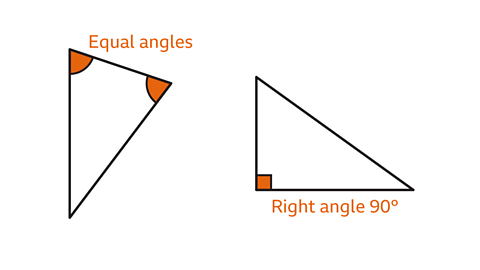 Image caption,
 - A triangle is a closed 2D shape with three straight edges, known as a three-sided polygon.
- Triangles are classified by the lengths of their sides and the sizes of their angles. Diagrams often use hash marks to represent equal lengths and arcs to show equal angles at vertices.
Triangle Classification
- Triangles are categorized based on side length and angle size, crucial for understanding their properties.
- For instance, an equilateral triangle has three equal sides and three equal angles of 60 degrees each.
- An isosceles triangle has two equal sides and two equal angles opposite those sides.
- A scalene triangle has no equal sides or angles, offering unique geometric characteristics.
Symmetry in Triangles
- Symmetry plays a key role in understanding triangles. Line symmetry and rotational symmetry are important concepts.
- Recognizing that the angles within a triangle always sum up to 180 degrees is fundamental in geometry.
Understanding Geometric Shapes
Edge: The edge refers to a side of a polygon or a 3D shape.
- Hash Marks:
Hash marks are short lines marked on the side or edge of a shape. They are used to represent segments of equal length on diagrams.
- Arcs (Annotation) at Vertex:
Arcs are curved marks inside the vertex of a shape. Equal numbers of marks indicate angles that are equal in size. The vertex is where two or more lines intersect, forming the corner of a shape.
Additional Properties
- Other properties relate to the symmetry that a triangle possesses.
Angle Classification in Triangles
- Understanding angles in a triangle:
Knowing different types of angles and that the sum of angles in a triangle is 180 degrees can aid in classifying triangles effectively.
Recognise equilateral, isosceles and scalene triangles
To interpret a diagram:
- Recognize that hash marks, short lines marked on the side or edge of a shape, indicate equal lengths.
- Recognize that arcs (annotation), curved marks inside the vertex of a shape, can be used to indicate equal angles.
To classify a triangle using comparative lengths or angles:
Classifying a Triangle
- The same number of markings means equal lengths, while different numbers indicate varying lengths.
- Equal numbers of arcs signify equal angles, whereas differing numbers suggest different angles.
Identifying Symmetry of a Triangle
Types of Triangles
Understanding Geometric Shapes
Examples
Hash Marks and Equal Lengths
Equal Angles and Arcs
Triangle Properties
Equilateral Triangles
Geometry Concepts
Equilateral Triangle Symmetry
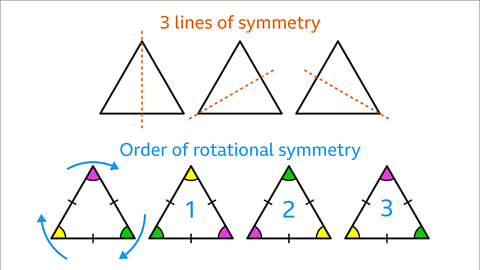
An equilateral triangle exhibits specific symmetry properties:
- It has three lines of symmetry, each passing through a vertex and the midpoint of the opposite side.
- The triangle has rotational symmetry of order 3, fitting into its outline three times in a full 360° turn.
Isosceles Triangle Properties
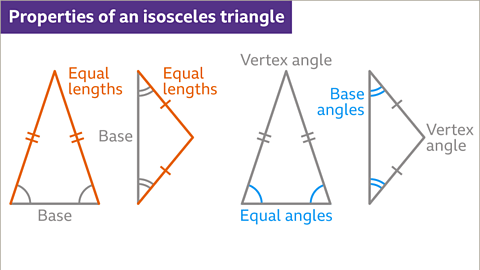
An isosceles triangle is characterized by:
- Having two sides of equal length referred to as 'legs' and a third side (base).
- Posessing two equal angles known as base angles and a different angle called the vertex angle.
Isosceles Triangle
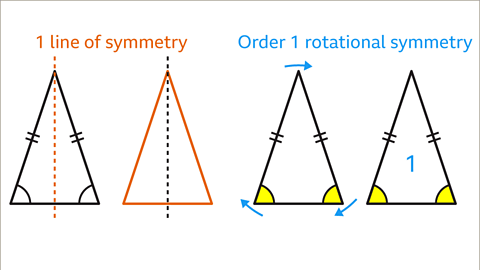 Image caption,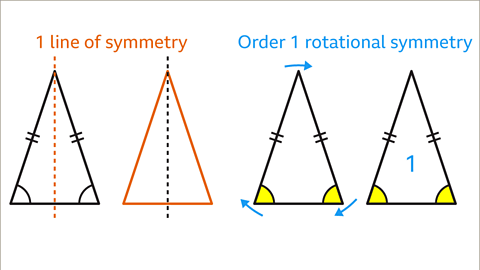
Rotational Symmetry
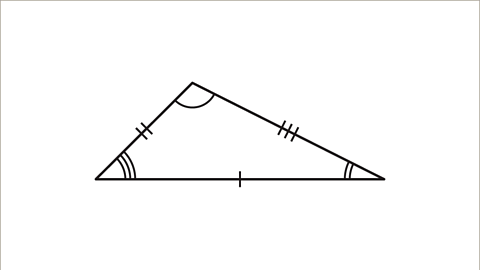
Scalene Triangle
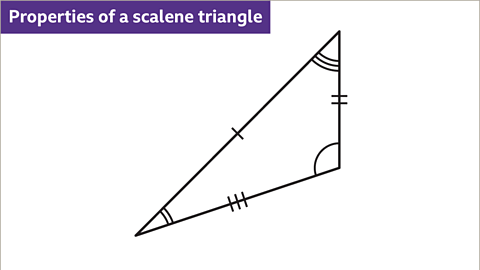
Properties of Scalene Triangle
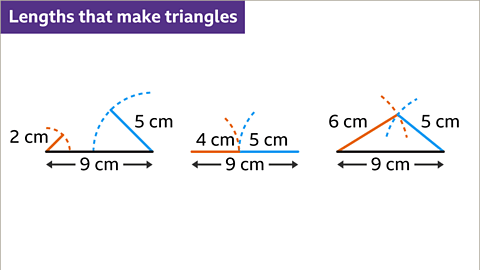
Triangle Inequality Theorem
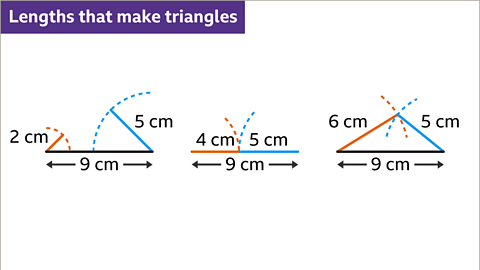
Example of Triangle Inequality
Understanding Annotations on a Diagram
- An isosceles triangle is depicted in the image.
- The two sides of the triangle that have the same length are marked with a single hash symbol.
- Within the triangle, it is noted that these sides have equal lengths.
- The hash marks and the sides they represent are colored orange.
- Hash marks are utilized to indicate edges that are of equal length.
- The number of hash marks on different lines signifies equality in their lengths.
Question
Back to top
Recognising acute-angled, right-angled, and obtuse-angled triangles
To identify the type of triangle based on its angle measurements:
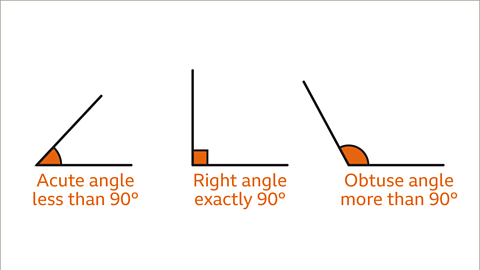
- Acute angles: These are angles less than 90 degrees.
- Right angle: This is an angle measuring exactly 90 degrees, usually denoted by a square symbol.
- Obtuse angles: These are angles greater than 90 degrees but less than 180 degrees.
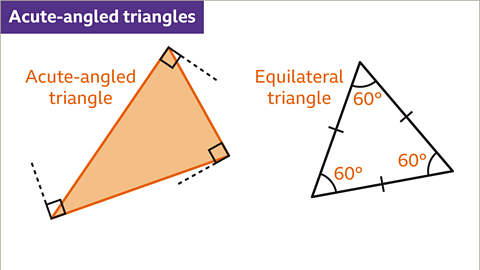
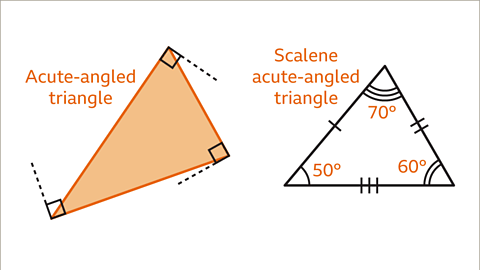
- An acute-angled triangle: All angles are less than 90 degrees.
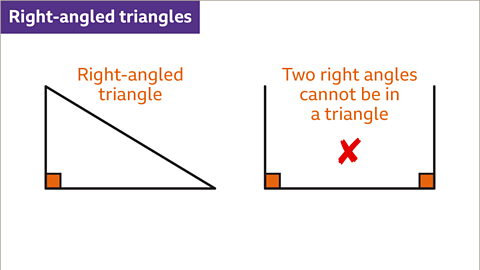
- A right-angled triangle: One angle is exactly 90 degrees.
- An obtuse-angled triangle: One angle is greater than 90 degrees.
Triangles can also be categorized as:
- Equilateral triangle: All sides are equal in length, and all angles are 60 degrees.
- Isosceles triangle: Two sides are equal in length, and two angles are the same size.
- Scalene triangle: Each side has a different length, and each angle is of a different size.
It's important to note that a triangle can fall into multiple categories based on its angle measurements.
Let's explore these classifications through examples:
| Triangle Type | Description |
|---|---|
| Equilateral Triangle | All sides are equal, and all angles are 60 degrees. |
| Isosceles Triangle | Two sides are equal, and two angles are of the same size. |
| Scalene Triangle | Each side has a different length, and each angle varies in size. |
Understanding Types of Angles in Geometry
Angles are a fundamental concept in geometry, describing the amount of rotation needed to bring one line or plane into coincidence with another. Let's delve into the different types of angles:
Acute Angles
- An acute angle is less than 90 degrees. It is like a narrow 'V' shape.
- In an acute-angled triangle, all angles are less than 90 degrees. For instance, an equilateral triangle has all angles measuring 60 degrees.
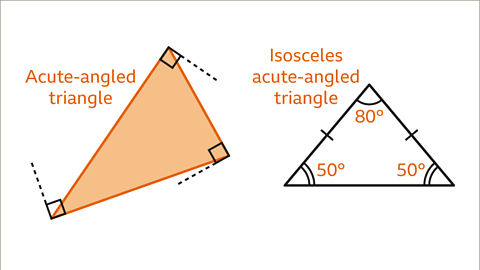
- In an isosceles triangle with angles of 50°, 50°, and 80°, all angles are less than 90°, making it an acute-angled triangle.
- A scalene triangle with angles of 50°, 60°, and 70° is also classified as an acute-angled triangle.
Right Angles
- A right angle measures exactly 90 degrees. It looks like an 'L' shape.
- Right angles are present in various geometric shapes and are crucial in many constructions.
Obtuse Angles
- An obtuse angle is greater than 90 degrees but less than 180 degrees.
- Angles in an obtuse-angled triangle exceed 90 degrees, creating a wider angle.
Key Takeaways
- Understanding angles is essential in geometry as they form the basis for various calculations and constructions.
- Acute, right, and obtuse angles each have distinct properties and applications in geometry.
Visual Representation
Visual aids like the images below can help reinforce your understanding of angle types:
 |  |
 |  |
Types of Triangles Based on Angles
- Right-Angled Triangles:
- Scalene Right-Angled Triangles:
- Isosceles Right-Angled Triangles:
- Obtuse-Angled Triangles:
Right-Angled Triangles
A right-angled triangle contains one angle that is 90 degrees. It cannot have more than one right angle in a triangle.
Scalene Right-Angled Triangles
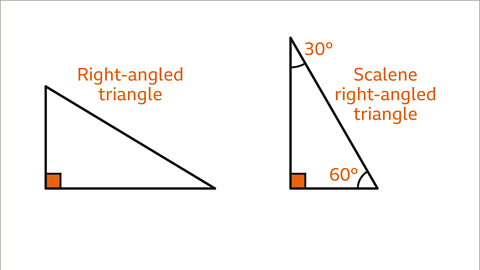
A scalene triangle may be a right-angled triangle. For example, a scalene triangle with angles 90 degrees, 30 degrees, and 60 degrees forms a scalene right-angled triangle.
Isosceles Right-Angled Triangles
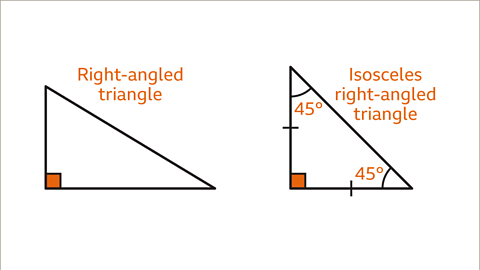
An isosceles triangle with angles of 90 degrees, 45 degrees, and 45 degrees is a right-angled triangle. This combination of angles is unique and all right-angled isosceles triangles will have these same angles.
Obtuse-Angled Triangles
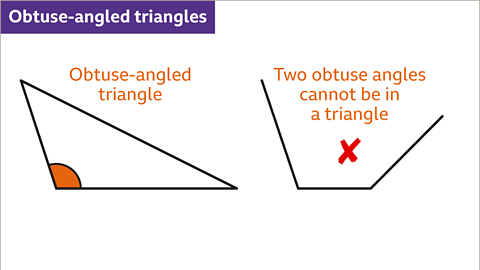
An obtuse-angled triangle has one angle greater than 90 degrees and less than 180 degrees. It is not possible for a triangle to have more than one obtuse angle.
Types of Triangles Based on Angles
Obtuse-Angled Triangle
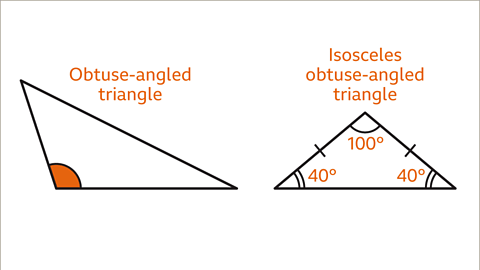
An obtuse-angled triangle is a type of triangle where one of the angles is greater than 90 degrees. When dealing with an isosceles triangle with angles measuring 100°, 40°, and 40°, it falls under the category of an obtuse-angled triangle.
Scalene Triangle
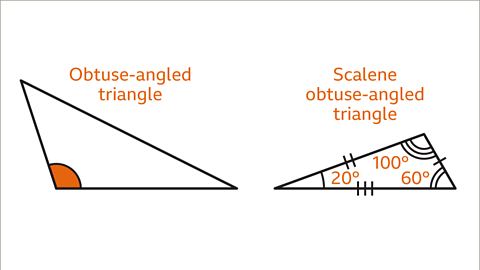
An obtuse-angled triangle can also be formed with a scalene triangle, where one of the angles exceeds 90 degrees. For instance, a scalene triangle with angles measuring 100°, 20°, and 60° fits the criteria of an obtuse-angled triangle.
Types of Angles in Triangles
Acute Angle
An acute angle is less than 90 degrees. It is exemplified by angles smaller than a right angle, such as those seen in acute-angled triangles.
Right Angle
A right angle precisely measures 90 degrees. This angle is common in right-angled triangles and squares.
Obtuse Angle
An obtuse angle exceeds 90 degrees but is less than 180 degrees. It is commonly observed in obtuse-angled triangles.
A triangle's classification can be based on its angles, such as acute-angled, right-angled, or obtuse-angled triangles. Understanding these angles is crucial in geometry.
| Slide 1 of 10 | A series of three images depicting different types of angles:
|
Questions
Back to topPractise working out properties of triangles
Practise working out properties of triangles with this quiz. You may need a pen and paper to help you with your answers.
Quiz
Back to topReal-life maths
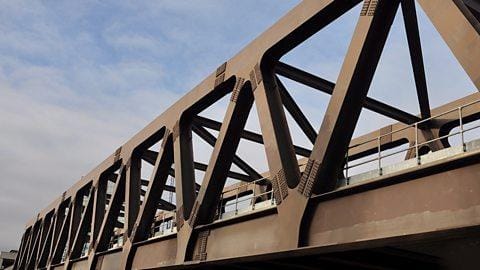 Image caption,
 A triangle is a rigid shape. This fact is put to good use in constructing scaffolding. Separate lengths of iron pipework are fixed together with diagonals across any four-sided shapes.
This gives rigidity to the overall structure, which is essential for safety. This type of construction is also seen in bridges, cranes, and mobile launcher platforms used for space rockets.
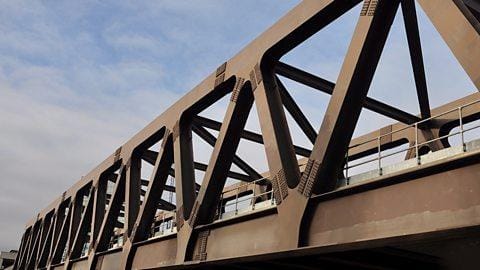 Image caption, Back to top
 Game - Divided Islands
Back to topPractise working out properties of triangles
- Triangles are rigid shapes used in various constructions like scaffolding and bridges for stability and safety.
- They are formed by connecting separate lengths of material with diagonals, providing structural rigidity.
- This construction method is crucial in applications such as bridges, cranes, and platforms for space rockets.
Real-life maths
- Triangles, being rigid shapes, play a vital role in ensuring the stability and safety of structures.
- Construction techniques involving triangles are commonly observed in scaffolding, bridges, cranes, and space rocket platforms.
Game - Divided Islands
Back to top