Chapter Notes: Time Goes On


Introduction
Imagine you're getting ready for school, the sun shining brightly outside. Have you ever wondered how we know what time it is? Well, today, we're going to learn all about it in our chapter, "Time Goes On." We'll talk about calendars, and birthdays. Let's explore time together and have lots of fun!
Let's Understand With a Story
Once upon a time, there was a little girl named Mia. Mia loved playing outside with her friends and going on adventures. One day, her mom said they were going to have a special picnic in the park on Wednesday.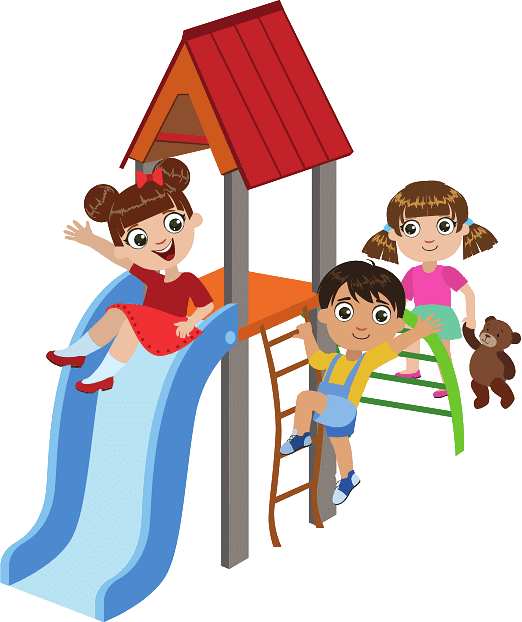
"But how will we remember when Wednesday is?" Mia asked, looking puzzled. Mom smiled and pointed to a colorful calendar hanging on the wall. "We'll use this!" she said.
She showed Mia the days of the week and the names of the months. Then Mom circled "Wednesday, 22nd May" on the calendar.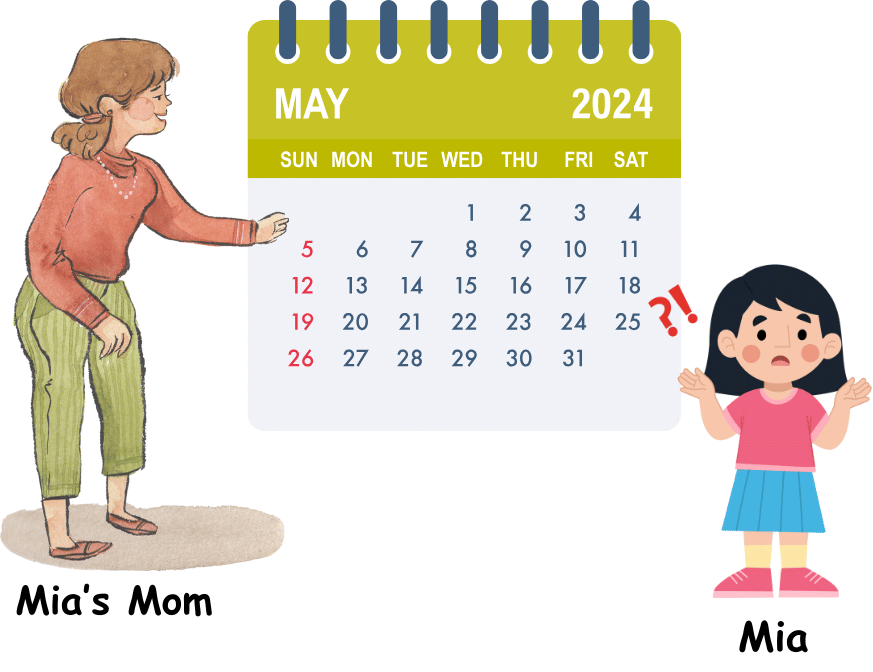 "Now we know when our picnic is!" Mom said cheerfully. And so, Mia learned that the calendar was like a magical guide that helped her family plan fun adventures together.
Understanding Calendars
Imagine you have a special book that helps you know what day it is, plan events, and remember important dates like birthdays and holidays. This special book is called a calendar!
Days and Months
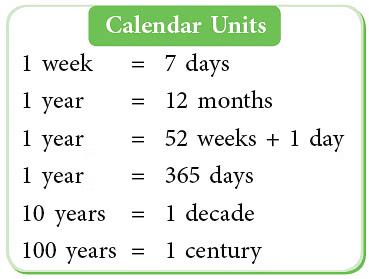
- Every week has seven days: Sunday, Monday, Tuesday, Wednesday, Thursday, Friday, and Saturday.
- Each month has a different number of days.
- There are 12 months in a year.
- There are 365 days in an ordinary year and the month of February has 28 days.
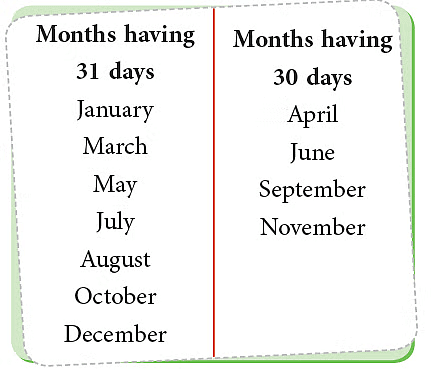
But every fourth year, February has 29 days and the year has 366 days. It is called a leap year. - Some months have 31 days, like January, March, May, July, August, October, and December.
- Some have 30 days, like April, June, September, and November.
Writing Dates
- When we write a date, we first write the number of the day, then the name of the month, and finally the year.
- We can use dots or slashes to separate them.
For example, if it's May 6, 2024, we can write it as 6.05.2024 or 6/05/2024.
Examples
- If someone tells you to meet them on 25th June, you'll know it's the 25th day of June.
- On your birthday, your family might write the date like this: 10.12.2013 (10th December 2013) to remember your special day!
Isn't it cool how the calendar helps us keep track of time and remember special moments?
Age Fun
Family Ages
Let's talk about Mia's family.
- Mia is 8 years old, and her mom is 32 years old.
- When Mia's mom was born, her grandma was already 40 years old. Can you guess her grandma's age?
- Yes, you guessed it right! Mia's grandma is 72 years old now!
Siblings' Ages
Consider Lily and her brother.
- Lily is 10 years old. If she is twice as old as her brother, can you guess the age of his brother?
- Since Lily is twice as old as her brother, her brother is half her age. That means her brother is 5 years old.

Lily's Birth Certificate
Birth Certificate is a special document which contains important information about Lily's birth, like her birth date and her parents' names, making it a special keepsake for her family.
- Lily was born on 2nd May 2015.
- To find out her age on her birthday in 2025, we count the years from when she was born to 2025. That's 10 years!
- To find out her age in 2030, we count the years from when she was born to 2030. That's 15 years!
- Lily's birth certificate was issued 16 days after she was born, on 18th May 2015.
These simple examples help us understand how ages are connected within families and how we can figure out different ages and dates using basic math.
Time
Time is a way to measure and quantify the duration or sequence of events. It's a concept that helps us understand when things happen, how long they last, and in what order they occur.
What is a Clock?
A clock is used to measure time. A clock has two hands- the short hand called the hour hand and the long hand called the minute hand.
- An hour (h) and minute (min) are the standard units for the measurement of time.
- The hour hand shows the hour and the minute hand shows the minutes before and after the hour.
- The minute hand goes around the clock once in 1 hour. The hour hand goes around the clock once in 12 hours.
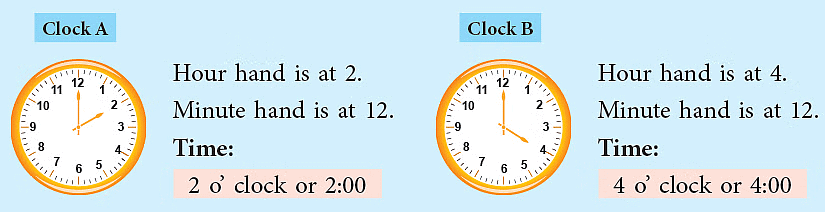
- When the minute hand moves all the way round the clock, i.e., from 12 to 12, an hour passes.
60 minutes = 1 hour
1 day = 24 hours
Telling Time to the Half Hour
In the clock shown alongside, the hour hand is between 9 and 10 and the minute hand points to 6. The coloured part shows that the long hand or minute hand has moved half way round.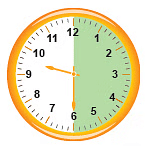 When the minute hand moves half way round the face of the clock, half an hour has passed and we say that it is half past nine.∴ Half past nine can also be written as 9:30.
60 minutes = 1 hour
30 minutes = One-half of an hour
Observe the following clocks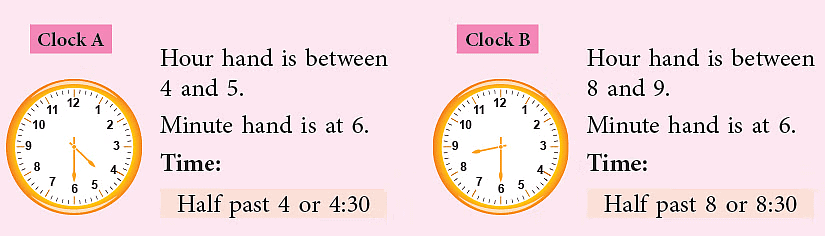
Telling Time to the Nearest Five Minutes
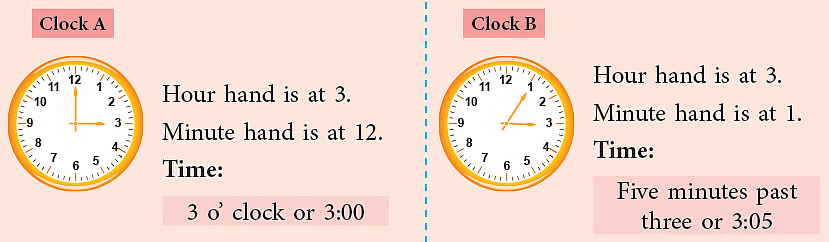
- When the hour hand (short hand) moves from one digit to the other, 1 hour passes.
- When the minute hand (long hand) moves from one digit to the other, 5 minutes pass.
- Count the minutes all around the clock by 5s, starting at 12.
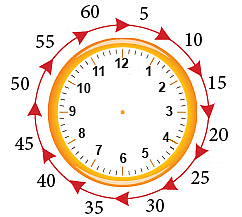 The numbers outside the clock show the count.
 - So, we skip count by 5s to find the time to the nearest five minutes. There are many ways of reading and telling the time.
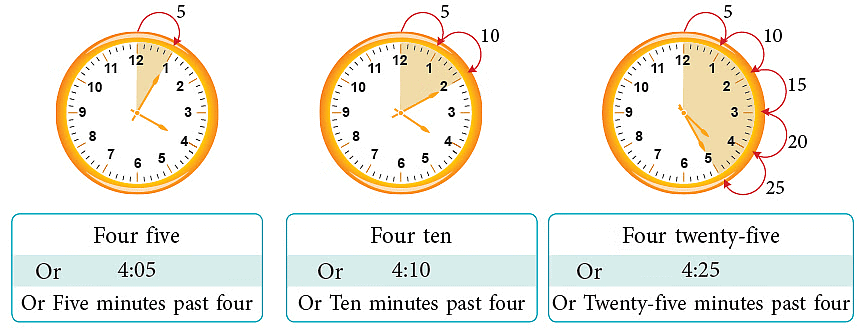
When the minute hand has moved past 6, we say the time in the following two ways:
1. First Way : The hour hand is between 4 and 5, so the time is after 4 o' clock. The minute hand is at 7. Starting at 12 and counting ahead by 5s to 7, we get 35 minutes.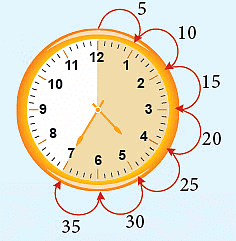 Thirty-five minutes past 4 or 4:35
So, we say that the clock shows the time 35 minutes after 4 or 35 minutes past 4.
2. Second Way: The hour hand is between 4 and 5, so the time is before 5 o' clock. The minute hand is at 7. Starting at 12 and counting back by 5s to 7, we get 25 minutes. We write 25 minutes to 5 to tell the time because there are 25 minutes left to 5 o' clock.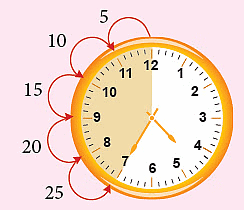 Twenty-five minutes to 5
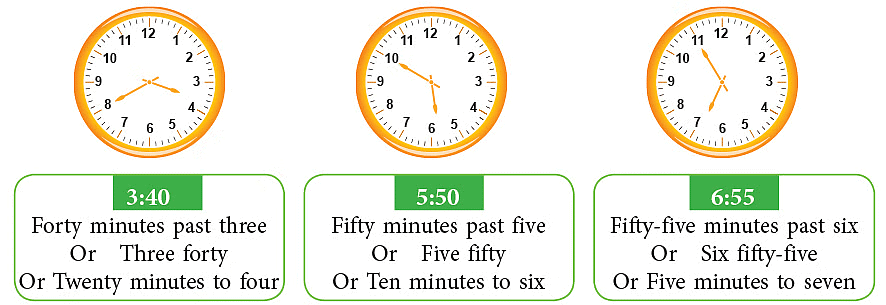
Telling Time to the Quarter Hour
Let us read time on the clocks given below: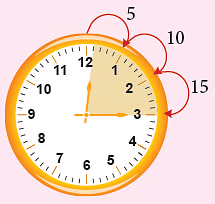 The minute hand has moved one quarter (one-fourth) of the circle in moving from 12 to 3.So, 1 / 4 of an hour = 15 minutes.
- The time shown on the clock is 12:15 or Fifteen minutes past twelve, which we generally read as quarter past twelve.
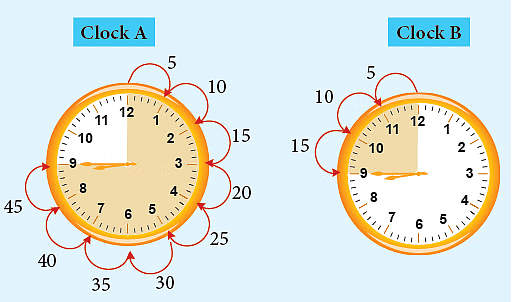
- Both the clocks A and B given show the same time which can be read in clock A as: 8:45 or Forty-five minutes past 8.
- In clock B, the same time can be read as: Fifteen minutes to nine or Quarter to nine.
Examples: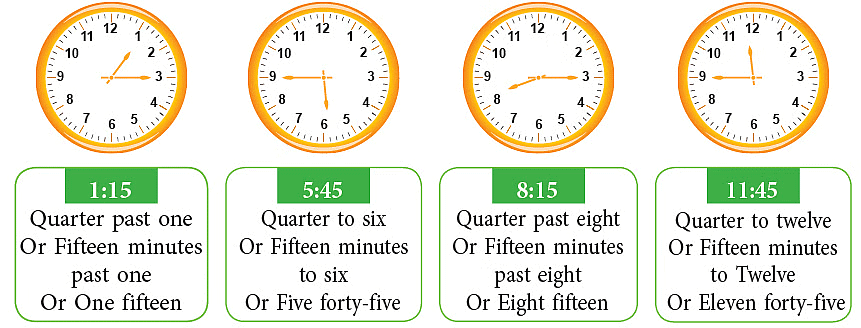
Let's Practice
1. Observing the calendar of month July 2024 given below, can you answer the following questions: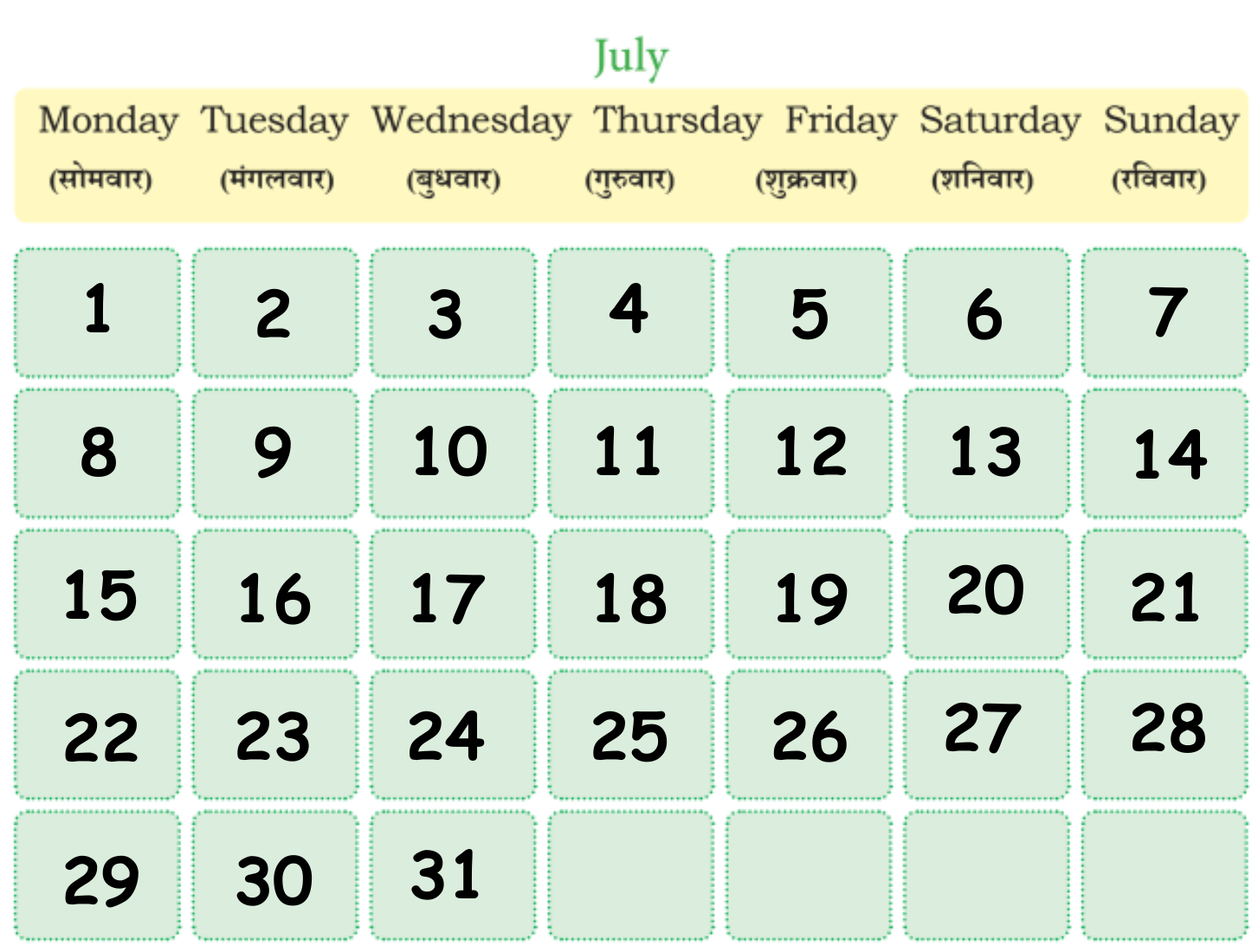
(i) Number of Sundays ______________________________
(ii) Write the dates in this month that are Thursday ___________________________
(iii) Three days after July 22 is July _____________________.
The day on this date is _____________________
(iv) A school closes on July 7 for 15 days. The date on which the school will open is _____________________
Sol:
(i) No. of Sundays = 4.
(ii) The dates that are thursday in this month are 4, 11, 18, 25.
(iii) Three days after July 22 is July 25, and the day on this date is thursday.
(iv) A school closes on July 7 for 15 days. The date on which the school will open is July 22.
2. Match the activity with the statement shown in the picture. Write the time and draw the minute hand and the hour hand wherever
it is required.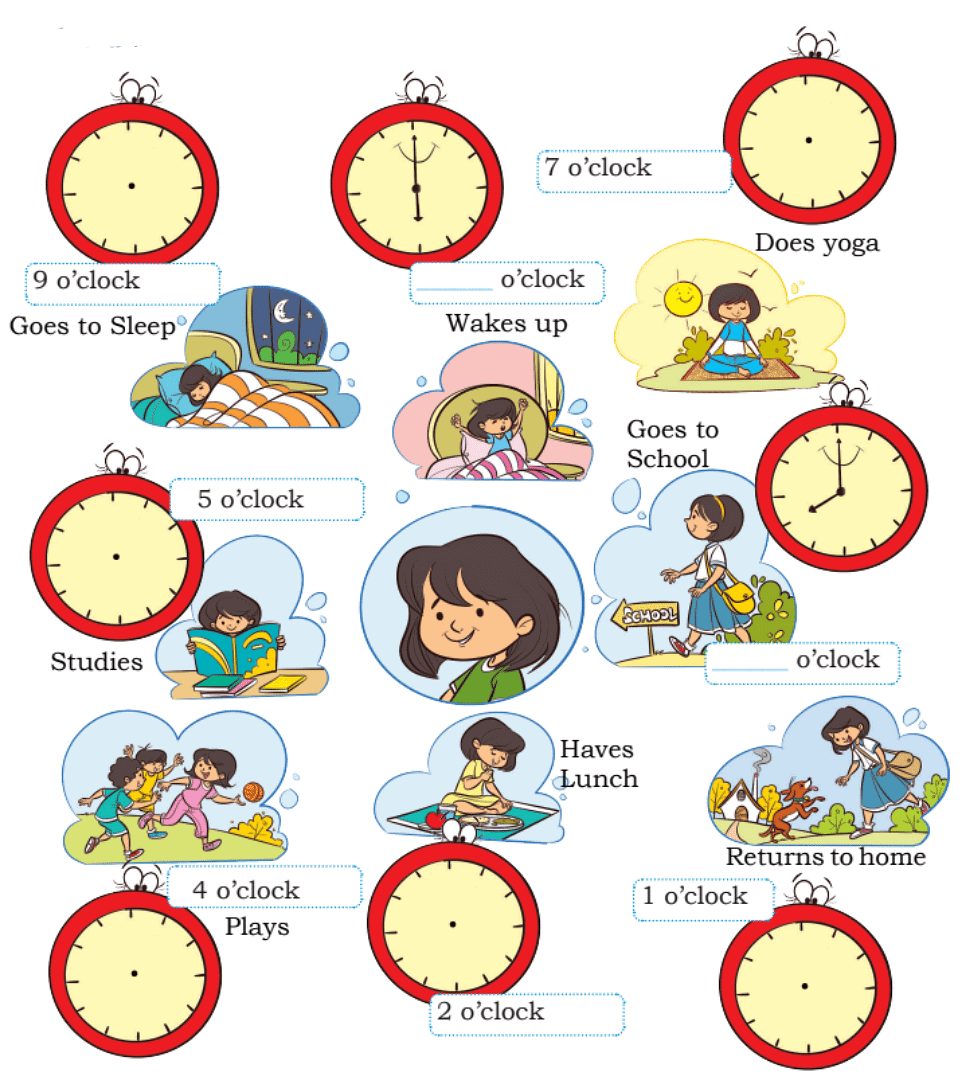
Sol: 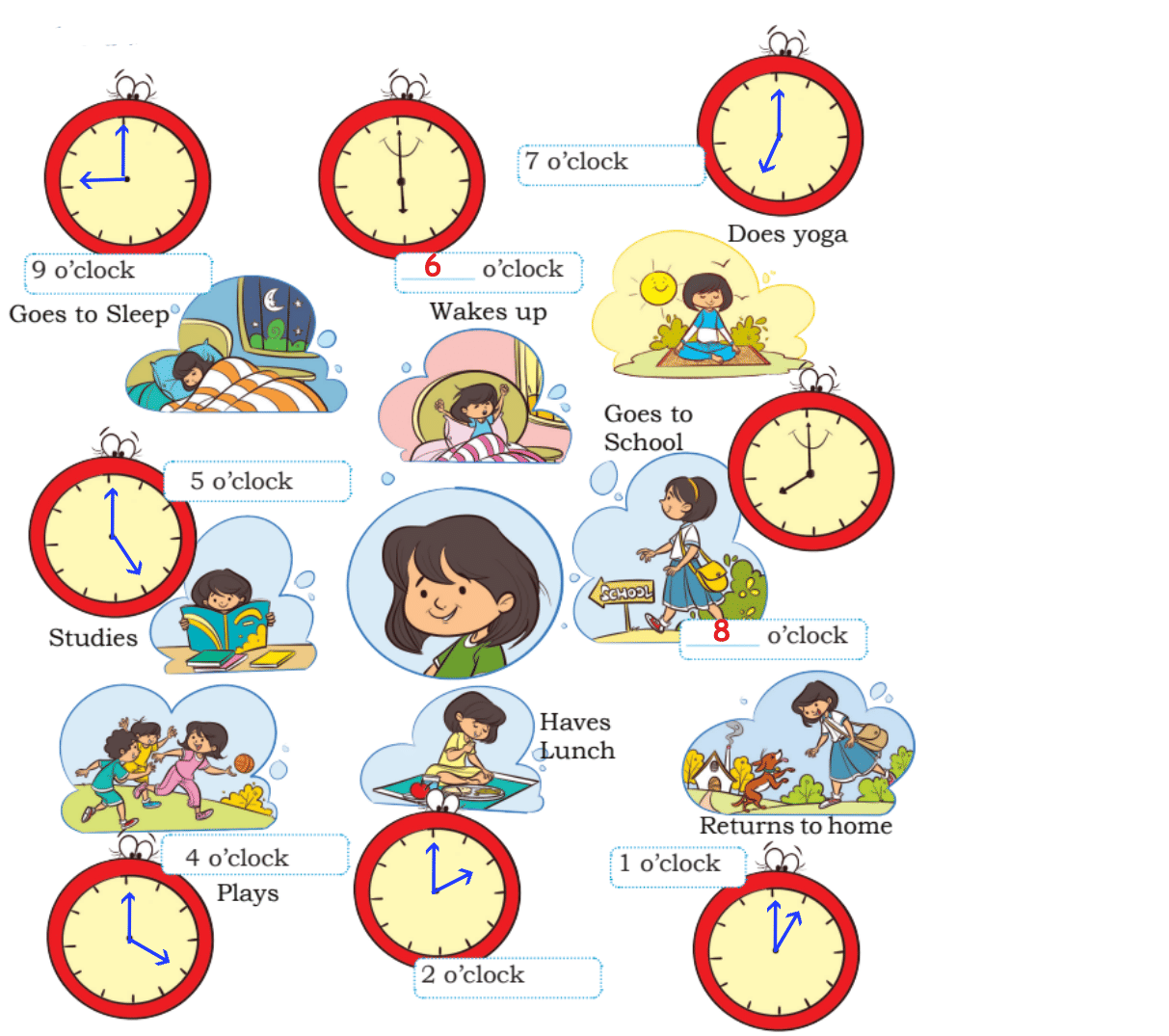
FAQs on Chapter Notes: Time Goes On
| 1. How do calendars help us understand the concept of time? |  |
| 2. Why is it important to learn about clocks and time management? | |
| 3. How can we use clocks to measure time accurately? | |
| 4. What are some fun activities or games that can help children learn about time? | |
| 5. How can understanding the concept of time benefit us in our daily lives? | |
