Notes: Motivation & Learning


Motivation serves as the mental fuel that sparks the mind's desire to achieve greatness. It plays a crucial role in the teaching and learning process, significantly influencing its success. The level of motivation in students can determine how well they reach their learning goals. Thus, motivation is fundamental to the success of the teaching and learning process. Without it, achieving learning objectives becomes challenging. When students are motivated, they approach the teaching and learning process with enthusiasm, driving them to study effectively. Consequently, motivation and learning are closely linked, working together harmoniously.

Motivation
Motivation in psychology refers to the internal and external factors that activate, sustain and direct an individual's behaviour towards a goal. We infer motivation when people persistently work to achieve something-for example, when a student consistently completes assigned tasks with effort and care. Motivation may originate from physiological drives, psychological needs, social influences or environmental incentives.
Several scholars have defined motivation in concise ways that are useful for teachers and educators:
- Skinner: "Motivation is the super highway to learning."
- Good: "Motivation is the process of arousing, sustaining, and regulating activity."
Types of Motivation
Motivation is commonly classified by its source into two broad types: intrinsic and extrinsic. Both types influence learners differently and both are important in classroom settings.
Intrinsic (Internal) Motivation
- Arises from within the learner; the activity itself is rewarding (e.g., studying a subject for enjoyment or curiosity).
- Is linked to interest, curiosity, the desire for mastery, competence and self-satisfaction.
- Fosters persistence, self-confidence and deeper engagement with learning tasks.
- Example: A student reads about wildlife because they enjoy learning about animals, not because of marks or rewards.
Extrinsic (External) Motivation
- Comes from outside the individual and is driven by rewards, recognition, grades, praise, or avoiding punishment.
- Can be effective for initiating behaviour and for short-term tasks (e.g., studying to obtain a scholarship or to avoid parental reprimand).
- Should be used carefully because excessive external rewards can undermine intrinsic motivation for tasks that could otherwise be internally rewarding.
- Example: A learner works hard for a prize or certificate rather than for the pleasure of learning.
Characteristics of Motivation
From the definitions and theories of motivation, the following key characteristics can be identified and used by teachers to plan instruction and classroom activities.
1. Motivation is a Psychological Phenomenon
- It is experienced internally and often operates at conscious and unconscious levels.
2. Motivation is Based on Needs
- Needs can be basic (physiological) or higher-order (psychological) and vary across individuals and time.
- Examples include needs for food, safety, belonging, esteem, understanding and self-actualisation.
3. Goals Act as Motivators
- When a need is felt, it directs behaviour towards specific goals that are expected to satisfy that need.
4. Motivation is Different from Satisfaction
- Motivation is the drive to attain an outcome; satisfaction is the contentment felt after the outcome is achieved.
5. Motivation is a Continuous Process
- Human wants are many and ongoing; fulfilment of one need often gives rise to another, so motivation continues over time.
6. Motivation Relates to the Whole Person
- A learner's motivations are interconnected with their emotions, values, experiences and social context.
Principles of Motivation in Learning
Teachers can apply the following principles to design motivating learning experiences and maintain learner engagement.
- All learning must have a purpose: Collaborate with students to set relevant short‐term and long‐term goals so learning connects to their lives.
- Students need skills and knowledge: Ensure learners have the prerequisite skills and knowledge so they can succeed and build confidence.
- Specific directions empower students: Give clear, concise and logical instructions so students know what is expected and how to proceed.
- Students want to have fun while they work: Use enjoyable activities to reduce boredom and promote sustained engagement.
- Offer activities that involve higher‐order thinking skills: Use open‐ended questions, problem‐solving and critical thinking tasks to stimulate interest.
- Curiosity is an important component of motivation: Pose provocative questions and design inquiry tasks that stimulate learners' desire to explore.
- A blend of praise and encouragement builds self‐reliance: Give sincere, specific praise and supportive feedback to nurture persistence and confidence.
- A combination of extrinsic and intrinsic rewards: Use external incentives judiciously alongside strategies that develop intrinsic interest and ownership.
- Involve students in collaborative activities: Cooperative tasks increase motivation through peer interaction, shared responsibility and social learning.
- Students work harder when they feel the teacher likes and respects them: Build positive teacher-student relationships to support motivation and classroom engagement.
Maslow's Hierarchy of Needs
Abraham Maslow proposed that human needs are organised in a hierarchy where more basic needs must be satisfied before higher needs become strong motivators. He emphasised that needs include both physiological and psychological dimensions and that as lower needs are met, higher growth needs emerge.
Basic Needs
- Physiological: Needs for sleep, food, drink, shelter, sex and oxygen.
- Safety: Needs for security from harm, predictability, routine and stability.
Growth Needs
- Love and Belonging: Affectionate relationships, a sense of belonging to groups and caring social ties.
- Esteem - Self‐respect: Desire for competence, achievement, autonomy and confidence.
- Esteem - Respect of others: Desire for recognition, reputation, status and appreciation.
- Understanding and Knowledge: Curiosity, exploration, desire to learn, discover and make meaning.
- Aesthetics: Appreciation for beauty, balance and harmonious surroundings.
- Self‐actualisation: Growth, fulfilment and realisation of one's potential and purpose.
Suggestions for Application to Education
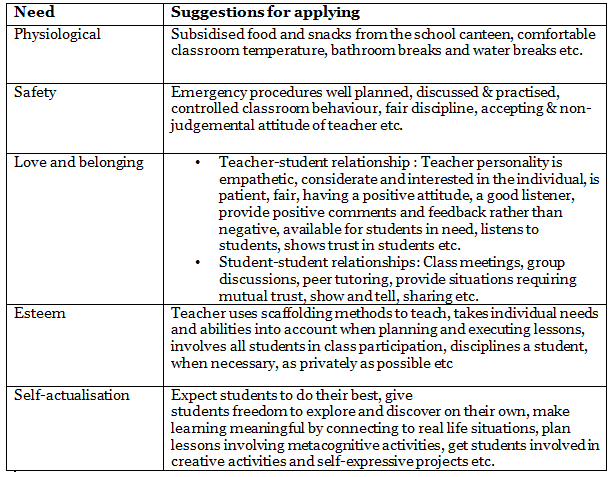
The hierarchy has practical implications in education: teachers should attend to learners' basic needs (nutrition, safety, belonging) before expecting higher academic engagement. Classrooms that provide emotional security, clear routines, positive relationships and opportunities for meaningful challenge better support motivated learning.
Motivation and Learning
Motivation affects learning and classroom behaviour in multiple interrelated ways. The following points show how motivation drives effective learning:
- Guides behaviour towards goals: Motivation directs choices, such as subject selection, time allocation and persistence on tasks.
- Boosts effort and energy: It determines how much effort learners invest in activities aligned with their aims.
- Encourages task initiation and persistence: Motivated students start tasks willingly and continue despite difficulties or distractions.
- Influences cognitive processes: Motivation affects attention, depth of processing, organisation of information and the desire to understand applications.
- Determines perception of rewards and consequences: Learners with high academic motivation take pride in achievements and learn from setbacks.
- Enhances performance: By directing behaviour, sustaining engagement and improving cognitive processing, motivation contributes to better learning outcomes.
Important Suggestions to Keep Students Motivated for Learning
- Plan every class carefully; do not teach without preparation.
- Recognise students' strengths and limitations; reward strengths and support weaknesses.
- Vary instructional strategies: lectures, demonstrations, discussions, case studies and group activities.
- Review learning objectives with students so they know expected outcomes and performance criteria.
- Encourage students to share ideas and feedback; involve them in the learning process even when responses are imperfect.
Importance of Motivation for Teachers
- Make classroom learning relevant to students' lives and the wider world.
- Treat students consistently and fairly to build trust and predictability.
- Ensure assessments are current, valid and reliable.
- Align tests and evaluation with stated course objectives and learning outcomes.
- Provide frequent opportunities for students to speak and express their understanding.
- Plan teaching segments (for example, 30-40 minute periods) to match students' attention spans.
- Be expressive, enthusiastic and productive in classroom delivery to model engagement.
- Create a healthy competitive environment while emphasising individual progress and collaboration.
Summary
Motivation is central to teaching and learning. Teachers who understand different types of motivation, apply principles that build intrinsic interest, address learners' needs, and design purposeful, varied and challenging activities can significantly improve engagement and achievement. Small, consistent practices-clear goals, timely feedback, respectful relationships and tasks that stimulate curiosity-create classrooms where motivation flourishes and learning deepens.
FAQs on Notes: Motivation & Learning
| 1. What are the key principles of motivation in learning? |  |
| 2. How does Maslow's Hierarchy of Needs relate to education? | |
| 3. What are some practical suggestions for applying motivation principles in education? | |
| 4. Why is motivation important in the learning process? | |
| 5. How can teachers assess student motivation effectively? | |




