IGCSE Year 10 > Year 10 Notes > History for GCSE/ > Did the Republic Recover After 1923?
Did the Republic Recover After 1923?

How Important was Stresemann to the Recovery of the Weimar Republic? - Summary
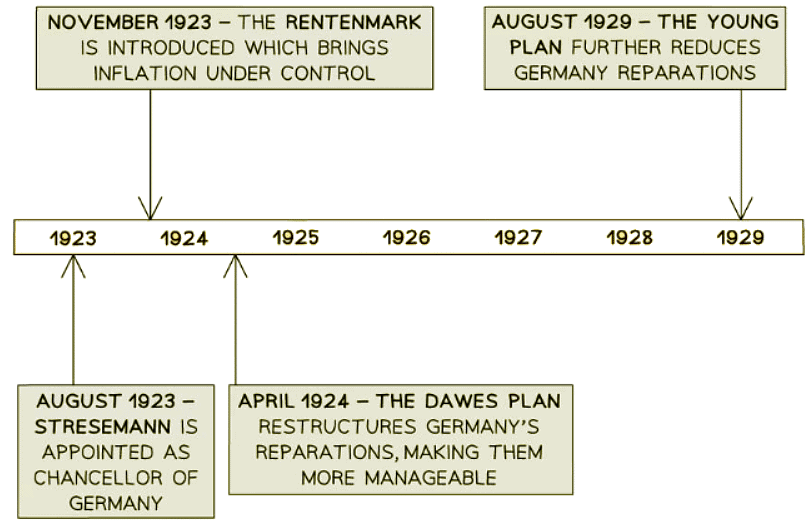
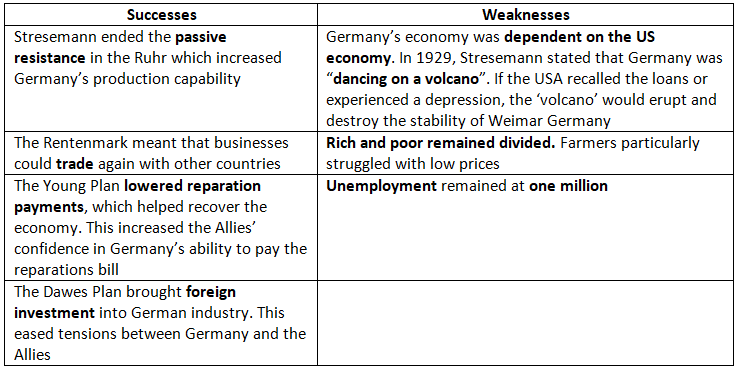
- When President Ebert appointed Gustav Stresemann as chancellor in August 1923, the German economy had collapsed. The French invasion of the Ruhr had caused hyperinflation, rendering the German currency, the mark, worthless.
- Stresemann served as chancellor from August to November 1923 and implemented numerous measures to rescue Germany's economy. He controlled inflation by introducing a new currency, the Rentenmark. Stresemann also negotiated the Dawes Plan (1924) and the Young Plan (1929), which reduced Germany's reparations payments to the Allies.
- By November 1923, Stresemann had lost his position as chancellor due to the collapse of the coalition government when the SPD withdrew their support from Stresemann's party, the DVP. Wilhelm Marx from the Centre Party became the next chancellor, forming a coalition with the DVP and the DDP, and appointed Stresemann as foreign minister.
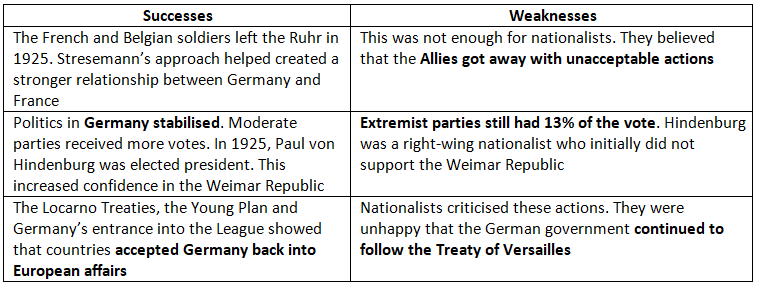
- As foreign minister, Stresemann pursued treaties such as Locarno and Kellogg-Briand to improve relations with Europe and restore Germany's international standing. Stresemann's efforts were successful, with Germany being accepted as a permanent member of the League of Nations in 1926, the same year Stresemann won the Nobel Peace Prize. He remained in office until his death on October 3, 1929.
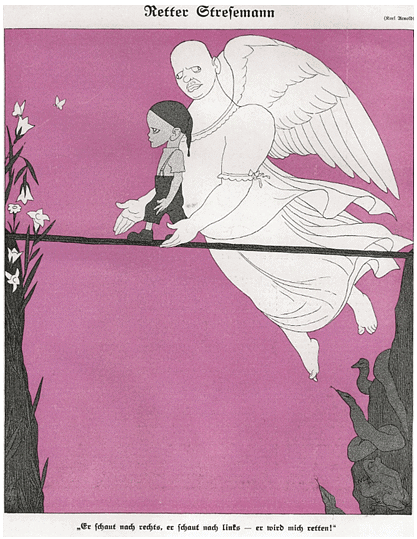 The front page of the German satirical magazine Simplicissimus in 1923. It shows Gustav Stresemann as a guardian angel of the German Michel. The caption reads: "He looks to the right, he looks to the left - he will save me!"
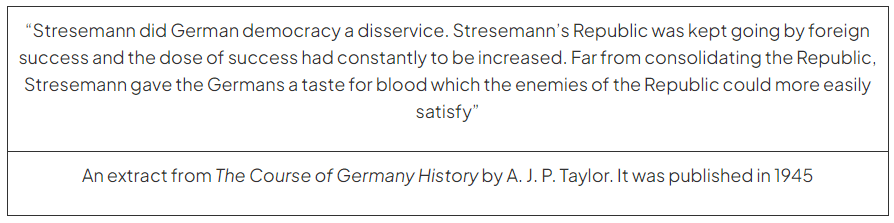
Economic Achievements of Gustav Stresemann
Who was Gustav Stresemann?
- Gustav Stresemann assumed the role of chancellor in August 1923. He held nationalist sentiments.
- Initially, Stresemann harbored disapproval towards the Weimar Republic. However, his perspective shifted following the assassination of Rathenau, Germany's foreign minister.
- Subsequently, Stresemann founded the DVP (People's Party), a moderate right-wing political entity.
- During his tenure as chancellor, Stresemann aimed to stabilize inflation, restore Europe's esteem towards Germany, and diminish the backing for extremist factions.
The Creation of the Rentenmark
- Germany faced an overwhelming currency crisis as the mark had reached an unsustainable level, with the largest note being a staggering 100 trillion marks.
- The German government estimated that a mind-boggling 400.3 billion trillion marks were circulating within the economy.
- To address this dire situation, in November 1923, Gustav Stresemann introduced a new currency known as the Rentenmark.
- The Rentenmark was designed to offer stability, with one Rentenmark being equivalent to a trillion of the previous marks.
- Stresemann also established the Rentenbank, a state-owned institution where the public could exchange their old marks for the new Rentenmarks.
- Operating on the gold standard, the Rentenmark's value was tied to the price of gold, which instilled trust not only locally but also among European nations that valued gold-backed currencies.
- By August 1924, the Reichsbank was created to oversee the management of the Rentenmark, leading to its eventual renaming as the Reichsmark.
- The introduction of the Reichsmark facilitated smoother trading for German businesses with foreign partners, aiding in the country's economic recovery.
Dawes Plan
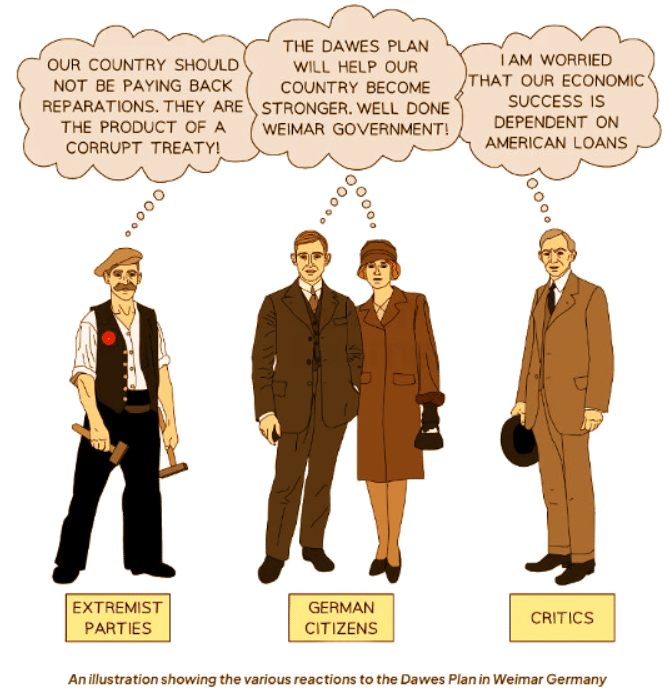
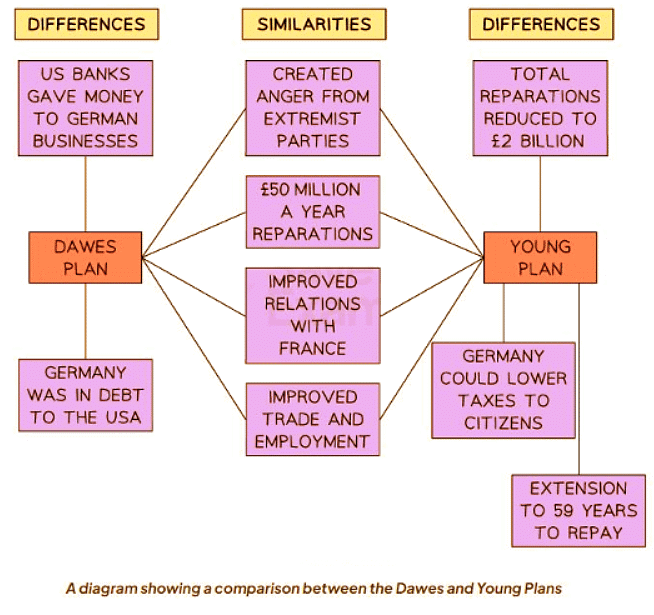
- The Dawes Plan agreement played a pivotal role in Germany's economic resurgence.
Young Plan
- The Young Plan played a significant role in advancing Germany's economic condition.
MULTIPLE CHOICE QUESTIONTry yourself: What was the new currency introduced by Gustav Stresemann to stabilize the German economy?
Foreign Policy Achievements of Gustav Stresemann
The Locarno Treaties
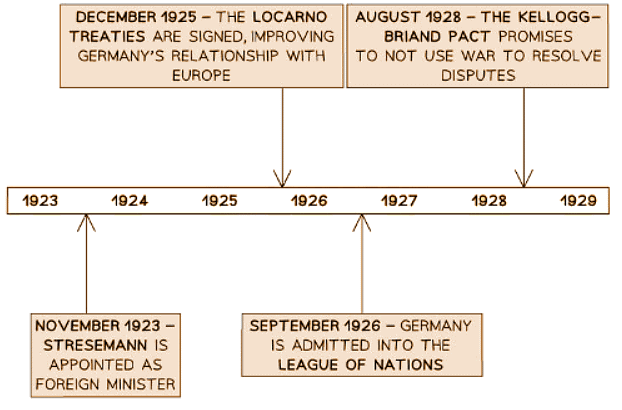
- The Locarno Treaties enhanced Germany's diplomatic relations with other nations.
Germany's Entry into the League of Nations
- The League of Nations served as a platform for countries to address issues before resorting to warfare.
- Woodrow Wilson, the American President, played a pivotal role in establishing the League, drawing from his 14 Points vision.
- The Treaty of Versailles laid the foundation for the League.
- The League's inaugural formal assembly took place on January 10, 1920.
- To become a permanent League member, a country needed a two-thirds majority vote.
- Countries could exit the League by providing a two-year notice.
- The Treaty of Versailles, influenced by Clemenceau's stance, prohibited Germany from League membership.
- Following the Locarno Treaties, Stresemann engaged with the League regarding German membership.
- In September 1926, Germany acquired a seat on the League of Nations Council.
The Impacts of Joining the League of Nations

The Kellogg-Briand Pact, 1928
- French Foreign Minister Aristide Briand met with U.S. Secretary of State Frank B. Kellogg to discuss additional measures for achieving world peace.
- The USA was not a member of the League of Nations as it was focusing on its own domestic affairs.
- Some U.S. politicians were idealists who sought world peace.
- On August 27, 1928, they brought together Germany and 61 other countries to sign the Kellogg-Briand Pact.
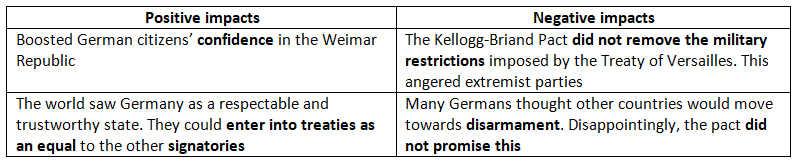
- The Kellogg-Briand Pact declared that war should never be used to resolve disputes between countries.
Impacts of the Kellogg-Briand Pact on Germany
Impact on the Reichstag
- When Gustav Stresemann assumed the role of Chancellor in August 1923, his primary objective was to diminish the backing for radical political factions.
- His adept management of financial and political affairs played a pivotal role in achieving this objective.
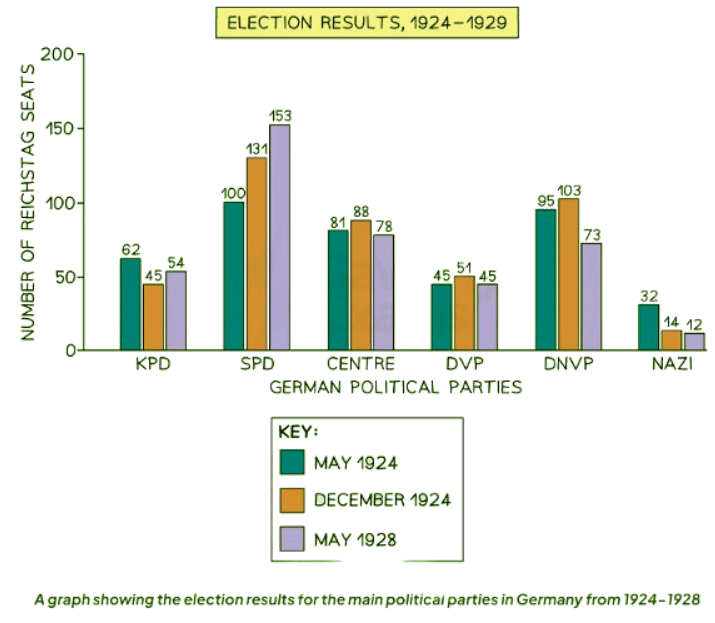
- By October 1929, the political climate in Germany had significantly changed.
- There were no political assassinations between 1924 and 1929.
- During 1924-1929, there were six coalition governments, which was much fewer than before 1924.
- Friedrich Ebert died in 1925.
- Throughout his presidency, Ebert could not shake off the negative association with the Treaty of Versailles.
- Paul von Hindenburg succeeded Ebert as president.
- Hindenburg had served as the army chief of staff under the Kaiser.
- He was elected president at the age of 77.
- Hindenburg held strong conservative and nationalist views.
- The right-wing middle class respected Hindenburg, leading to increased support for the Weimar Republic.
- On October 3, 1929, Stresemann died in office from a heart attack.
- The Republic lost one of its most capable ministers with Stresemann's death.
- The Wall Street Crash occurred at the end of October.
The document Did the Republic Recover After 1923? is a part of the Year 10 Course History for GCSE/IGCSE.
All you need of Year 10 at this link: Year 10
About this Document

4.61/5 Rating

Apr 29, 2026 Last updated
Related Exams
Document Description: Did the Republic Recover After 1923? for Year 10 2026 is part of History for GCSE/IGCSE preparation. The notes and questions for Did the Republic Recover After 1923? have been prepared according to the Year 10 exam syllabus. Information about Did the Republic Recover After 1923? covers topics like and Did the Republic Recover After 1923? Example, for Year 10 2026 Exam. Find important definitions, questions, notes, meanings, examples, exercises and tests below for Did the Republic Recover After 1923?.
Introduction of Did the Republic Recover After 1923? in English is available as part of our History for GCSE/IGCSE for Year 10 & Did the Republic Recover After 1923? in Hindi for History for GCSE/IGCSE course. Download more important topics related with notes, lectures and mock test series for Year 10 Exam by signing up for free. Year 10: Did the Republic Recover After 1923?
Description
Did the Republic Recover After 1923? of History covers all the important topics, helping you prepare for the Year 10 exam on EduRev. Start for free!
Information about Did the Republic Recover After 1923?
In this doc you can find the meaning of Did the Republic Recover After 1923? defined & explained in the simplest way possible. Besides explaining types of Did the Republic Recover After 1923? theory, EduRev gives you an ample number of questions to practice Did the Republic Recover After 1923? tests, examples and also practice Year 10 tests



Related Searches
past year papers, Important questions, Did the Republic Recover After 1923?, shortcuts and tricks, Summary, Exam, pdf , Extra Questions, Free, Semester Notes, Previous Year Questions with Solutions, MCQs, ppt, Viva Questions, Sample Paper, mock tests for examination, practice quizzes, Did the Republic Recover After 1923?, Objective type Questions, Did the Republic Recover After 1923?, video lectures, study material;