IGCSE Year 10 > Year 10 Notes > History for GCSE/ > How Far was the New Economic Policy a Success?
How Far was the New Economic Policy a Success?


Why did the Bolsheviks Introduce the NEP? - Summary
- The NEP marked a significant shift from War Communism. The Bolsheviks had introduced War Communism in June 1918 due to the Russian Civil War. This policy embodied a communist approach to the economy, aligning with Marx's vision of communism where there would be no private businesses. Consequently, the Bolshevik government took control of all areas of production.
- War Communism, however, had severe negative impacts on the Russian economy. Lenin realized that continuing War Communism was untenable, despite the desire of many Bolsheviks, such as Bukharin, to persist with it. Therefore, Lenin had to introduce capitalist elements into the Bolshevik economy. This shift brought both benefits and costs to Lenin and the Russian economy.
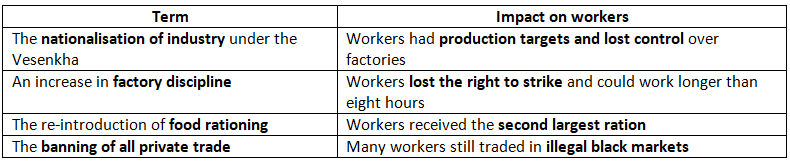
Effect of War Communism in Towns
- The Bolsheviks required the backing of Russian towns during the civil war.
- Persistent scarcity of industrial products due to World War I and labor strikes.
- Bolsheviks aimed to regulate the armament sector to ensure optimal supplies for the Red Army.
- The Decree on Workers enabled many laborers to receive high wages even for minimal work.
- After the First World War and strikes, there remained a scarcity of industrial goods.
- The Bolsheviks aimed to manage the armament industry to ensure optimal supplies for the Red Army.
- Under the Decree on Workers, numerous workers were able to grant themselves substantial wages despite minimal or no productivity.
Industrial Concepts during the War Communism Era
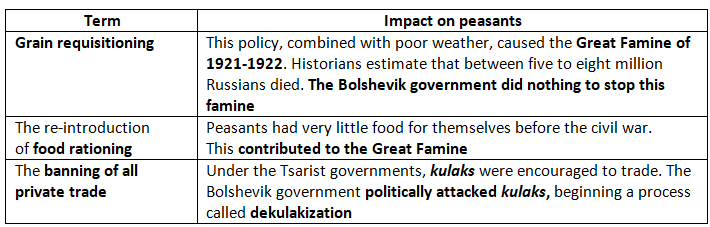
Effect of War Communism in the Countryside
- The Bolsheviks sought the backing of Russian peasants for their cause.
- Many peasants were forcibly enlisted into the Red Army by the Bolsheviks.
- To sustain their troops' strength, the Red Army required a steady food source.
- Resistance from certain peasants towards the Bolsheviks was encountered.
- The implementation of stringent War Communism policies contributed to the expansion of Bolshevik authority throughout Russia.
Agricultural Terms of War Communism
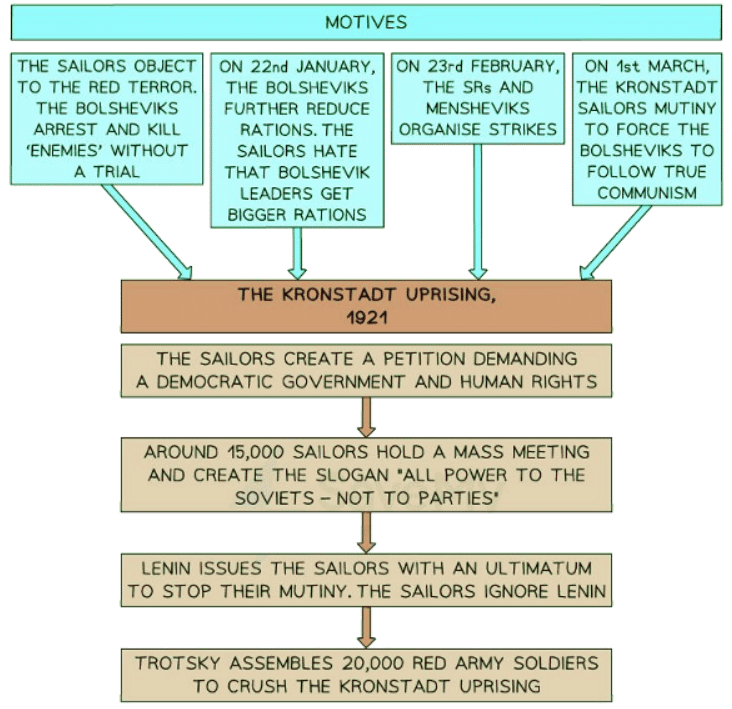
Kronstadt Uprising 1921
- War Communism had significant repercussions on Russian society by 1921:
- Industrial production fell below pre-War Communism levels of 1913.
- The country witnessed widespread famine leading to the death of millions.
- Russia endured seven consecutive years of warfare.
- The Kronstadt Uprising marked a turning point, compelling Lenin to abandon the policies of War Communism.
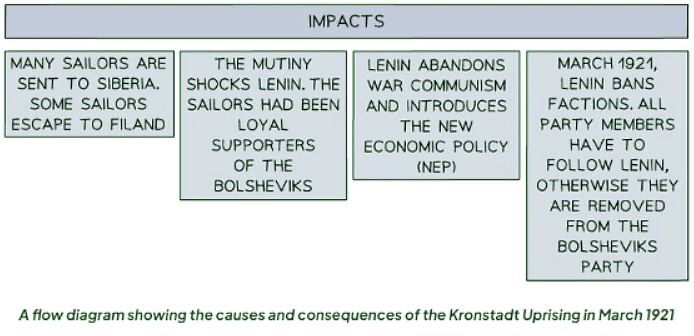
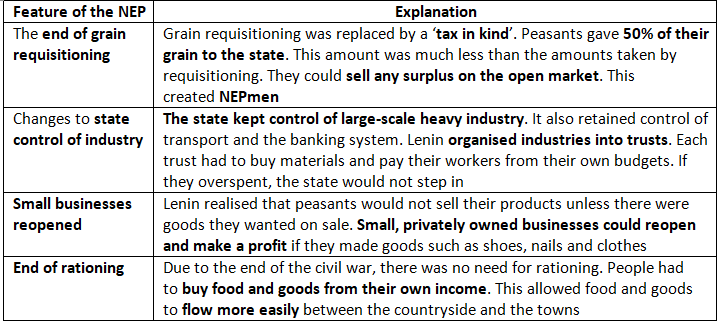
Features of the New Economic Policy (NEP)
- After the Red Army's victory over the Bolsheviks' adversaries, Lenin implemented the New Economic Policy (NEP), a significant departure from War Communism.
- The NEP marked a stark contrast to the economic strategies of War Communism, emphasizing a more market-oriented approach.
MULTIPLE CHOICE QUESTIONTry yourself: What was the main reason behind the Bolsheviks introducing the New Economic Policy (NEP)?
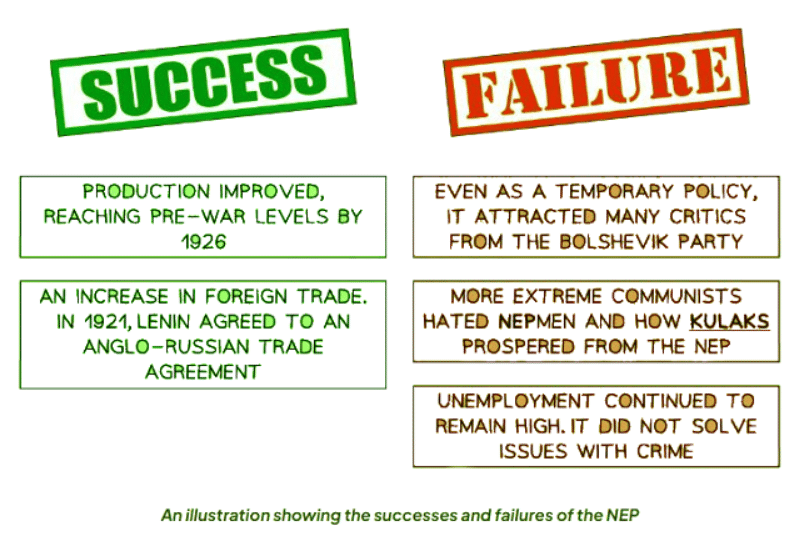
Was the NEP a Success?
The document How Far was the New Economic Policy a Success? is a part of the Year 10 Course History for GCSE/IGCSE.
All you need of Year 10 at this link: Year 10
FAQs on How Far was the New Economic Policy a Success?
| 1. How did the economic policies of War Communism impact the towns in Soviet Russia? |  |
Ans. The economic policies of War Communism led to widespread shortages, hyperinflation, and a breakdown of the urban economy in Soviet Russia. Factories were unable to produce goods efficiently, leading to a lack of essential items for urban residents.
| 2. What were the key features of the New Economic Policy (NEP) introduced by the Bolsheviks? | |
Ans. The NEP allowed for limited capitalism, private enterprise, and small-scale trade in Soviet Russia. It also reintroduced a form of currency, encouraged agricultural production, and aimed to stabilize the economy after the chaos of War Communism.
| 3. How did the NEP impact agricultural production in the countryside? | |
Ans. The NEP allowed peasants to sell their surplus produce on the open market, incentivizing increased agricultural production. This led to a boost in food supplies and helped alleviate the famine conditions that had plagued the countryside during War Communism.
| 4. Was the New Economic Policy (NEP) considered a success by the Bolsheviks? | |
Ans. The NEP was initially seen as a success by the Bolsheviks as it helped stabilize the economy, increase production, and improve living conditions for many. However, some party members criticized it for deviating from socialist principles and allowing capitalist elements to thrive.
| 5. What factors contributed to the eventual end of the New Economic Policy (NEP) in Soviet Russia? | |
Ans. The NEP was gradually phased out in the late 1920s due to growing opposition within the Communist Party, concerns over the rise of a capitalist class, and the desire to accelerate industrialization through centralized planning under Stalin's leadership.
About this Document

4.76/5 Rating

Apr 29, 2026 Last updated
Related Exams
Document Description: How Far was the New Economic Policy a Success? for Year 10 2026 is part of History for GCSE/IGCSE preparation. The notes and questions for How Far was the New Economic Policy a Success? have been prepared according to the Year 10 exam syllabus. Information about How Far was the New Economic Policy a Success? covers topics like and How Far was the New Economic Policy a Success? Example, for Year 10 2026 Exam. Find important definitions, questions, notes, meanings, examples, exercises and tests below for How Far was the New Economic Policy a Success?.
Introduction of How Far was the New Economic Policy a Success? in English is available as part of our History for GCSE/IGCSE for Year 10 & How Far was the New Economic Policy a Success? in Hindi for History for GCSE/IGCSE course. Download more important topics related with notes, lectures and mock test series for Year 10 Exam by signing up for free. Year 10: How Far was the New Economic Policy a Success?
Description
How Far was the New Economic Policy a Success? of History covers all the important topics, helping you prepare for the Year 10 exam on EduRev. Start for free!
Information about How Far was the New Economic Policy a Success?
In this doc you can find the meaning of How Far was the New Economic Policy a Success? defined & explained in the simplest way possible. Besides explaining types of How Far was the New Economic Policy a Success? theory, EduRev gives you an ample number of questions to practice How Far was the New Economic Policy a Success? tests, examples and also practice Year 10 tests



Related Searches
Important questions, How Far was the New Economic Policy a Success?, Free, pdf , study material, shortcuts and tricks, How Far was the New Economic Policy a Success?, Sample Paper, How Far was the New Economic Policy a Success?, past year papers, MCQs, mock tests for examination, Extra Questions, Summary, Exam, video lectures, Previous Year Questions with Solutions, Viva Questions, Objective type Questions, practice quizzes, Semester Notes, ppt;