IGCSE Class 10 > Class 10 Notes > Mathematics for GCSE/ > Area & Perimeter
Area & Perimeter

Perimeter
What is perimeter?
- Perimeter represents the total distance around the exterior of a 2D shape.
- To calculate perimeter, add together the lengths of all the sides.
- For a circle, the perimeter is referred to as the circumference.
How do I find the perimeter of a 2D shape?
- To find the perimeter of any 2D polygon, add the lengths of its sides.
- For any regular 2D shape, the perimeter equals the number of sides multiplied by the length of one side.
- For example, a square with side length x cm has a perimeter of 4x cm.
- When dealing with more complex 2D shapes, use the given information to determine the lengths of some sides.
- Shapes composed of two or more 2D shapes are called compound shapes.
- In compound shapes made of two rectangles (e.g., an L-shape), the lengths of two shorter sides opposite a longer side will add up to the same length as the longer side.
- For compound shapes made of different 2D shapes, additional information is needed to find the lengths of the sides.
- Be familiar with the properties of 2D shapes to identify equal sides.
- Equal sides might be marked with dashes or specified in the question, such as in rectangles, parallelograms, or isosceles triangles.
Area Formulae
What is area and why do we need to calculate it?
- Area refers to the space occupied by a two-dimensional shape. It is crucial in various practical scenarios, guiding us in determining space requirements for designs and constructions.
- Volume pertains to the capacity of three-dimensional shapes and their spatial dimensions, contrasting with area's focus on flat surfaces.
- Applications of area extend beyond mathematical realms, finding practical utility in everyday situations. For instance, calculating floor space for carpeting or land area for sports field layouts.
Area - Using Formulae
- Familiarize yourself with basic formulas and feel confident using them.
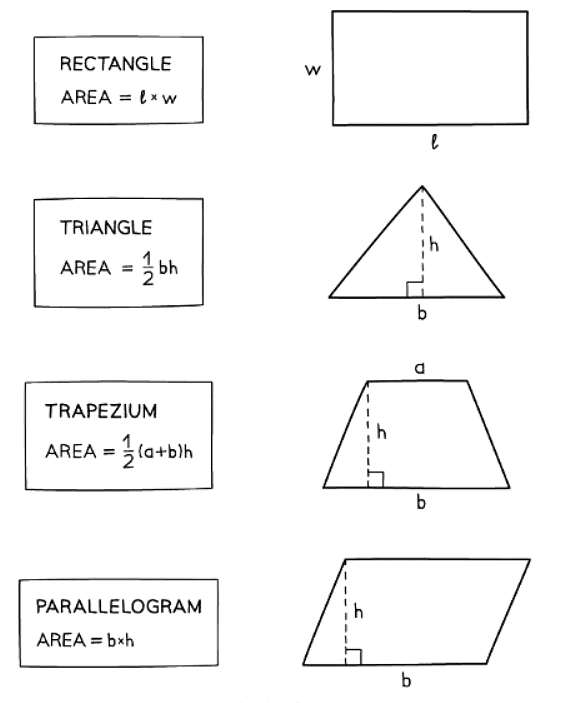
- Note that some area formulas involve distances that may not correspond to one of the shape's sides.
- Understand the meaning of the different letters in each formula.
- Master these fundamental formulas, as more complex ones will be provided during exams:
MULTIPLE CHOICE QUESTIONTry yourself: What is the perimeter of a square with a side length of 5 cm?
The document Area & Perimeter is a part of the Class 10 Course Mathematics for GCSE/IGCSE.
All you need of Class 10 at this link: Class 10
FAQs on Area & Perimeter
| 1. What is the difference between area and perimeter of a 2D shape? |  |
Ans. The perimeter of a 2D shape is the total length of its boundary, while the area is the measure of the space enclosed by the shape.
| 2. How do you calculate the perimeter of a rectangle? | |
Ans. To calculate the perimeter of a rectangle, add up the lengths of all four sides: Perimeter = 2(length + width).
| 3. How can you find the area of a parallelogram using its base and height? | |
Ans. The area of a parallelogram can be calculated by multiplying the base by the height: Area = base x height.
| 4. What is the formula for finding the area of a right-angled triangle? | |
Ans. The area of a right-angled triangle can be found by multiplying the base by the height and dividing by 2: Area = 0.5 x base x height.
| 5. How do you find the missing length of a compound shape when given the total perimeter? | |
Ans. To find the missing length of a compound shape, subtract the sum of the known lengths from the total perimeter.
About this Document

4.89/5 Rating

Apr 29, 2026 Last updated
Related Exams
Document Description: Area & Perimeter for Class 10 2026 is part of Mathematics for GCSE/IGCSE preparation. The notes and questions for Area & Perimeter have been prepared according to the Class 10 exam syllabus. Information about Area & Perimeter covers topics like and Area & Perimeter Example, for Class 10 2026 Exam. Find important definitions, questions, notes, meanings, examples, exercises and tests below for Area & Perimeter.
Introduction of Area & Perimeter in English is available as part of our Mathematics for GCSE/IGCSE for Class 10 & Area & Perimeter in Hindi for Mathematics for GCSE/IGCSE course. Download more important topics related with notes, lectures and mock test series for Class 10 Exam by signing up for free. Class 10: Area & Perimeter
Description
Area & Perimeter of Mathematics covers all the important topics, helping you prepare for the Class 10 exam on EduRev. Start for free!
Information about Area & Perimeter
In this doc you can find the meaning of Area & Perimeter defined & explained in the simplest way possible. Besides explaining types of Area & Perimeter theory, EduRev gives you an ample number of questions to practice Area & Perimeter tests, examples and also practice Class 10 tests



Related Searches
Area & Perimeter, shortcuts and tricks, Viva Questions, pdf , Area & Perimeter, Extra Questions, video lectures, practice quizzes, Objective type Questions, Free, Previous Year Questions with Solutions, MCQs, Important questions, Semester Notes, Exam, Sample Paper, Area & Perimeter, mock tests for examination, study material, Summary, ppt, past year papers;