IGCSE Class 10 > Class 10 Notes > Mathematics for GCSE/ > Pythagoras Theorem
Pythagoras Theorem

What is Pythagoras?
- Pythagoras, an ancient Greek mathematician, lived more than 2500 years ago.
- He is renowned for Pythagoras' Theorem, a fundamental formula for right-angled triangles.
What is Pythagoras' theorem?
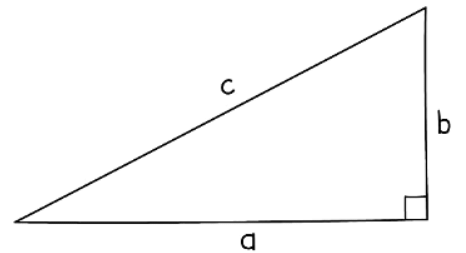
- The longest side in a right-angled triangle is known as the hypotenuse.
- It always stands opposite the right angle.
- If we denote the hypotenuse as 'c' and the other two sides as 'a' and 'b', Pythagoras' Theorem states: a2 + b2 = c2, where a, b, and c represent the lengths of the three sides.
How do I use Pythagoras' theorem?
- To find the length of the hypotenuse use
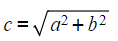
- This is just a rearrangement of the formula a2 + b2 = c2, to make c the subject
- Note that when finding the hypotenuse you add inside the square root
- To find the length of one of the other sides use

- This is a rearrangement of the formula a2 + b2 = c2, to make either a or b the subject
- Note that when finding one of the shorter sides you subtract inside the square root
MULTIPLE CHOICE QUESTIONTry yourself: What is the formula for Pythagoras' Theorem?
The document Pythagoras Theorem is a part of the Class 10 Course Mathematics for GCSE/IGCSE.
All you need of Class 10 at this link: Class 10
FAQs on Pythagoras Theorem
| 1. How can Pythagoras' Theorem be applied in real-life situations? |  |
Ans. Pythagoras' Theorem can be used to calculate distances, such as the length of a ladder leaning against a wall or the diagonal of a square. It is also used in fields such as architecture, engineering, and physics.
| 2. Can Pythagoras' Theorem be used for non-right-angled triangles? | |
Ans. No, Pythagoras' Theorem can only be applied to right-angled triangles where one angle is 90 degrees. For non-right-angled triangles, trigonometry formulas such as the sine rule or cosine rule are used.
| 3. How can Pythagoras' Theorem be proven geometrically? | |
Ans. Pythagoras' Theorem can be proven geometrically using squares constructed on each side of a right-angled triangle. The areas of these squares can be compared to show that the square of the hypotenuse is equal to the sum of the squares of the other two sides.
| 4. What are the key components of a right-angled triangle that Pythagoras' Theorem applies to? | |
Ans. Pythagoras' Theorem applies to right-angled triangles, which have one angle measuring 90 degrees. The sides of the triangle are known as the hypotenuse (the side opposite the right angle) and the two legs (the other two sides).
| 5. How can Pythagoras' Theorem be used to find the length of a side in a triangle? | |
Ans. To find the length of a side in a triangle using Pythagoras' Theorem, identify the two sides that form the right angle (the legs) and the side opposite the right angle (the hypotenuse). Square the lengths of the legs, add them together, and then take the square root to find the length of the hypotenuse.
About this Document

4.74/5 Rating

Apr 29, 2026 Last updated
Related Exams
Document Description: Pythagoras Theorem for Class 10 2026 is part of Mathematics for GCSE/IGCSE preparation. The notes and questions for Pythagoras Theorem have been prepared according to the Class 10 exam syllabus. Information about Pythagoras Theorem covers topics like and Pythagoras Theorem Example, for Class 10 2026 Exam. Find important definitions, questions, notes, meanings, examples, exercises and tests below for Pythagoras Theorem.
Introduction of Pythagoras Theorem in English is available as part of our Mathematics for GCSE/IGCSE for Class 10 & Pythagoras Theorem in Hindi for Mathematics for GCSE/IGCSE course. Download more important topics related with notes, lectures and mock test series for Class 10 Exam by signing up for free. Class 10: Pythagoras Theorem
Description
Pythagoras Theorem of Mathematics covers all the important topics, helping you prepare for the Class 10 exam on EduRev. Start for free!
Information about Pythagoras Theorem
In this doc you can find the meaning of Pythagoras Theorem defined & explained in the simplest way possible. Besides explaining types of Pythagoras Theorem theory, EduRev gives you an ample number of questions to practice Pythagoras Theorem tests, examples and also practice Class 10 tests



Related Searches
mock tests for examination, Summary, shortcuts and tricks, Semester Notes, video lectures, ppt, Objective type Questions, Previous Year Questions with Solutions, Sample Paper, Free, Exam, Pythagoras Theorem, past year papers, Extra Questions, Pythagoras Theorem, Pythagoras Theorem, MCQs, practice quizzes, Viva Questions, pdf , study material, Important questions;