IGCSE Class 10 > Class 10 Notes > Mathematics for GCSE/ > SOHCAHTOA
SOHCAHTOA

What is Trigonometry?
- Trigonometry is the branch of mathematics that deals with angles in triangles.
- It explores the relationships between the side lengths and angles of triangles.
- The term originates from the Greek words "trigonon," meaning 'triangle,' and "metron," meaning 'measure.'
What are Sin, Cos and Tan?
- The fundamental trigonometric functions - Sine, Cosine, and Tangent - originate from the ratios of side lengths within right-angled triangles.
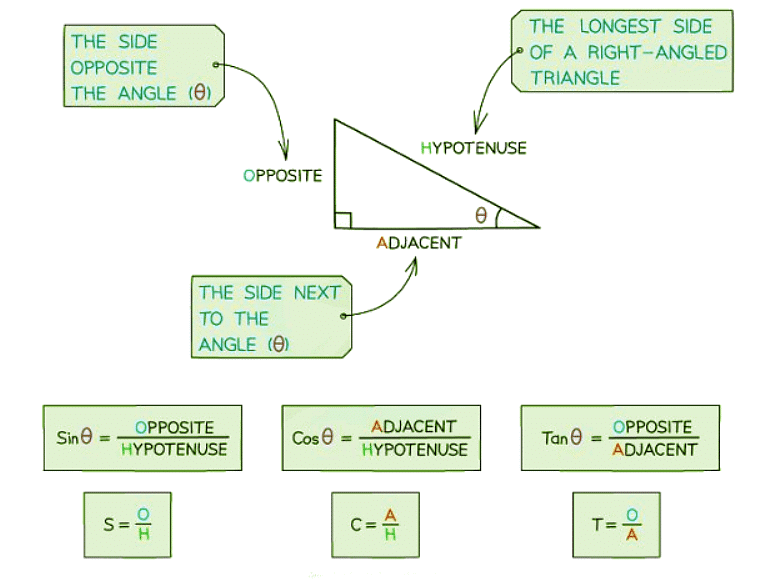
- To comprehend these ratios, it is essential to assign labels to the sides of a right-angled triangle concerning a specified angle:
- The longest side in a right-angled triangle is termed the hypotenuse (H) and always lies opposite the right angle.
- If we designate one of the other angles as θ, the side opposite θ is referred to as the opposite side (O), while the side adjacent to θ is known as the adjacent side (A).
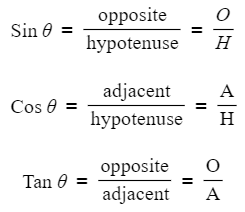
- The functions Sine, Cosine, and Tangent represent the ratios of the lengths of these sides in the following manner.
What is SOHCAHTOA?
- SOHCAHTOA is a helpful mnemonic used in trigonometry to remember trigonometric ratios.
- It stands for:
- Sine is Opposite over Hypotenuse
- Cosine is Adjacent over Hypotenuse
- Tangent is Opposite over Adjacent
- In a right-angled triangle, label one angle other than the right angle and label the sides of the triangles as follows:
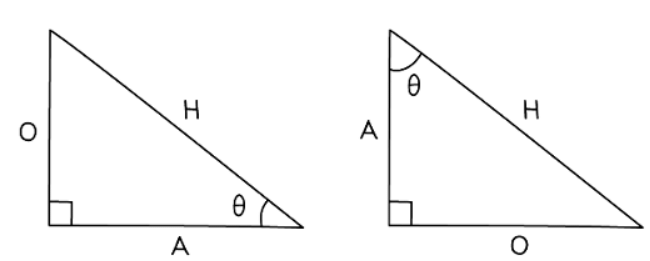
- Note that θ is the Greek letter theta. In a right-angled triangle, consider:
- O = opposite side to angle θ
- A = adjacent side next to angle θ
- H = hypotenuse - 'H' remains constant, while 'O' and 'A' vary based on the angle being referred to.
- Using those labels, the three SOHCAHTOA equations are:
How can we use SOHCAHTOA to find missing lengths?
- If you know the length of one side of a right-angled triangle and one of the angles, you can use SOHCAHTOA to find the lengths of the other sides.
- Start by labeling the sides of the triangle with H (hypotenuse), O (opposite), and A (adjacent).
- Choose the appropriate ratio based on the known values and the value you need to find.
- For example, if you know the angle and the side opposite it (O), and you need to find the hypotenuse (H), use the sine ratio.
- Substitute the known values into the chosen ratio.
- Use your calculator or knowledge of trigonometric exact values to solve for the unknown side.
How can we use SOHCAHTOA to find missing angles?
- If you know two sides of a right-angled triangle, you can utilize SOHCAHTOA to determine the size of one of the angles.
- The missing angles can be found using inverse trigonometric functions:

- After selecting the appropriate ratio and substituting the values, apply inverse trigonometric functions either using a calculator or trigonometric exact values to obtain the correct angle measurement.
Do sin, cos and tan work with obtuse angles?
- Your calculator or knowledge of trigonometric exact values can assist in finding sine, cosine, and tangent of any angle.
- Certain patterns can be helpful, particularly when determining obtuse angles:
- sin(x) = sin(180° - x)
- For example, sin(150°) = sin(180° - 150°) = sin(30°)
- cos(x) = -cos(180 - x)
- For example, cos(150°) = -cos(180° - 150°) = -cos(30°)
- tan(x) = -tan(180 - x)
- For example, tan(150°) = -tan(180° - 150°) = -tan(30°)
- Exercise caution when dealing with obtuse angles; calculators typically provide the acute angle, so apply the rules above to obtain the correct obtuse angle.
How do I find the shortest distance from a point to a line?
- The most direct route from any point to a line is always the perpendicular distance.
- Construct a right-angled triangle with the point, the perpendicular distance, and a point on the line, then utilize SOHCAHTOA to calculate the distance effectively.
MULTIPLE CHOICE QUESTIONTry yourself: What does the acronym SOHCAHTOA stand for in trigonometry?
The document SOHCAHTOA is a part of the Class 10 Course Mathematics for GCSE/IGCSE.
All you need of Class 10 at this link: Class 10
About this Document

4.87/5 Rating

Apr 21, 2026 Last updated
Related Exams
Document Description: SOHCAHTOA for Class 10 2026 is part of Mathematics for GCSE/IGCSE preparation. The notes and questions for SOHCAHTOA have been prepared according to the Class 10 exam syllabus. Information about SOHCAHTOA covers topics like and SOHCAHTOA Example, for Class 10 2026 Exam. Find important definitions, questions, notes, meanings, examples, exercises and tests below for SOHCAHTOA.
Introduction of SOHCAHTOA in English is available as part of our Mathematics for GCSE/IGCSE for Class 10 & SOHCAHTOA in Hindi for Mathematics for GCSE/IGCSE course. Download more important topics related with notes, lectures and mock test series for Class 10 Exam by signing up for free. Class 10: SOHCAHTOA
Description
SOHCAHTOA of Mathematics covers all the important topics, helping you prepare for the Class 10 exam on EduRev. Start for free!
Information about SOHCAHTOA
In this doc you can find the meaning of SOHCAHTOA defined & explained in the simplest way possible. Besides explaining types of SOHCAHTOA theory, EduRev gives you an ample number of questions to practice SOHCAHTOA tests, examples and also practice Class 10 tests



Related Searches
study material, Extra Questions, Exam, past year papers, SOHCAHTOA, mock tests for examination, Summary, Important questions, Semester Notes, pdf , Objective type Questions, practice quizzes, MCQs, ppt, video lectures, Free, Previous Year Questions with Solutions, SOHCAHTOA, Sample Paper, Viva Questions, shortcuts and tricks, SOHCAHTOA;