How to Participate in Science Olympiad


Introduction to NSO
The National Science Olympiad (NSO) is an engaging competition organized by the Science Olympiad Foundation (SOF) for students in grades 1 to 10. The primary focus of NSO is to develop logical and numeracy skills in a fun and enjoyable manner. This competition aims to boost students' confidence, enhance their logical reasoning abilities, and equip them with the skills to tackle challenging problems.

Objectives of NSO
The main objectives of the National Science Olympiad are:
- To stimulate scientific curiosity among students
- To enhance logical reasoning and analytical skills
- To promote a deeper understanding of scientific concepts
- To identify and nurture young scientific talent
- To prepare students for higher-level competitive examinations
- To encourage healthy academic competition
NSO 2026-2027 Eligibility Criteria
To appear for the NSO, students must fulfill the following conditions:
- Students must be studying in Classes 1 to 10.
- They must belong to a recognized education board such as CBSE, ICSE, or State Boards.
- Registration must be done only through the school.
- Individual registrations are not accepted.
- The school must be registered with the Science Olympiad Foundation (SOF).
- Science is a compulsory subject for participation.
Steps to Participate in the National Science Olympiad (NSO)
To participate in the NSO, students need to follow these steps:
- Eligibility: Students from classes 1 to 10 are eligible to participate in the NSO.
- Registration Forms: These forms are sent to all schools that are registered with the Science Olympiad Foundation (SOF).
- For Unregistered Schools: Schools not registered with SOF can request prospectuses by emailing info@sofworld.org or by calling the foundation.
Completing and Returning Forms:
- After filling out the registration forms, schools must send them to SOF by the specified deadline.
Roll Numbers:
- The school's coordinating teacher is responsible for filling out the School Registration Form (SRF) and the Students' Registration Sheet (SRS) as per the guidelines provided.
- These forms need to be submitted to SOF's office before the deadline.
- Once SOF receives the SRS from the school, they will register the school and its students and issue roll numbers for all participating students.
Registration Fee Details:
- For Schools in India, Bangladesh, Bhutan, and Nepal:. registration fee of Rs 125 per student per Olympiad is required, which includes GST. Schools may charge an additional Rs 25 per student for in-charge honorarium, teacher remuneration, and other expenses.
- For Schools Outside India, Bangladesh, Bhutan, and Nepal: The registration fee is US$ 9 per student per Olympiad, with an extra US$ 1 per student for related expenses.
Fee Exemption:
- Students with major physical disabilities or Indian students whose parents were martyred during defense operations are exempt from registration fees.
No Individual Registrations:
- Individual student registrations are not accepted for the NSO. Students must register through their respective schools to participate.
Exam Pattern and Syllabus
Pattern
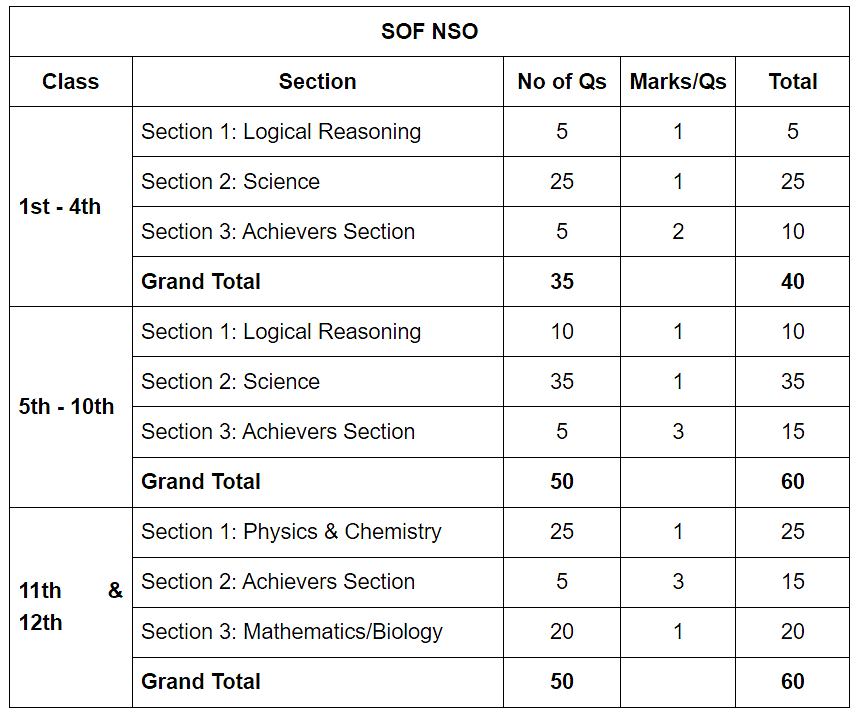
The NSO exam is divided into three stages for students.
- Section I tests Verbal and Non-Verbal Reasoning for grades 1 to 5.
- Section II focuses on Science topics as per the syllabus.
- Section III includes questions that require higher-order thinking, with increasing difficulty by grade.
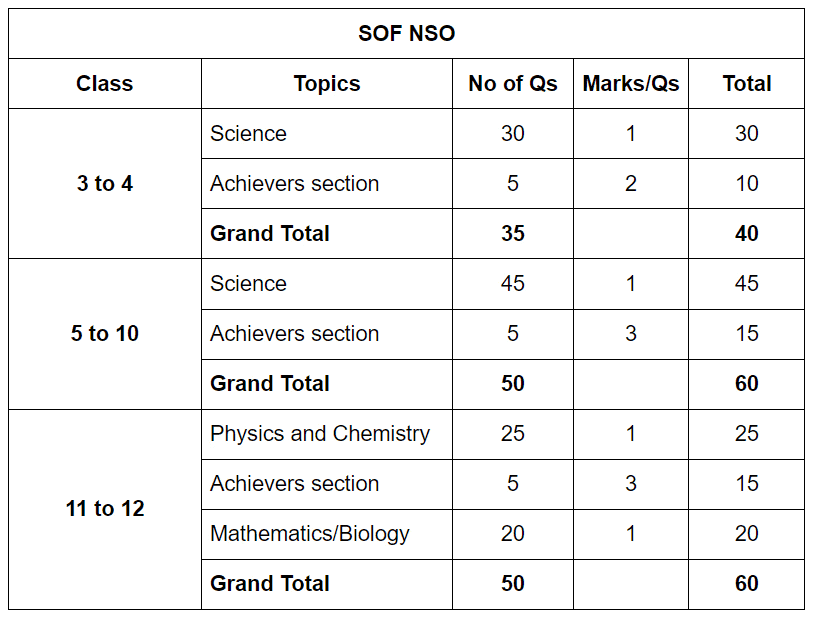
- The question paper has 35 objective-type questions for Classes 1 to 4 and 50 for Classes 5 to 10.
- Duration: Students have 60 minutes to complete the exam.
Marking Scheme and Syllabus
- There is no negative marking.
- Logical Reasoning (Section - 1): Patterns, Analogy and Classification, Geometrical Shapes, Mirror and Water Images, Direction Sense Test, Ranking Test, Alphabet Test, Logical Sequence of Words, Puzzle Test, Coding-Decoding, Clock and Calendar.
- Science Section (Section - 2): Animals, Human Body and Health, Plants, Natural Resources and Indian Heritage, Pollution and Calamities, Earth and Universe, Matter and Materials, Force and Energy.
- Achiever's Section (Section 3): This section may include questions aimed at assessing a student's understanding of the syllabus topics.
NSO Exam Pattern for Class 5 (Level 1)
NSO Exam Pattern for Class 5 (Level 2)
Benefits of Science Olympiad
The Science Olympiad is a prestigious competition that encourages students to explore and engage with scientific concepts in a competitive environment. It provides an opportunity for students to showcase their skills and knowledge across various scientific domains.

- Improved Problem-Solving Skills: Students are pushed to think critically and tackle intricate problems, enhancing their reasoning capabilities in science.
- Deeper Understanding of Scientific Concepts: Preparing for the Olympiads often requires a broader understanding of mathematical principles than what is covered in regular classes, leading to a more profound comprehension of the subject.
- Enhanced Academic Performance: The knowledge and skills acquired from preparing for the Olympiads can boost performance in school subjects like mathematics.
- Preparation for Higher Education: Participating in Olympiads can be a valuable experience for students aspiring to study STEM subjects in university, providing a strong foundation in advanced mathematics.
- Networking Opportunities: Olympiads connect students with like-minded individuals, allowing them to meet peers, mentors, and professionals in mathematics.
- International Exposure: Many Olympiads, such as the National Science Olympiad (NSO), offer opportunities for international travel and cultural exchange, broadening students' horizons.
- Boosted Self-Confidence: Successfully solving challenging problems and competing can enhance a student's confidence in their mathematical abilities and overall academic skills.
- Enhanced Time Management: Preparing for Olympiads instills effective time management and organizational skills, which are beneficial in various aspects of life.
To participate in the Science Olympiad, students need to register through their school or the official NSO website. Eligibility typically requires being a Class 5 student with an interest in mathematics and science. These benefits, coupled with the personal growth and intellectual development gained from participating in these competitions, make them highly rewarding for students.
Preparation Tips and Tricks
View this as an exciting adventure into the world of numbers and logic, rather than just a test. With enthusiasm and dedication, you can approach it effectively and enjoy the process of learning and problem-solving.
To help you on this journey, here are some useful tips and tricks:
Preparation:
- Understand the syllabus thoroughly and aim to cover topics daily.
- Choose a consistent time and place for studying to establish a routine.
- Focus on learning with a strong understanding of concepts.
- Take notes while studying, using bullet points or mind maps to organise information, and highlight key points for easier revision.
- After completing the syllabus, practice chapter-wise questions and mock tests to identify strengths and weaknesses.
- Once confident, attempt previous years' question papers to understand the exam pattern and improve time management, speed, and accuracy.
Exam Strategies:
- Stay calm and focused. Take deep breaths and read instructions carefully.
- Manage your time effectively, allocating time for each section based on strengths and the number of questions.
- Read questions carefully, analysing them before attempting answers and identifying keywords.
- Use the elimination method by removing incorrect options if unsure about an answer.
- Double-check answers to avoid mistakes before submitting.
Bonus Tips:
- Stay curious! Experiment, ask questions, and explore the world of numbers and logic.
- Make Science enjoyable by using digital whiteboards and interactive problem-solving platforms for calculating distances, travel times, and costs for trips.
- Believe in yourself. Trust in your preparation and give your best effort.
Remember:
- The Science Olympiad is challenging but rewarding; focus on learning and enjoying the experience.
- Celebrate your achievements, learn from mistakes, and keep your passion alive.
FAQs on How to Participate in Science Olympiad
| 1. What is the National Science Olympiad (NSO) and who can participate? |  |
| 2. What are the steps to register for the NSO? | |
| 3. What is the exam pattern and syllabus for Class 5 in the NSO? | |
| 4. What are the benefits of participating in the Science Olympiad? | |
| 5. How can students prepare effectively for the NSO? | |