Plate Girder in Steel Structures

What are plate girders in steel structure?
In steel structures, plate girders are specialized beams designed to support substantial vertical loads over long spans, handling bending moments that exceed the capacity of rolled sections. The most prevalent type is the composite plate girder, constructed from shapes and plates. These girders feature an I-shaped section, with two flange plates welded to a web plate.- The web is designed to resist shear forces, while the upper and lower flanges handle the compressive and tensile forces along the axis due to bending moments. This structural behavior is often the basis for design codes used in construction. Plate girders are particularly common in modern bridge architecture, with main spans exceeding 200 meters and cross-sectional depths at the supports typically ranging from 5 to 10 meters.
- To reduce design and fabrication costs, the flange area for a given moment can be minimized by increasing the distance between flanges. Additionally, to lighten the girder, the web is made thinner as the depth increases, although this can lead to web buckling issues more frequently than in rolled sections.
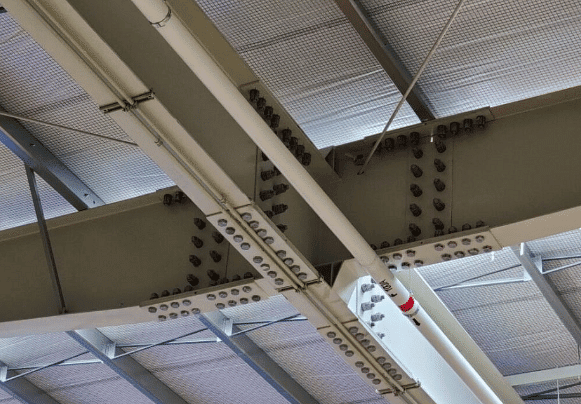
Structure of plate girders
The structure of a plate girder includes the following components:Web: The central vertical plate in a steel plate girder, known as the web, provides the necessary separation between the two flange plates. Its primary role is to withstand shear forces in the girder.
Flanges: These horizontal components, located above and below the web, resist the bending moments acting on the girder. The upper flange handles compressive forces, while the lower flange handles tensile forces. Both need adequate width and thickness to withstand these forces effectively.
Stiffeners: These elements reinforce the girder and prevent localized buckling. They also help distribute loads throughout the beam. Stiffeners come in two types: vertical and horizontal.
Splices for Flange and Web: Splice connections are necessary when the girder length is shorter than the span. These connections transfer bending moments and shear forces across the girder.
End Lap Joints: Designing end lap joints is challenging. In continuous structures, connecting details must be installed correctly. Typically, plate girders are supported at the end bearing, and stiffener plates assist in these connections.
Classifications of Plate Girders in Steel Structures
1. Riveted Plate Girders:- Riveted plate girders use mechanical methods, such as rivets and plates, instead of welding.
- The web bears 90% of the shear force in these girders.
- The angled section is attached to the flange to stabilize the connection between the web and flange.
- Rivets are designed to withstand horizontal shear forces, particularly where the angled section connects the web to the flange, as they must endure both horizontal shear forces and vertical loads.
2. Welded Plate Girders:
- Welded plate girders are favored in construction for their ease of fabrication and efficiency.
- They are mainly used in bridge construction, including railway bridges, due to their rigidity and ability to handle high loads and resist lateral movements.
- Welded plate girders can also be used to create box girders.
- Engineers can determine the overall height, flange width, and web thickness of welded plate girders through experiments or estimation methods.
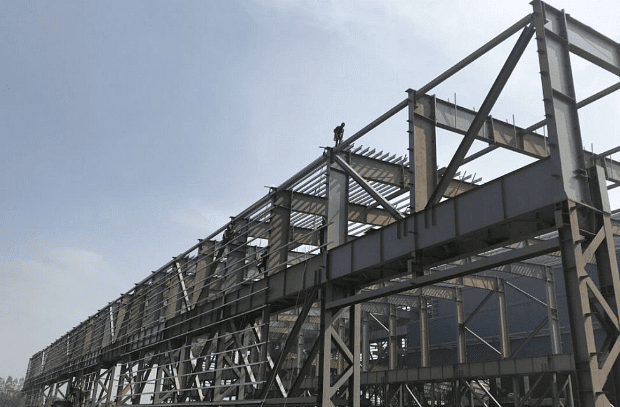
Design of Plate Girders
Assumptions in Plate Girder Design- Shear Force: Entirely carried by the web with uniform shear stress across all depths of the girder.
- Stress Distribution:
- The stress intensity on the inner flange corners and flange plate is the same.
- Stress intensity in the web varies, reaching maximum near the upper edge, equalizing at the flange plates or corners, and zero at the neutral axis.
Minimum Thickness
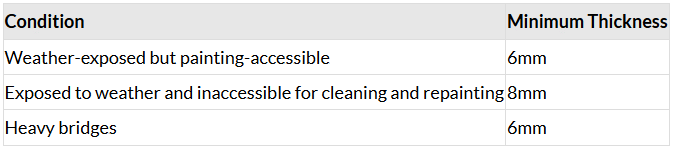
The web panel dimensions, where t is the thickness of the web plate, should be between 270t and 180t.
Self-Weight Standards
- Riveted Plate Girder: W/300 per meter run
- Welded Plate Girder: W/400 per meter run
- W is the total imposed load with factors.
Economical Depth
- Cost-effective Depth:

- Depth Over Angles for Riveted Plate Girders:

- Overall Depth for Welded Plate Girders:

Where:
- M = Bending moment in N-mm
- f = Permissible stress in MPa
- t = Plate thickness in mm
Applications of Plate Girders
Plate girders are widely used as structural supports in various applications, particularly in bridge construction. Common applications include:
Bridges:
- Railway bridges
- Road bridges
- Box girder bridges
- Truss bridges
- Military composite bridges
- Half-through plate girder bridges
Other Structures:
- Cranes
- Lifting structures
- Oil and gas platforms
- Load testing structures
- Ships
- Gantry beams
When using plate girder structures in construction, it's essential to collaborate with reputable and skilled organizations to ensure project quality. For instance, Pebsteel is a global enterprise specializing in high-quality pre-engineered steel building and steel structure solutions. They offer comprehensive, professional services with a customer-centric approach and a team of skilled engineers.
FAQs on Plate Girder in Steel Structures
| 1. What are plate girders in steel structure? |  |
| 2. What is the structure of plate girders? | |
| 3. How are plate girders classified in steel structures? | |
| 4. How are plate girders designed in steel structures? | |
| 5. What are some frequently asked questions about plate girders in steel structures for UPSC exam preparation? | |




