Reasoning: Concepts and Types

Key Concepts
Reasoning, one of the highest orders of thinking, is the stepwise thinking and mental recognition of cause and effect relationships. Reasoning involves productive thinking in which insight and past experiences are required. Reasoning is a factor of intelligence.
- Reasoning is a process in which pre-knowledge, experiences, insight, and understanding of relationships are used to solve problems.
- The ability to reason is closely related to intelligence and is always goal-oriented.
- Reasoning is creative, reflective in nature, and develops gradually with experiences contributing to the development of reasoning power.
- There may be more than one logic to draw an inference, making reasoning multi-dimensional.
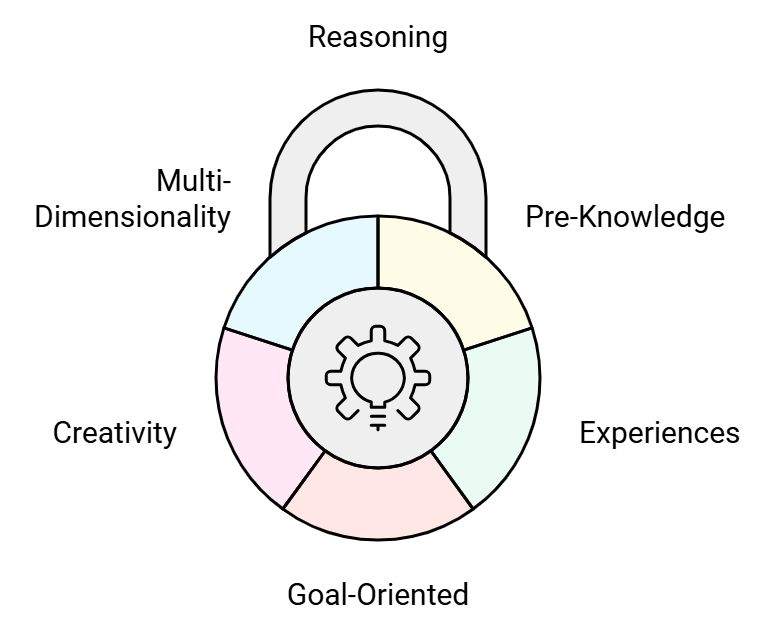
Reasoning is a cognitive process that involves the systematic thinking and mental recognition of cause-and-effect relationships. It requires insight, past experiences, and an understanding of relationships to solve problems effectively. This ability is closely intertwined with intelligence and is always directed towards achieving a specific goal. Additionally, reasoning is characterized by its creative and reflective nature, evolving gradually with experiences playing a crucial role in enhancing reasoning capabilities.
Types of Reasoning
Aristotle provided an extensive and systematic explanation of the methods of human reasoning.
He outlined three main methods: deductive, inductive, and abductive reasoning.
1. Deductive Reasoning
This type of reasoning, also known as analytical reasoning, involves examining objects by studying their component parts.
- Formal logic is often referred to as the science of deduction.
- When utilizing deductive reasoning, individuals start with general premises or principles and derive specific conclusions based on those premises.
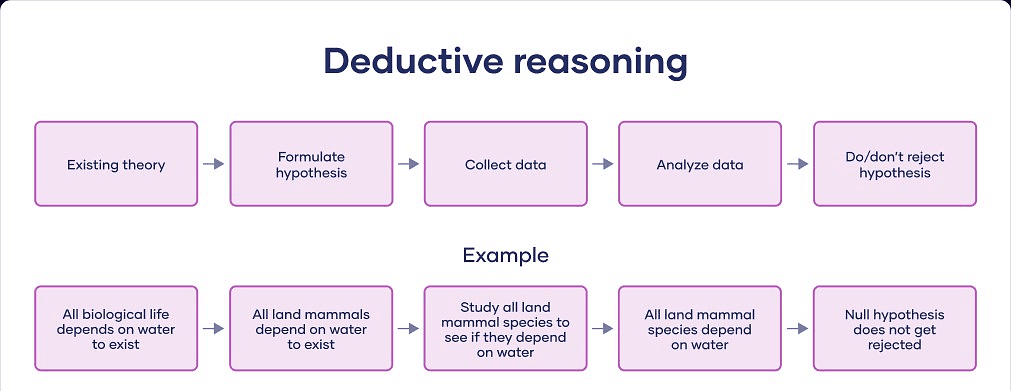
- It is a top-down approach where the conclusions logically follow from the given premises.
- Deductive reasoning involves deriving specific conclusions from general principles.
- It is characterized by moving from the general to the specific.
- Formal logic is closely associated with deductive reasoning.
2. Inductive Reasoning
Inductive reasoning is a powerful cognitive tool that enables individuals to infer general principles from specific observations, fostering a deeper understanding of the world around us and facilitating logical decision-making processes.
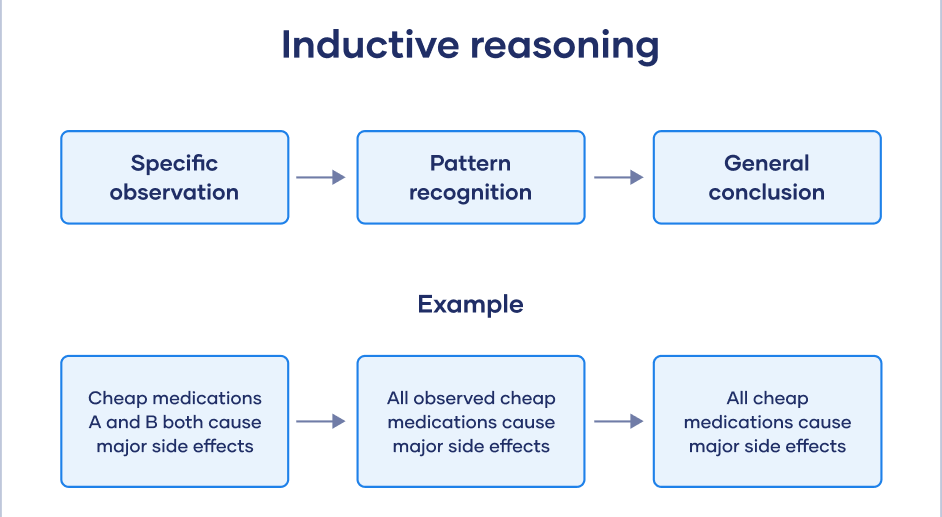
- Focuses on identifying common properties within a group of objects.
- By utilizing inductive reasoning, individuals can make generalized conclusions based on specific observations, allowing for the derivation of broader principles from specific instances.
- This approach contrasts with deductive reasoning, which moves from general principles to specific instances.
- Elaboration: Inductive reasoning plays a crucial role in various fields, including scientific research, problem-solving, and everyday decision-making. It involves moving from specific observations to broader generalizations, which can be used to predict future outcomes or understand patterns in data.
- Importance: Understanding inductive reasoning is fundamental for developing strong analytical skills and forming logical arguments. By recognizing patterns and regularities in specific instances, individuals can draw conclusions that extend beyond the information initially provided.
- Application: In academic settings, inductive reasoning is often used to analyze data, formulate hypotheses, and draw conclusions based on empirical evidence. It is a valuable tool for researchers, scholars, and critical thinkers seeking to make sense of complex information.
3. Abductive Reasoning
Abductive reasoning is considered as the third form of reasoning. It is somewhat similar to inductive reasoning. It takes its clues from the term 'guessing', since conclusions drawn here are based on probabilities.
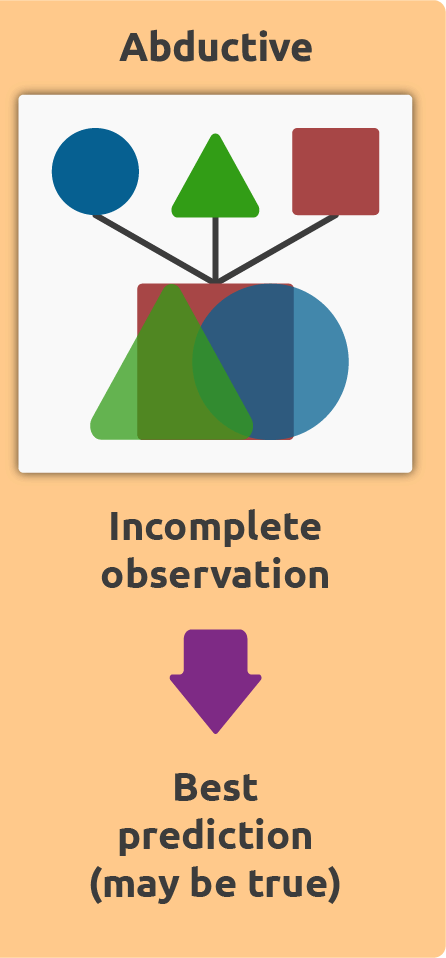 Abductive Reasoning
- Abductive reasoning is the third form of reasoning.
- It is akin to inductive reasoning and relies on probabilities.
- It presumes the most plausible conclusion is correct.
- Abductive reasoning involves forming conclusions based on incomplete information.
- It is not commonly utilized in psychometric testing.
FAQs on Reasoning: Concepts and Types
| 1. What's the difference between deductive and inductive reasoning for UGC NET exams? |  |
| 2. How do I identify logical fallacies in reasoning questions? | |
| 3. What exactly is analogical reasoning and why does it appear in UGC NET? | |
| 4. Can abductive reasoning really help me solve tricky UGC NET Mathematical Reasoning problems? | |
| 5. How should I approach categorical syllogisms to score better on UGC NET reasoning sections? | |