UPSC Exam > UPSC Notes > Civil Engineering Optional > Counterfort Retaining Wall
Counterfort Retaining Wall

Overview
A counterfort retaining wall is a reinforced concrete structure used in construction to prevent the intrusion of soil, groundwater, or rock into a designated area. Designed to resist lateral pressures from earth or water, counterfort walls are typically employed where significant quantities of soil need to be retained, space is limited, or a flat surface is required at the top of the wall.Purpose
The primary purpose of a counterfort retaining wall is to provide structural stability in areas prone to soil erosion or land movement. By transferring the lateral pressure from the retained soil to the wall's foundation, the counterfort retaining wall ensures the soil remains stable and prevents the wall from collapsing. This is crucial in protecting infrastructure such as highways, railroads, bridges, and buildings from natural phenomena like soil erosion, landslides, or floodwater erosion.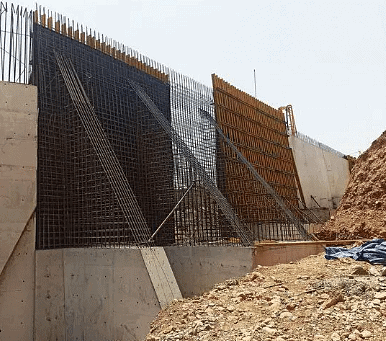
Construction
The construction of a counterfort retaining wall involves several steps:- Reinforced Concrete Base: A concrete footing is poured to serve as the foundation.
- Counterforts Installation: Vertical concrete columns called counterforts are cast on the back of the wall, spaced equally apart.
- Monolithic Joint: The wall and counterforts are cast together to form a monolithic structure.
- Horizontal Beams: Horizontal concrete beams are placed between the counterforts and the wall to help transfer the load towards the counterforts.
- Finishing: The wall's face is typically finished with materials such as decorative stone or a smooth concrete surface.
Advantages
Counterfort retaining walls offer several benefits:- High Load Capacity: Their reinforced concrete structure enables them to withstand higher loads than other retaining wall types.
- Durability: They have a long lifespan, reducing the need for frequent repairs and maintenance.
- Space Efficiency: They occupy less space compared to other retaining walls, making them ideal for areas with limited available space.
- Aesthetic Appeal: The design allows for the use of various materials, enhancing the visual appeal and blending with the surrounding environment.
- Flexibility: They can be designed in various heights and lengths to meet specific project requirements.
Conclusion
Counterfort retaining walls are effective solutions for stabilizing soil and preventing geological hazards. Their structural design, involving counterforts and reinforced bases, provides additional strength and load transfer capabilities. With advantages such as high load capacity, durability, minimal land use, aesthetic appeal, and design flexibility, counterfort retaining walls are suitable for critical infrastructure projects where soil stability and erosion prevention are essential.The document Counterfort Retaining Wall is a part of the UPSC Course Civil Engineering Optional for UPSC.
All you need of UPSC at this link: UPSC
FAQs on Counterfort Retaining Wall
| 1. What is a counterfort retaining wall? |  |
Ans. A counterfort retaining wall is a type of structure used to support soil on one side and resist lateral pressure. It consists of a series of vertical concrete wall panels (counterforts) connected to a horizontal base slab and a top slab.
| 2. How does a counterfort retaining wall differ from other types of retaining walls? | |
Ans. Counterfort retaining walls differ from other types like gravity walls or cantilever walls in that they use counterforts, which are buttresses located on the side opposite the retained soil. These counterforts help to distribute the lateral pressure more effectively.
| 3. When is a counterfort retaining wall typically used in construction projects? | |
Ans. Counterfort retaining walls are commonly used in situations where the soil is softer and the lateral pressure is higher, such as in highway embankments, bridge abutments, or large commercial developments.
| 4. What are the advantages of using a counterfort retaining wall? | |
Ans. Some advantages of counterfort retaining walls include their ability to withstand high lateral pressures, their cost-effectiveness for high walls, and their relative ease of construction compared to other types of retaining walls.
| 5. What are the key design considerations for a counterfort retaining wall? | |
Ans. Design considerations for a counterfort retaining wall include determining the height of the wall, the spacing and size of the counterforts, the type of soil being retained, and any additional reinforcements needed for stability.
About this Document

4.88/5 Rating

Apr 30, 2026 Last updated
Related Exams
Document Description: Counterfort Retaining Wall for UPSC 2026 is part of Civil Engineering Optional for UPSC preparation. The notes and questions for Counterfort Retaining Wall have been prepared according to the UPSC exam syllabus. Information about Counterfort Retaining Wall covers topics like and Counterfort Retaining Wall Example, for UPSC 2026 Exam. Find important definitions, questions, notes, meanings, examples, exercises and tests below for Counterfort Retaining Wall.
Introduction of Counterfort Retaining Wall in English is available as part of our Civil Engineering Optional for UPSC for UPSC & Counterfort Retaining Wall in Hindi for Civil Engineering Optional for UPSC course. Download more important topics related with notes, lectures and mock test series for UPSC Exam by signing up for free. UPSC: Counterfort Retaining Wall
Description
Counterfort Retaining Wall of Civil Engineering Optional covers all the important topics, helping you prepare for the UPSC exam on EduRev. Start for free!
Information about Counterfort Retaining Wall
In this doc you can find the meaning of Counterfort Retaining Wall defined & explained in the simplest way possible. Besides explaining types of Counterfort Retaining Wall theory, EduRev gives you an ample number of questions to practice Counterfort Retaining Wall tests, examples and also practice UPSC tests



Related Searches
Objective type Questions, Semester Notes, ppt, past year papers, Important questions, Counterfort Retaining Wall, Extra Questions, Viva Questions, Summary, Counterfort Retaining Wall, Exam, Counterfort Retaining Wall, Sample Paper, MCQs, video lectures, pdf , Free, mock tests for examination, Previous Year Questions with Solutions, shortcuts and tricks, practice quizzes, study material;