NCERT Solutions: A Bottle of Dew


Let us do these activities before we read
1. Circle the picture that matches with each word. Check your answers by sharing them with your classmates and teacher.
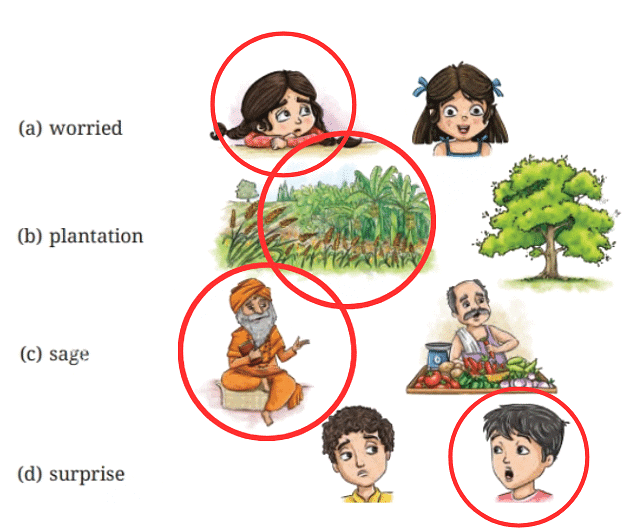
2. Answer these questions and discuss them with your classmates and teacher.
(a) Think of a time when you worked hard. What did you do then?
Ans: When I worked hard, I spent many hours studying for my exams. I made sure to review all my notes, practice problems, and ask my teacher for help with topics I didn't understand.
(b) How did it help you?
Ans: It helped me understand the subjects better and perform well in my exams. My hard work paid off when I saw good grades, which made me feel proud of my efforts.
(c) How did it make you feel?
Ans: It made me feel accomplished and happy. Knowing that my hard work led to success was very satisfying and motivated me to continue working hard in the future.
Let us discuss (Page 3)
Ans: Rama Natha believed that there was a magic potion that could turn any object into gold.
Q2: How did the sage help Rama Natha?
Ans: The sage Mahipati tricked Rama Natha into working hard by telling him to collect five litres of dew, making him plant and tend banana plants, which eventually made him wealthy through hard work.
Q3: Do you think Rama Natha will be able to collect the dew? Give a reason.
Ans: No, it is highly unlikely because collecting five litres of dew manually would take an enormous amount of time, far beyond just a few winter months.
Let us discuss (Page 5)
Q1. Why was Rama Natha angry?
Ans: Rama Natha was angry because he realized that the sage had tricked him, making him believe in a non-existent magic potion after he had spent six years collecting dew.
Q2. How did Rama Natha and Madhumati create wealth?
Ans: Rama Natha and Madhumati created wealth by planting and tending banana plants. Madhumati sold the banana produce in the market, generating income.
Let us think and reflect (Page 6)
1. Read the following lines and answer the questions that follow.
(a) He spent all his time to learn about the magic potion. People cheated him often, promising to tell him about it, but he did not give up. His wife, Madhumati, was tired of this and also worried because she saw how much money Rama Natha was spending. She was sure that soon they would be without money.
(i) Complete the sentence with a suitable reason. Rama Natha did not 'give up' because ____________.
Ans: Rama Natha did not 'give up' because he was determined to find the magic potion that could turn objects into gold.
(ii) Read the column which shows 'what happened' and write the correct outcome in the next column.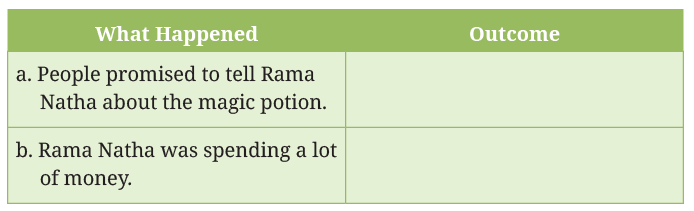 Ans:
Ans:
- What Happened: People promised to tell Rama Natha about the magic potion.
Outcome: He was often cheated by people claiming to know the secret. Despite being tricked, he did not give up on his search for the potion. - What Happened: Rama Natha was spending a lot of money.
Outcome: His wife, Madhumati, became worried about their finances. This concern motivated them to start working on the land and eventually led to creating real wealth through the banana plantation.
(iii) Write whether the following statements are True or False.
(a) Madhumati was troubled about what her husband did.
Ans: True
(b) Rama Natha was very happy digging his fields.
(Ans: False
(c) The sage wanted to show the right path to Rama Natha.
Ans: True
(b) Carefully, he took the bottle to the sage. The sage smiled and muttered something over the water. Then he returned the bottle and said, "Try it out." Rama Natha sprinkled a few drops on a copper vessel and waited for it to turn to gold. To his surprise nothing happened!
(i) Choose the option that lists the events given below in the correct order.
a. The sage smiled.
b. Rama Natha gave the bottle to the sage.
c. Rama Natha dropped a few drops of water on a copper vessel.
d. He said something in a low voice over the water.
e. Rama Natha waited to see if the magic worked.
1. a, e, d, b, c
2. b, a, d, c, e
3. c, d, a, b, e
4. a, d, b, e, c
Answer:
2. b, a, d, c, e
(ii) Fill in the blank with the correct word from the lines given above.
Seeing that the plant had dried up, the gardener ____________ some water on it.
Ans: sprinkled
(iii) How might Rama Natha have felt when nothing happened to the copper vessel?
Ans: Rama Natha might have felt disappointed and cheated when nothing happened to the copper vessel.
(a) What did the sage ask Rama Natha to do to make the magic potion?
Ans: The sage asked Rama Natha to plant banana plants and collect five litres of dew from the leaves over the winter months.
(b) Why did the sage ask Rama Natha to do everything himself?
Ans: The sage wanted Rama Natha to work hard and realize that wealth comes from hard work, not magic.
(c) How could Rama Natha have a big banana plantation after six years?
Ans: Rama Natha could have a big banana plantation after six years because he diligently planted and tended to many banana plants, increasing their number over time.
(d) How did the sage make Rama Natha believe that there is no magic potion?
Ans: The sage made Rama Natha believe there is no magic potion by showing him that his hard work in planting and selling bananas had created wealth, not a magic potion.
(e) Fill in the 'before' and 'after' table about Rama Natha.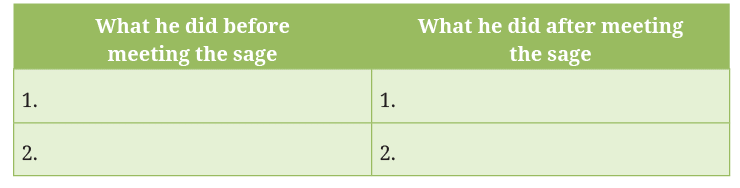

Let us learn (Page 8)
1. Read the following words from the story.
Use the words correctly to complete the paragraph given below. There are two extra words in the box that you do not need.
There was a farmer who had a ________________ coconut plantation. He worked hard and did not depend on ________________. Every day was _______________ but he did not give up. One day, a man bought a bag of coconuts from him, and ________________ to pay him the money the next day. Days passed and the man did not pay him anything. The farmer felt ________________. About two months later, he met the same man and asked him about his money. The man said, "Oh! I had forgotten. Now, I ________________ buying coconuts from you." And he paid the money.
Ans: There was a farmer who had a huge coconut plantation. He worked hard and did not depend on luck. Every day was difficult but he did not give up. One day, a man bought a bag of coconuts from him, and promised to pay him the money the next day. Days passed and the man did not pay him anything. The farmer felt cheated. About two months later, he met the same man and asked him about his money. The man said, "Oh! I had forgotten. Now, I remember buying coconuts from you." And he paid the money.
2. Read the words from the story in Column A. Read the new words in Column B. Complete the meanings of the words given in Column B. Meanings of some words are given. 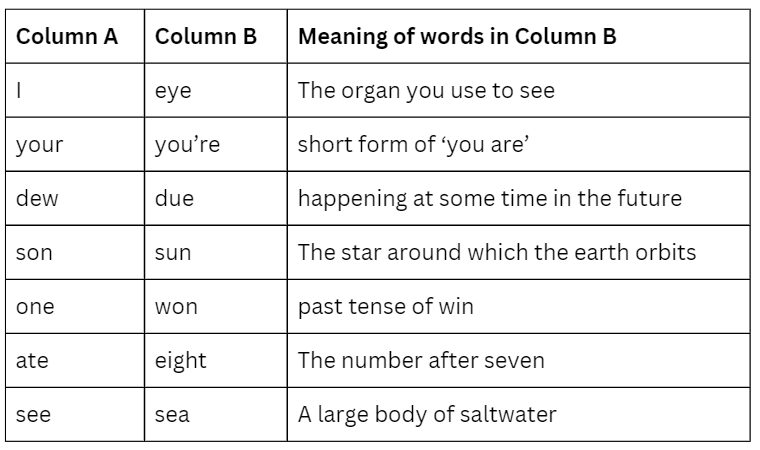
3. Choose four pairs of homophones from the table above, and for each pair write a sentence that uses both homophones in the same sentence. Check your answers by sharing them with your teacher and classmates. An example has been given below:
I ate eight bananas for breakfast today.
Ans:
- The sun is shining bright, but my son is still sleeping.
- She won the race and became the number one.
- Sea the difference between right and wrong.
- The farmer collected the dew early in the morning, which was due to the weather conditions.
4. Match the phrases in Column A with the phrases in Column B. Use the connecting words given in the middle column to make meaningful sentences.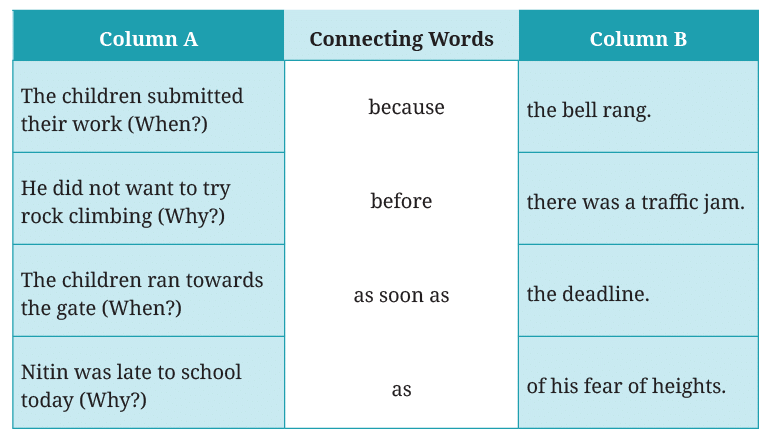 Ans:
Ans: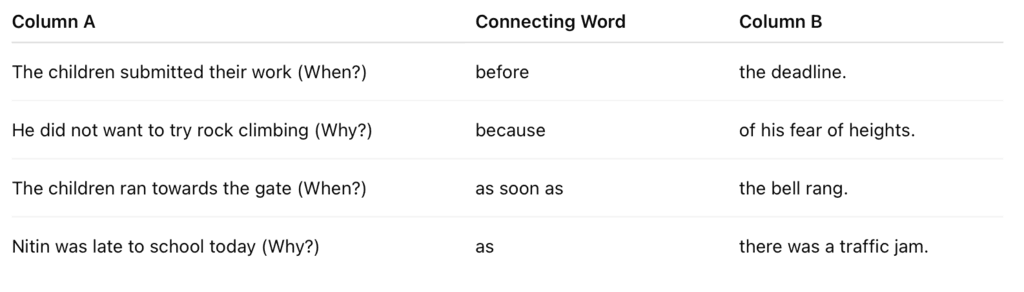
Now, write the new sentences in your notebook.
Let us listen (Page 10)
You will listen to what Madhumati does with the bananas in her plantation. As you listen, number the events in the correct order in which they happen. Write the number in the box beside each event. (refer to page 36 for transcript)
(a) Gives two bananas to a boy who is hungry
(b) Meets her friend Kalawati in the market
(c) Visits her mother and gives her two dozen bananas
(d) Chooses to go home as only some bananas were left
(e) Visits her neighbour and gifts them a bunch of bananas
(f) Gives twelve bananas to her friend
(g) Goes to the market to sell the bananas
Ans: Correct order of events is as follows:
c-->g-->b-->f-->d-->a-->e.
(c) Visits her mother and gives her two dozen bananas - 1
(g) Goes to the market to sell the bananas - 2
(b) Meets her friend Kalawati in the market - 3
(f) Gives twelve bananas to her friend - 4
(d) Chooses to go home as only some bananas were left - 5
(a) Gives two bananas to a boy who is hungry - 6
(e) Visits her neighbour and gifts them a bunch of bananas - 7
FAQs on NCERT Solutions: A Bottle of Dew
| 1. What is the main message or theme in "A Bottle of Dew" for Class 6 English? |  |
| 2. Who are the main characters in "A Bottle of Dew" and what do they represent? | |
| 3. Why does the bottle of dew become so important to the character in this Class 6 NCERT story? | |
| 4. What is the symbolism of nature elements like dew in "A Bottle of Dew" NCERT chapter? | |
| 5. How should students approach answering comprehension questions on "A Bottle of Dew" for exams? | |