NCERT Solutions: The Kites


Let us do these activities before we read
Page 141
Q1: Answer the following questions and share them with your teacher and classmates.
(a) Have you ever flown a kite or seen someone fly it? Where? When?
Ans: Yes, I have flown a kite during the kite festival in January at the local park.
(b) Describe the kite-colour(s), shape, design of tail, and any other detail.
Ans: The kite was diamond-shaped, with bright red and blue colours, and had a long tail with small ribbons attached.
(c) What did you think when you saw the kite up in the sky?
Ans: I felt very excited to see my kite flying up in the sky.
Students will perform the activities and will share their experiences in class.
Q2: Search the internet for videos on Kite Festivals and watch them with your teacher and classmates.
(a) Share the things with your teacher that you saw and what the people were doing.
Ans: In the videos, I saw people flying kites of many different shapes and sizes, taking part in kite-flying competitions, and enjoying the lively festival atmosphere.
(b) Would you like to participate in this kind of festival? Why?
Ans: Yes, I would like to participate because it looks fun and exciting to fly kites with others and be part of the celebration.
(c) What kind of kite would you like to fly?
Ans: I would like to fly a large, colorful kite shaped like a dragon.
Q3: Look at the picture and complete the sentences. Share your responses with your teacher.

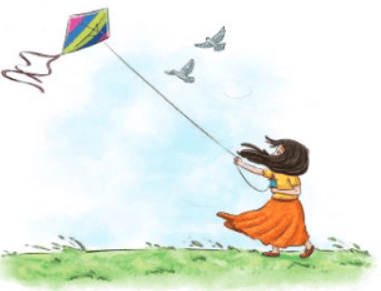
(a) I can see ___________, ___________ and ___________ in the picture.
Ans: I can see kites, birds and the sky in the picture.
(b) The weather in the picture is ___________.
Ans: The weather in the picture is windy.
(c) The kite is ___________ high in the sky.
Ans: The kite is flying high in the sky.
(d) The child is ___________ from below.
Ans: The child is looking from below.
(e) The tail of the kite ___________.
Ans: The tail of the kite has ribbons.
Q4: Now, think and answer.
(a) List two more things that you want to add to the picture.
Ans: The sun and clouds.
(b) If I were the child, I would ___________
Ans: I would love to fly the kite.
(c) If I were the kite, I would ___________
Ans: I would love to fly high.
Let us discuss
Page 143, 144
Q1: Read the poem silently. As you read, mark the given statements as True or False.
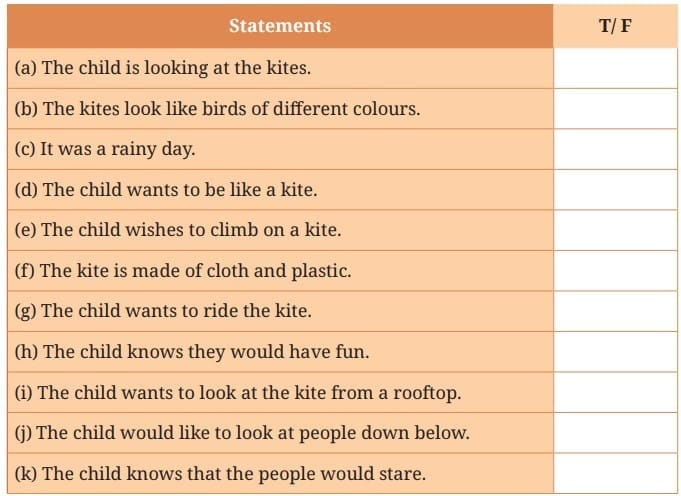
Ans:
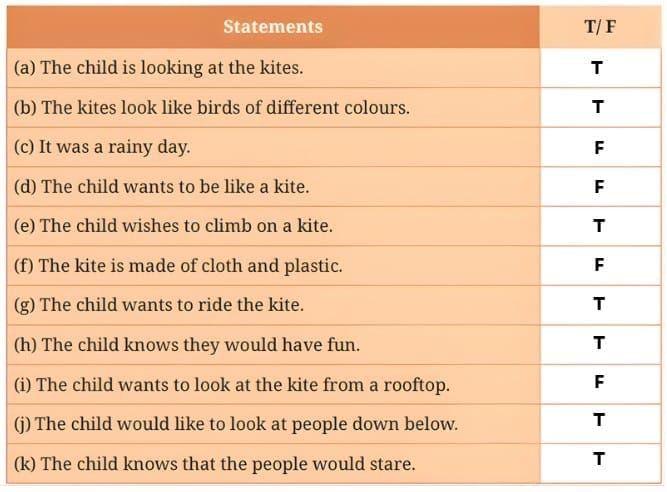
Q2: Complete the following sentences.
(a) The poet says that the kites are like coloured birds - See the kites fly/Like coloured birds in the sky.
Ans: The kites have been compared to birds because they fly high and look colourful.
(b) The child wishes to be like air - I wish I were small / And as light as air.
Ans: The child wishes to be as light as air so that they can climb onto a kite and fly.
Do you think that the use of simile in this poem helps us imagine better when we read the poem? Share your thoughts with your teacher and classmates.
Ans: Yes, the use of simile helps us picture the kites as colourful birds and the child as light as air, making the scenes easier to imagine and more interesting.
Q3: Find a set of words from the poem that begin with the same consonant sound.
Stanza 1: Which consonant sound do both words begin with?
Stanza 3: Which consonant sound do both words begin with?
This is called alliteration. For example, big bright blue bag, funny fan, etc.
Create 4 other sets of words using alliteration.
Ans: Stanza 1: wind-whipped
Stanza 3: wild- wind
Alliteration Examples:
- Bouncing balloon, bright bird
- Dusty dawn, dreamy days
- Sweet smiles, silver star
- Calm cat, crisp crackers
These examples show alliteration by repeating the same consonant sound at the start of each word in a set.
Q4: In the last stanza, the two words that the poet repeats are __________, __________ to tell us that the kite is flying __ __ __ y high.
Ans: In the last stanza, the two words that the poet repeats are high, high to tell us that the kite is flying very high.
Q5: Study each stanza and underline the rhyming words from the end of each line. Also, circle the end words in the stanzas that do not rhyme.
Ans:
Rhyming Words in Each Stanza:
- Stanza 1: fly - sky
- Stanza 2: air - there
- Stanza 3: wings - sings
- Stanza 4: down - town
- Stanza 5: stare - air
Each stanza has one end word that does not rhyme with the others.
- Stanza 1: birds
- Stanza 2: kite
- Stanza 3: paper
- Stanza 4: park
- Stanza 5: me
Let us think and reflect
Page 144
Q1: Read the given lines from the poem and answer the following questions.
What fun it would be
To look right down,
Over the park
And the rooftops of town.
(a) Circle the word that does not share the same feeling as 'fun':
joy, excitement, care, happiness
Ans: Care
(b) Which line tells us that the poet was somewhere above?
Ans: "To look right down"
(c) Choose the scene the child saw.
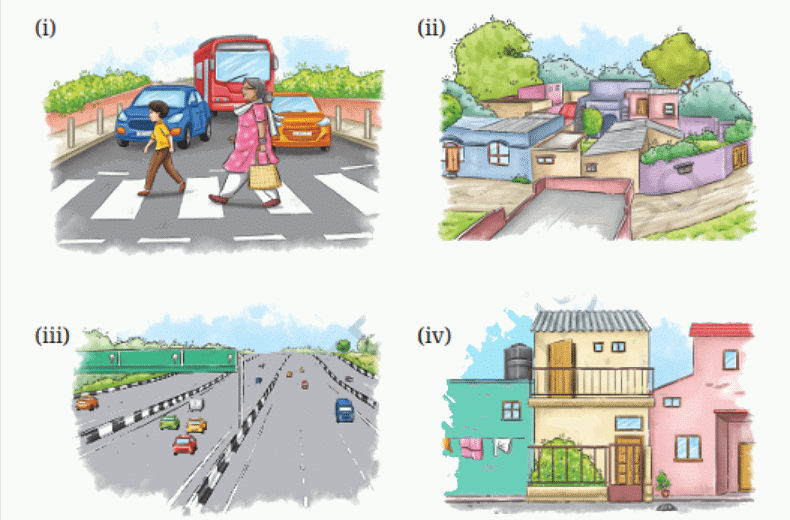
Ans: Scene (ii)
The child imagines looking down from high above and sees the park and the rooftops of the town. Scene (ii) shows an aerial view of houses and trees matching this view.
Q2: Answer the following questions.
(a) How does the poet describe the kites in the first two lines?
Ans: The poet describes the kites as flying in the sky like coloured birds, showing their bright colours and graceful movement.
(b) Why does the child say that they have to climb a tree first to get onto the kite?
Ans: The child says they have to climb a tree first to get onto the kite because the kite is stuck or entangled in the tree. When a kite gets caught in the branches, and the child needs to climb the tree to retrieve it.
(c) What are the songs that the child hears when flying atop the kite?
Ans: When flying atop the kite, the child imagines hearing the songs of nature including the whistling of the wind as it rushes past.
(d) Why did the people look up at the child and stare? If you looked up and saw that, what feelings would you have?
Ans: The people looked up and stared because it would be surprising and wonderful to see a child flying on a kite. If I saw that, I would feel amazed and be excited.
(e) If you were the kite carrying the child high up in the air, what would you tell them?
Ans: If I were the kite, I would tell the child to hold on tight, enjoy the view, and enjoy flying with the wind.
Let us learn
Page 146, 147, 148
Q1: Look at the picture of the kite and read what some of its parts are named.
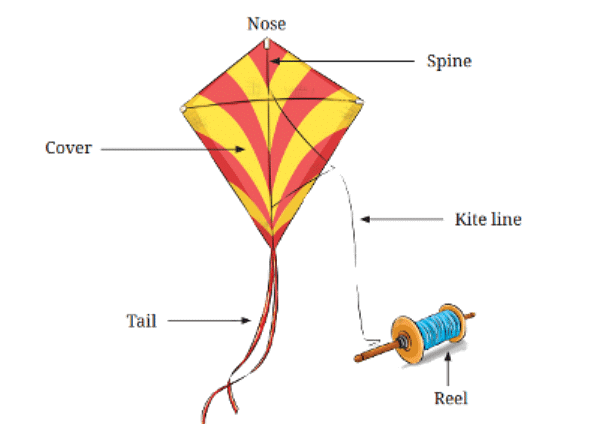
Now, Complete the given conversation by filling the blanks with some 'parts of a kite' words from above.
Bina: I love the long yellow t _ _ _ at the end of my kite. What colour is your kite?
Saroj: My kite's c _ _ _ _ is pink. The s _ _ _ _ e is black.
Bina: Oh wonderful! My kite l _ _ _ is red. The r_ _ l that wraps it is green. I like it.
Saroj: My kite line is red too. The tip of my kite has a blue _ _ _ e.
Bina: Beautiful! Let's go and fly our pretty kite.
Ans: Bina: I love the long yellow tail at the end of my kite. What colour is your kite?
Saroj: My kite's cover is pink. The spine is black.
Bina: Oh wonderful! My kite line is red. The reel that wraps it is green. I really like it.
Saroj: My kite line is red too. The tip of my kite has a blue nose.
Bina: Beautiful! Let's go and fly our pretty kite.
Q2: Let us create a poem using words in a kite!
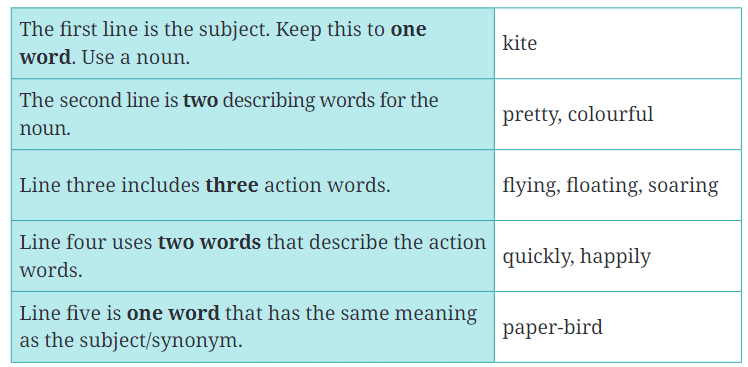
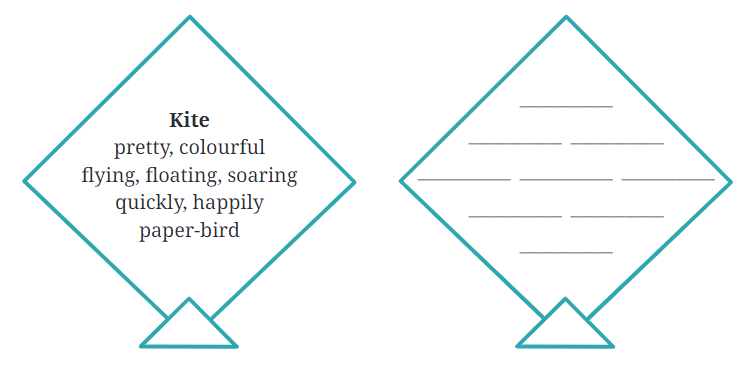
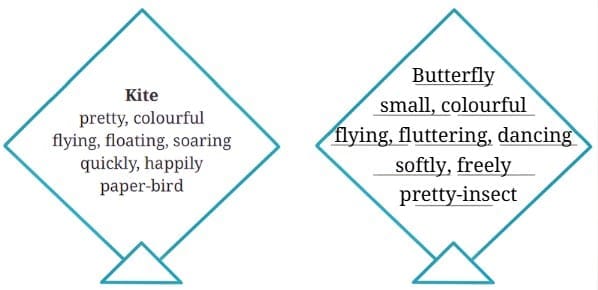
This is called a cinquain poem. It is a five-line poem that describes a person, a place, or a thing.
Now, create a cinquain poem yourself on anything you like.
Ans:
Q3: The poet uses the words 'fly' and 'drift' to describe the kite's movement.
(a) Circle the words matching the 'drift' movement. You can choose more than one word.

Ans:
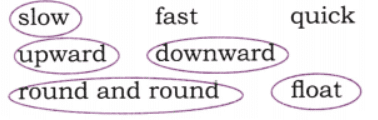
(b) Study some other words about the kite's movement and share what type of movement they show. You can look at (a) for the type of movement.

Ans:
Glide: A smooth and continuous movement, often slow and graceful, similar to drifting.
Dive: A fast downward movement that is sudden.
Soar: A quick upward movement that goes high and stays for a while.
Swoop: A rapid movement, usually downwards and then upwards again.
Circle: A movement that goes round and round, keeping a steady path.
Q4: The poet has used expressions like-
up in the air; look right down; stay up there; stand and stare
(a) Read how these expressions are used in the poem.
Ans: Usage of Expressions in the Poem:
"Up in the air" is used in the lines "Up in the air/See the kites fly," to show kites flying high.
"Look right down" appears in "What fun it would be/To look right down,/Over the park/And the rooftops of town." to show looking down from above.
"Stay up there" is used when the child talks about sailing up on a kite: "I would climb on a kite/And sail up there."
"Stand and stare" appears in "The people below/Would stand and stare," to show how amazed people would be.
(b) In pairs, make sentences using these expressions. Discuss with your teacher and then write in your notebooks.
Ans: Making Sentences:
Up in the air: We watched the hot air balloon rise up in the air as the sun set behind the hills.
Look right down: From the top of the tower, I could look right down and see the whole town below.
Stay up there: The bird built its nest high in the tree and stayed up there during the summer.
Stand and stare: The magician was so good that people would stand and stare in surprise.
Let us listen
Page 148
The Kites
Hello everyone! I'm happy to share with you some details about the Kite Festival. It is a popular festival in India and it takes place during Makar Sankranti in January. People can even be seen flying kites from their terraces and rooftops and taking part in kite flying competitions. This festival is celebrated as Uttarayan in Western India. The festival gives everyone a chance to look at kites of different shapes, sizes, and colours. Gujarat is the main centre of celebrations but Uttarayan is also celebrated in Rajasthan and Telangana. In Karnataka, the Tourism Department has also been organizing the kite festival once each year. Punjab also celebrates this festival of kites during Baisakhi and Basant Panchami. Kite fling is a tradition that is deep-rooted in Indian culture and the Kite Festival is eagerly awaited. This is also a reason why people across India also fly kites to celebrate Independence Day. Happy kite-fling to all of you!
Listen about the Kite Festival in India. As you listen, circle the words that are not correct. Then, listen again and write the correct words (refer to page 163 for transcript) .
(a) Kite Festival is celebrated during the month of June.
Ans: False (January)
Explanation: The Kite Festival (Uttarayan or Makar Sankranti) is celebrated in January, not in June.
(b) The International Kite Festival is named Uttarayan in Eastern India.
Ans: False (Western India)
Explanation: The name Uttarayan is used in Western India, especially in Gujarat, not in Eastern India.
(c) Uttarayan is mainly celebrated in Gujarat, but also in Maharashtra and Telangana.
Ans: True
Explanation: Uttarayan is mainly celebrated in Gujarat and is also observed with kite flying events in states such as Maharashtra and Telangana.
(d) During the Kite Festival, we can see kites of different shapes, sizes and colours.
Ans: True
Explanation: The festival features many kites of varied shapes, sizes and colours flown by participants.
(e) In Karnataka, the Tourism Department organises the kite festival every year.
Ans: True
Explanation: The Tourism Department in Karnataka organises kite festivals to promote tourism and local culture.
(f) The Punjab region celebrates Basant Panchami and Baisakhi by flying kites.
Ans: True
Explanation: In parts of Punjab, kite flying is a part of celebrations for Basant Panchami and Baisakhi.
(g) People of India also enjoy flying kites on Earth Day.
Ans: False (Independence Day)
Explanation: While people fly kites on many occasions, kite flying is especially popular on Independence Day (15 August) and festival days rather than Earth Day.
Let us speak
Page 149
Q: Share a kite-flying experience with your classmates. If you have not flown a kite yet, share an experience of watching kites fly. Give details-Where? When? Why? How? Speak in complete sentences.
Ans: I have flown a kite during the Makar Sankranti festival in January at the local park. Many people gathered there to fly kites. The breeze was gentle, which made it perfect for kite flying. I flew a colourful diamond-shaped kite with a long tail and enjoyed seeing it rise and fly along with other kites. Controlling the kite and keeping it from being cut by others made the day exciting and memorable.
Let us write
Page 149
Q1: Imagine yourself as a kite. In pairs, first discuss all the following hints.
What shape of kite are you? What colours do you have? What other parts of yourself are you happy about?
Ans:
- I am a diamond-shaped kite, the classic and graceful form that glides through the air.
- My body is a bright mix of blues and greens with a golden tail that sparkles in the sunlight.
- I am proud of my long, fluttering tail because it helps me stay steady and looks beautiful as I fly.
Where are you? Who do you belong to? What activities do you do? Who are your friends?
Ans: I am often found soaring above a wide, green park. I belong to a child who loves to fly me on weekends and during festivals. I enjoy dancing with the wind, racing other kites and making patterns in the sky. My friends are other kites of all shapes and colours that I meet as we fly together.
Do you have any message for humans?
Ans: Message for Humans: Friends, remember to find joy in simple things and to look up at the sky more often. Let the wind lift your spirits and enjoy the freedom and beauty that nature gives you.
Q2: Now, write a paragraph of about 100 words, with the title - I am a Kite.
Ans: I am a Kite
I am a kite, flying high in the blue sky. The wind carries me up and down, making me dance with joy. My bright colours shine under the sun, and children love to watch me soar. Sometimes the wind is strong and I glide smoothly; other times it is weak and I struggle to stay up. My string connects me to the hands of my owner, who guides my movement. I love the feeling of freedom in the air, though I know that one day my string might break and I may drift away into the unknown.
Let us explore
Page 149
Q1: The mention of kites exists in ancient Indian texts. It can be found in the poetry of the thirteenth-century Marathi saint and poet, Namadeva. In his poems or gathas, he called a kite a gudi, and there is a mention that the kites were made from kaagad (paper).
Ans: The Ancient Tradition of Kites in India:
The tradition of kite flying in India is very old and appears in historical writings and poetry. In the thirteenth century, the Marathi saint and poet Namadeva called a kite a gudi in his gathas and mentioned that kites were made from kaagad (paper). These references show that kite flying was a familiar and enjoyed activity long ago and that the practice has continued through generations.
Q2: Have a look at some of the different types of kites. Choose which one is commonly seen.
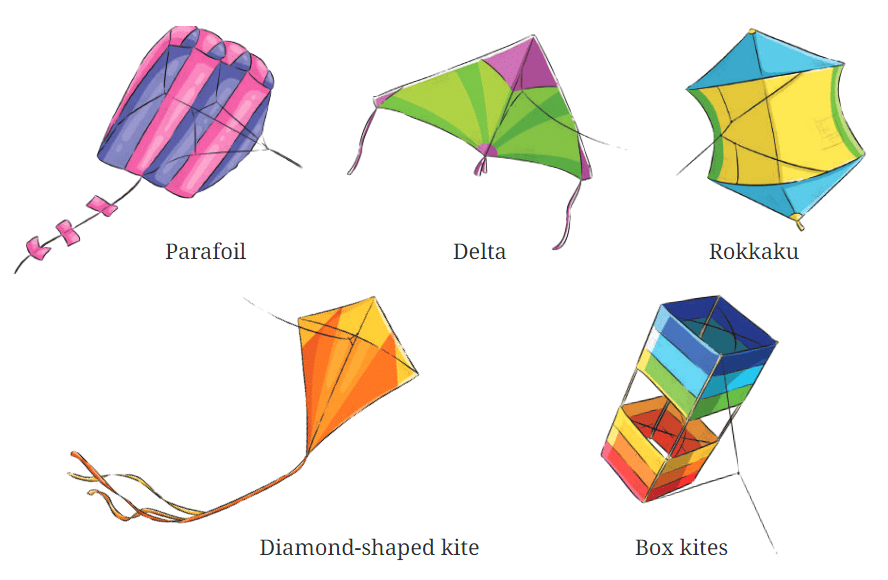
(a) Find out the steps to make a kite.
Ans: Step to make a kite:
- Prepare the frame using wooden dowels or bamboo sticks.
- Attach the frame to the kite material and secure it with glue or tape, making the material tight and well fixed to the frame.
- Make small holes at the top and bottom of the vertical stick and at the ends of the horizontal stick.
- Add the string.
- Cut a piece of cloth or ribbon to use as the tail.
- Use markers or paint to decorate your kite with patterns, colours or a message.
(b) Follow the steps and create your kite. Get it to school to show your teacher and classmates.
Ans: Create the Frame:
- Measure and cut the dowels. The longer dowel (spine) should be about 24 inches, and the shorter dowel (crossbar) about 20 inches.
- Lay the shorter dowel across the longer one to form a cross, about one-third of the way down the longer dowel.
- Secure the two dowels together using string or strong tape at the intersection, making sure they form a right angle.
Make the Cover:
- Place the frame on the paper or fabric and trace the outline of the kite, leaving an extra inch around the edges for folding.
- Cut out the kite shape from the paper or fabric.
- Fold the edges of the paper or fabric over the frame and secure with glue or tape.
Attach the String:
- Cut a piece of string about twice the length of the spine.
- Tie one end of the string to the top of the spine and the other end to the bottom.
- Attach another piece of string at the intersection of the dowels for the kite line.
Add the Tail:
- Attach the ribbon or fabric to the bottom of the kite; this helps to keep the kite stable in the wind.
Decorate:
- Use markers or paint to decorate your kite. You can write a message like "Happy Independence Day!" on it.
Creating and Flying Your Kite:
- Follow the steps above to make your kite.
- Once your kite is ready, take it to a large open area with a steady breeze.
- Fly your kite and enjoy!
(c) Write a message on the kite. For example: Happy Independence Day!
Ans: Example message: "CHASE YOUR DREAMS!"
FAQs on NCERT Solutions: The Kites
| 1. What is the main message or theme of The Kites NCERT chapter? |  |
| 2. Why do the kites keep breaking in The Kites story and what does it symbolise? | |
| 3. How does the father-son relationship develop through their kite-flying activity in this chapter? | |
| 4. What happens at the end of The Kites and why is the ending important for understanding the chapter? | |
| 5. What literary devices and writing techniques does the author use in The Kites to create emotional impact? | |