NCERT Solutions: Unit 5


Reading Comprehension
Read the passage below and answer the questions that follow.
THE MIRACULOUS ESCAPE
I had been very wealthy and prosperous and was leading a very comfortable life. I had all the worldly pleasures with me. But soon I became bored of my idle life. The urge to go on a voyage became stronger and stronger day by day. It haunted me like anything. So one day I boarded a ship and went trading from island to island with other merchants. When we started, the weather was fine and the sea was calm. But on the fourth day of our voyage, our ship was caught in a terrific/terrible hurricane and we wandered from our set course. The tempest continued for several days and drove us near an island. The captain of the ship was reluctant to cast anchor at the port as it was a much dreaded place. The violent waves of the sea had exhausted us. We were all tired and hungry so we went in search of food and water. We were fortunate enough to find fruit trees and a stream of fresh and cool water which gave us strength and energy and relieved us from hunger.
rustle: make a soft, muffled crackling sound like that caused by the movement of dry leaves or paper It had started getting dark. As we were tired we went to sleep but were soon startled by a rustling noise which came from a very long and huge python like serpent gliding swiftly towards us. We ran to save our lives but the serpent was quick enough to swallow one of my companions. We kept running till we had covered a good enough distance from the serpent. We felt a bit relieved but at the same time sad as we had lost a friend of ours. We took shelter on the top of a tree and thought ourselves to be safe.
alarm: a warning of danger But we were mistaken for we had hardly slept a little time when we heard a hissing sound which alarmed and frightened us. Coiling itself round the tree, the serpent reached my other companion who was positioned somewhat lower than me on the tree. It swallowed him and went away. Terror stricken I clung to the branch of the tree tightly and I did not know when I fell asleep. It was daylight when I awoke. I climbed down. It seemed to me that I had no courage left. It took me no time to realise that if I would not think of a way to escape soon, I would be a dead man. It was just a matter of time when I would also be swallowed like my two other companions. The instinct to prevent one's life is greater than any fear or frustration. I thought I should spare no means to save myself. I collected a lot of dry wood and bushes and tied them into a bundle with reeds. I arranged them in a circular structure round the tree and tied some of them with the branches of the tree. In this way I made a tent like structure in which
penetrate: force a way into or through I sat after dusk and securely tied from within. I had the satisfaction that whatever I could do I did it to prevent myself. This time when the serpent arrived he crept round the tree but he could not penetrate the defensive structure I had made around me. It just sat and waited the whole night like a cat that waits for the mouse to emerge out of its hole.
At dawn the serpent crept back but I dared not come out of my fortress. I lay there half dead and almost suffocated.
wildly: uncontrolled; unrestrained; very enthusiastic or excited When the Sun began to shine, I came out of my wooden fortress. I was so desperate that I ran towards the seashore. When I was about to jump into the sea, I saw a ship sailing at some distance. I shouted wildly, I took off my shirt and waved it too, which attracted the sailors on the ship and a rescue boat was immediately sent for me. This was my miraculous escape from the deadly serpent.
Discuss what effect did the story have an you? What would you have done, if you were in the narrator's place? Does it teach you how to save yourself from danger? Now based on your reading of the story, answer the questions that follow. You may read the story again.
Q1: What made the narrator go on a voyage?
(a) He was rich and satisfied with his life.
(b) He felt bored of his life.
(c) He had urge to go on a voyage.
(d) He was adventurous.
Ans: (c) He had urge to go on a voyage.
Explanation: The narrator explains that, although he had wealth and comforts, he grew bored of his idle life and felt a strong urge to travel. That desire became stronger day by day, so he boarded a ship to go on a voyage.
Q2: How did the narrator and his friends feed themselves?
(a) They ate fish.
(b) They could not find anything to eat.
(c) They ate fruits to survive.
(d) They ate the food they had brought with themselves.
Ans: (c) They ate fruits to survive.
Explanation: After their ship was driven near the island, the group found fruit trees and a stream of fresh water. The narrator says these gave them strength and relieved their hunger, so they survived by eating fruits.
Q3: The narrator and his companions were on the tree. The serpent swallowed his companion but not the narrator. Why?
Ans: The narrator was positioned higher on the tree than his companion. When the serpent coiled round the trunk, it reached the man who was lower down and swallowed him. Because the narrator sat higher on the branch, the serpent could not reach him then and so he was not swallowed.
Q4: How did the narrator save himself from the serpent?
Ans: The narrator collected dry wood and bushes and tied them together with reeds to form bundles. He arranged these bundles in a circular, tent-like structure around the trunk of the tree and fastened some bundles to the branches so they were secure. He sat inside this structure and tied himself from within. When the serpent returned it could not force its way into the defensive barrier and had to wait outside. The narrator stayed in the structure through the night and, at dawn, managed to attract the attention of a passing ship by waving his shirt and shouting. A rescue boat came and he was saved.
Q5: Find the words in the story which mean the nearest to the words given below.
(a) rich (First para) _______
Ans: wealthy
(b) moved (Second para) _______
Ans: wandered
(c) tired (Third para) _______
Ans: exhausted
(d) scared (Fifth para) _______
Ans: frightened
(e) urge (Fifth para) _______
Ans: instinct
Q6: Now find words in the story which mean the opposite of the given words.
(a) poor (First para) _______
Ans: wealthy
(b) weak (Third para) _______
Ans: strong
(c) enforce (Third para) _______
Ans: prevent
(d) insecurely (Sixth para) _______
Ans: securely
(e) offensive (Sixth para) _______
Ans: defensive
Vocabulary
Q1: The story of Miraculous Escape has a number of words which describe the narrator's feeling of fear and getting tired of the journey. List the words of the two feelings and experiences.
Ans: Words describing fear and getting tired
Fear:
- Terrific
- Frightened
- Alarmed
- Terror-stricken
Getting tired:
- Exhausted
- Tired
- Weary
- Fatigued
Q2: Can you now add suffix which can mean or relate to the word 'fear'? First one has been done for you.
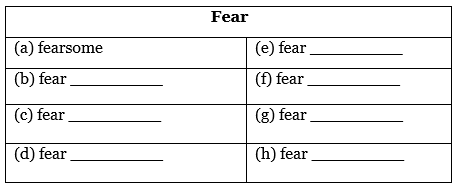
Ans: Suffixes to the word 'fear'
(a) fearsome
(b) fearful
(c) fearless
(d) fearing
(e) fearfully
(f) feared
(g) fearsome
(h) fearfulness
Reported Speech: Reporting questions
Q1: You have learnt how to report questions from direct to indirect speech. Here is a paragraph with direct speech questions. Read them carefully and report into indirect speech. Rewrite the paragraph in the space given below.Once an old man asked a young boy, "Who do you think are the most intelligent people?" The young man said in return, "Who do you think so?" The old man said, "How can sons and daughters be intelligent without learning from their parents?" The young man said, "How did you as a parent learn?" The old man said, "Why are you hijacking my question by asking me back?" The young man said, "Didn't you know that you as a parent, now have learnt all the things on your own?" The old man said, "How do you say that we all learnt from others?" The young man said, "Why do you ask me about how to operate electronic gadget all the time?" The old man said, "Why can't I ask you because I have paid for the gadget you use?"
Ans: Reporting questions from direct to indirect speech
Direct Speech Paragraph:
- Once an old man asked a young boy, "Who do you think are the most intelligent people?"
- The young man said in return, "Who do you think so?"
- The old man said, "How can sons and daughters be intelligent without learning from their parents?"
- The young man said, "How did you as a parent learn?"
- The old man said, "Why are you hijacking my question by asking me back?"
- The young man said, "Didn't you know that you as a parent, now have learnt all the things on your own?"
- The old man said, "How do you say that we all learnt from others?"
- The young man said, "Why do you ask me about how to operate electronic gadgets all the time?"
- The old man said, "Why can't I ask you because I have paid for the gadget you use?"
Indirect Speech Paragraph:
- Once an old man asked a young boy who he thought were the most intelligent people.
- The young man responded by asking the old man who he thought so.
- The old man asked how sons and daughters could be intelligent without learning from their parents.
- The young man asked the old man how he, as a parent, had learned.
- The old man questioned why the young man was hijacking his question by asking back.
- The young man retorted by asking if the old man did not know that he, as a parent, had learned many things on his own.
- The old man asked how the young man could say that people learnt from others.
- The young man asked why the old man kept asking him about operating electronic gadgets.
- The old man replied that he felt entitled to ask because he had paid for the gadget.
Q2: Now here is a set of sentences given in indirect speech. Change them into direct speech.
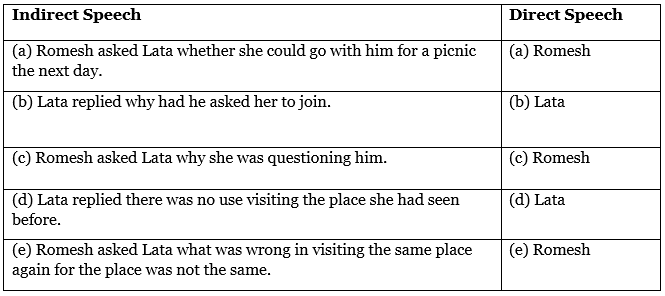
Indirect Speech Sentences:
Romesh asked Lata whether she could go with him for a picnic the next day.
Lata replied why had he asked her to join.
Romesh asked Lata why she was questioning him.
Lata replied there was no use visiting the place she had seen before.
Romesh asked Lata what was wrong in visiting the same place again for the place was not the same.
Direct Speech Sentences:
Romesh asked, "Lata, can you go with me for a picnic tomorrow?"
Lata replied, "Why are you asking me to join?"
Romesh asked, "Lata, why are you questioning me?"
Lata replied, "There is no use visiting the place I have seen before."
Romesh asked, "Lata, what is wrong in visiting the same place again? The place is not the same."
Editing
Q1: Some of the prepositions are incorrectly used in the following story. Correct them and read the story aloud. Then rewrite the story in the space given below.The Dog and His Bone
A hungry dog while searching about food found a bone. He picked it out and held it tightly in his mouth and ran out into the woods, to a safe place to enjoy it in ease. He growled and frowned at anyone who attempted to take it over. He chewed the bone for a very long time and this made him quite thirsty. He came to a stream to quench his thirst. He trotted around the footbridge and happened to glance into the water. He saw his own reflection in the water. Thinking it was another dog with a bigger bone, he growled and scowled towards it. The reflection growled and scowled back. Being greedy by nature, he wanted that bone too. He snapped his sharp teeth at the image on the water. He barked at the other dog, hoping to scare him into giving that bone. His own big bone fell with a splash, went over of sight, the moment he opened his mouth to bite!
footbridge: a bridge for pedestrians
Ans: Correcting prepositions and other small errors in the paragraph
Corrected Paragraph: A hungry dog, while searching for food, found a bone. He picked it up and held it tightly in his mouth and ran into the woods to a safe place to enjoy it in peace. He growled and frowned at anyone who attempted to take it from him. He chewed the bone for a very long time, and this made him quite thirsty. He came to a stream to quench his thirst. He trotted to the footbridge and happened to glance into the water. He saw his own reflection. Thinking it was another dog with a bigger bone, he growled and scowled at it. The reflection growled and scowled back. Being greedy by nature, he wanted that bone too. He snapped his sharp teeth at the image in the water. He barked at the other dog, hoping to scare him into giving that bone. His own big bone fell with a splash and went out of sight the moment he opened his mouth to bite.
Q2: Rearrange each set of words to make sentences. Use appropriate punctuation marks.
when I gave her, the bad news, she turned pale
Ans: When I gave her the bad news, she turned pale.
become rotten, as it has, the apple, don't eat
Ans: Don't eat the apple, as it has become rotten.
great friends, last quarrel, after their, they became
Ans: After their last quarrel, they became great friends.
first and only novel, after her, got a prize, she became famous
Ans: After her first and only novel got a prize, she became famous.
Listening
How brave are you?Take a minute to think over this question. There are people who risk their lives to save someone's life from danger. Here is a child who dared and saved lives. Let us listen to the story of a braveheart. The Brave Hearts On October 26, 2009, Jhalaram's hut in the village Sarneshwar in Rajasthan, suddenly caught fire. His two daughters, aged two-and-a-half years and one year, as well as ten goats were in the hut at that time.
Shrawan Kumar, a six-year old boy, was playing in his house at a distance of about 200 feet. Seeing smoke coming out from Jhalaram's house, he ran towards it. He saw the children sitting on a cot and screaming for help, and the goats caught in the flames.
Shrawan entered the house, lifted the younger child in one arm and pulling the older one by the hand, brought them out safely. He took them to his house, then ran to inform his father and the children's father.
The elders rushed to the site. But by that time, the goats had died and the household belongings had been destroyed in the fire. It was Shrawan Kumar's daring act that saved the lives of the two children.
Your teacher will read out the story. Listen to the story carefully and answer the questions below. You may ask the teacher to read out the story more than once.
Q1: Where is the village of Sarneshwar?
Ans: The village of Sarneshwar is in Rajasthan.
Q2: Whose hut had caught fire?
Ans: Jhalaram's hut had caught fire.
Q3: Who all were there in the hut when it caught fire?
Ans: Jhalaram's two daughters and ten goats were in the hut when it caught fire.
Q4: Why did Shrawan run towards Jhalaram's house?
Ans: Shrawan ran towards Jhalaram's house because he saw smoke coming out of it.
Q5: How did Shrawan save the two children?
Ans: Shrawan entered the burning hut, lifted the younger child in one arm and pulled the older child by the hand, bringing both out safely to his house before calling for help.
Q6: What happened to the goats?
Ans: The goats died in the fire.
Speaking
Q1: Imagine yourself as the narrator in the story 'The Miraculous Escape' and describe your experience during your voyage. Jot down the points you want to speak on. Then narrate your experience to your partner. You may begin like this:
Points:
- Decided to go on a voyage out of boredom.
- Enjoyed the initial days of the voyage.
- Faced a terrible hurricane on the fourth day.
- Ship wandered off course and reached a dreaded island.
- Faced hunger and exhaustion.
- Encountered a huge serpent that swallowed two companions.
- Built a defensive structure with wood and bushes.
- Survived the night and was rescued by a ship the next morning.
Narration Example:
I had been thinking of going on a voyage, and when the chance came I boarded a ship. I enjoyed the calm sea and the new places we visited. On the fourth day a violent hurricane struck and our ship drifted to a dreaded island. We were exhausted and hungry but found fruits and fresh water. That night a huge serpent attacked and swallowed two of my companions. Terrified, I collected dry wood and bushes, made a circular, tied structure around the tree and sat inside it. The serpent could not get in. At dawn I attracted the attention of sailors by waving my shirt and shouting, and I was rescued. It was a miraculous escape!
Writing
Q1: A group of pictures are given here. They make a story. This story is from the Tales of Panchatantra.
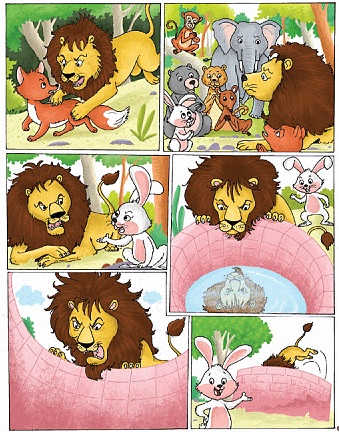
Now write the story in the lines provided below. Provide a suitable title to the story.
Ans:
Title: The Fox and the Grapes
A hungry fox wandered through the forest in search of food. He came upon a vineyard where ripe grapes hung from a high vine. The fox longed for the juicy grapes and tried to jump up to reach them. He tried again and again but could not reach the bunches because they were too high. After many attempts he gave up and walked away, telling himself that the grapes were probably sour anyway.
Q2: Courage needs no age and comes after we let go of all our fears. Every year, on the Republic Day, National Bravery Awards are given to selected children for their act of bravery against all odds. These children are able to achieve this glory as they overcome their moments of fear and do their best to save precious lives.
Make a list of any five such children and their actions for which they have been awarded the National Bravery Award. Write a few paragraphs on each child. Keep your writings in the Class Library or the Reading Club for all your friends to read.
Ans: Five children who have been awarded or honoured for acts of bravery (examples for class work)
- Child 1: Shrawan Kumar - Six-year-old Shrawan Kumar from Rajasthan saved two young children from a burning hut. He entered the house, carried the younger child in one arm and pulled the older child by the hand to safety before raising the alarm. His quick action saved lives despite the danger.
- Child 2: Nazia - Fourteen-year-old Nazia from Assam (example) risked her life to rescue her brother from a fast-flowing river. She swam against a strong current and brought him to the bank safely, showing courage and determination.
- Child 3: Pritesh - Twelve-year-old Pritesh from Maharashtra (example) saved his friend from electrocution by quickly moving the child away from a live wire. He sustained injuries but his timely action prevented a fatal accident.
- Child 4: Arjun - Ten-year-old Arjun from Karnataka (example) rescued a baby who had fallen into a well. He used a rope and lowered himself to reach the baby, then managed to bring the child up safely.
- Child 5: Aditi - Eleven-year-old Aditi from Haryana (example) woke her family when a fire started at night and helped them escape. She also alerted neighbours and called for help, preventing greater loss.
FAQs on NCERT Solutions: Unit 5
| 1. What are the key skills needed to excel in reading comprehension? |  |
| 2. How can vocabulary knowledge improve reading comprehension? | |
| 3. What is reported speech and how is it used in reading comprehension? | |
| 4. How can editing help improve reading comprehension skills? | |
| 5. Why is speaking practice important for reading comprehension? | |




