NCERT Solutions: Oceans and Continents

Questions, Activities and Projects
Q1: Explain the following terms:
(a) Continent
Ans: A continent is a large continuous expanse of land on Earth. There are seven commonly recognized continents: Africa, Antarctica, Asia, Australia, Europe, North America, and South America.
(b) Ocean
Ans: An ocean is a vast body of saltwater that covers almost three-fourths of the Earth's surface. The five major oceans are the Pacific, Atlantic, Indian, Arctic, and Southern Oceans.
(c) Island
Ans: An island is a smaller landmass completely surrounded by water. Islands can vary in size from small rocks to large landmasses like Greenland.
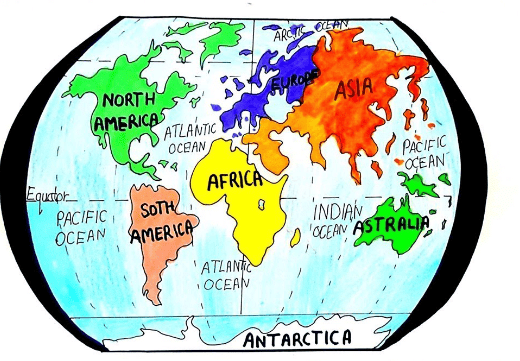
Q2: Let us draw - Without looking at the maps in this chapter, draw the continents freehand on a sheet of paper and color them. Then compare your drawing with the map of oceans and continents in the chapter.
Ans: Free Hand-Drawn Map:
- Representation: Shows the seven continents with simple shapes and labels.
- Colours: Each continent is coloured differently.
- Detail: Basic and easy to understand.
Q3: Let us do - On the outline map of the world given below, label all the continents and oceans.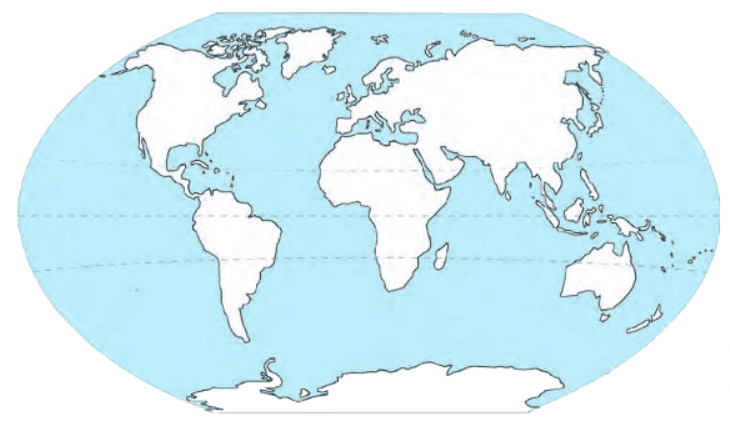 Ans:
Ans: 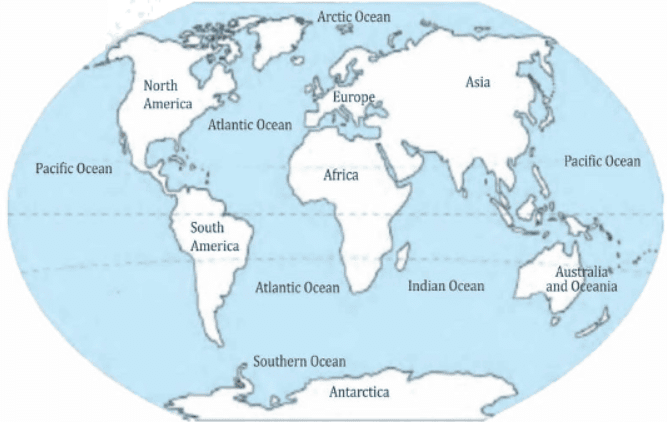
Q4: Solve this crossword:
 Ans:
Ans:
Across:
1. Plague (Abundantly produced by the oceans)
3. Continent (A large expanse of landmass)
6. Eurasia (A large continent of which India is a part)
8. Plastic (A major source of pollution of the oceans) coldest
10. Antarctica (The continent)
Down:
2. Greenland (The largest island on Earth)
4. Tsunami (A huge destructive wave from the ocean)
5. Australia (The smallest continent)
7. Pacific (The largest body of water on the Earth)
9. Island (A landmass (but not a continent) surrounded by the sea or ocean)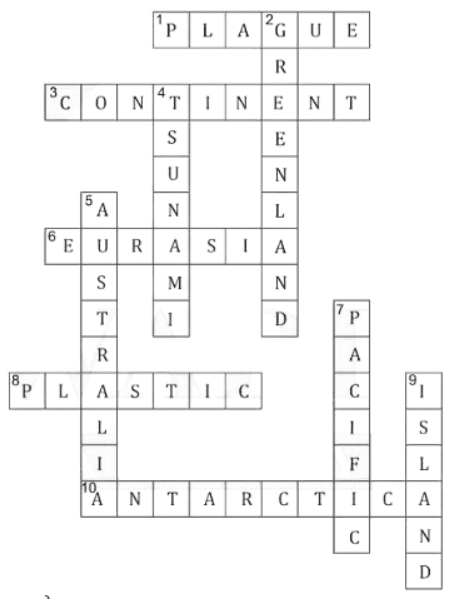
The Big Questions
Q1: What are oceans and continents? What are their names and their distribution?
Ans: Oceans are vast bodies of saltwater that cover almost three-fourths of the Earth's surface. There are five major oceans: the Pacific Ocean, Atlantic Ocean, Indian Ocean, Arctic Ocean, and Southern (or Antarctic) Ocean.
Continents are large continuous expanses of land. There are seven commonly recognized continents: Africa, Antarctica, Asia, Australia, Europe, North America, and South America.
Q2: In what ways do oceans and continents impact life on Earth, including human life?
Ans: Oceans and continents play vital roles in shaping the Earth's climate, geography, and ecosystems. Oceans regulate the Earth's climate and weather patterns through the water cycle, which includes rainfall and evaporation. They are home to diverse marine life and produce more than half of the world's oxygen, making them essential for sustaining life.
Continents provide habitats for various plant and animal species, including humans. They have influenced human history, culture, and civilization by providing land for agriculture, habitation, and development. Continents and their features, such as mountains, rivers, and forests, affect local climates and weather patterns. Additionally, oceans and continents facilitate trade, travel, and cultural exchange, impacting human societies globally.
Let's Explore
Page 29
Q1: What are the circular lines in each map called? And do you know what the lines radiating out of the two poles are called? (Hint: you studied them in the previous chapter, but here they are presented differently.)
Ans: The circular lines on the map are called latitude lines. The lines radiating out from the two poles are called longitude lines.
Q2: Which hemisphere holds more water?
Ans: The Southern Hemisphere holds more water compared to the Northern Hemisphere.
Q3: What do you think could be the approximate proportion of water to land in the Northern Hemisphere? And in the Southern Hemisphere? Discuss in groups.
Ans: The Southern Hemisphere has a higher proportion of water in comparison with the Northern Hemisphere.
The Northern Hemisphere has more land than the Southern Hemisphere.
- Northern Hemisphere: Approximately 61% water and 39% land.
- Southern Hemisphere: Approximately 81% water and 19% land.
Q4: Are all the oceans connected with one another, or are there separations between them?
Ans: All the oceans are connected to each other. Although we name them separately (like the Pacific, Atlantic, Indian, Arctic, and Southern Oceans), they form one continuous body of saltwater.
Page 32
Q: Locate the five oceans and, in the table below, mark the hemisphere or hemispheres they belong to.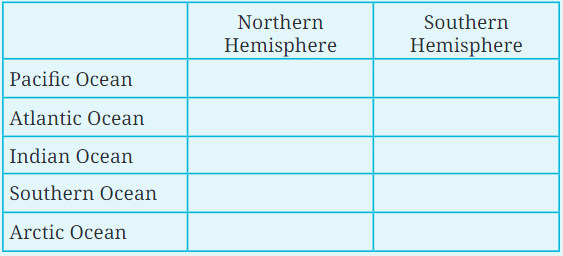 Ans:
Ans: 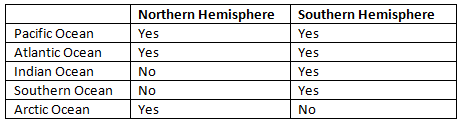
Page 36
Q1: Counting the numbers of squares, name the largest continent and the smallest.
Ans: Largest Continent: Asia
Smallest Continent: Australia
Q2: Which one is larger - North America or South America? Africa or North America? Antarctica or Australia?
Ans: North America vs. South America: North America is larger.
Africa vs. North America: Africa is larger.
Antarctica vs. Australia: Antarctica is larger.
Q3: Re-colour the diagram by having a single colour for Europe and Asia and rename the result as 'Eurasia'. Compare its size with South America's.
Ans: When Europe and Asia are combined into one continent called Eurasia, it is much larger than South America. Eurasia becomes the largest landmass.
Q4: Write down the list of continents from the smallest to the largest.
Ans: The list of continents from the smallest to the largest:
- Australia
- Europe
- Antarctica
- South America
- North America
- Africa
- Asia
Think About It
Page 31
Q1: If there is such abundance of water on the planet, why is there so much talk of 'water scarcity' or a 'water crisis'?
Ans: Despite the vast amount of water on Earth, most of it is in the oceans and is salty, making it unsuitable for drinking, agriculture, or most industrial uses. Only a small fraction of Earth's water is freshwater, which is found in glaciers, rivers, lakes, the atmosphere, and underground. This limited freshwater supply is unevenly distributed around the world, leading to water scarcity in many regions. Human activities, pollution, overuse, and climate change further exacerbate the availability of clean freshwater, causing water crises in various parts of the world.
Q2: What ways of saving water are you aware of? Which ones have you seen practised at home, at your school, and in your village, town or city?
Ans:
Ways of Saving Water:
- Fixing Leaks
- Using Water-Efficient Fixture
- Rainwater Harvesting
- Watering Plants Wisely
- Shorter Showers
- Turning Off Taps
- Reusing Water
Practices Observed:
- At Home: Fixing leaks, using water-efficient fixtures, and turning off taps while not in use.
- At School: Educating students about water conservation, installing water-efficient fixtures, and using rainwater harvesting systems.
- In Town: Implementing water-saving regulations, promoting rainwater harvesting, and encouraging the use of water-efficient appliances and practices among residents.
FAQs on NCERT Solutions: Oceans and Continents
| 1. What's the difference between continents and oceans in geography? |  |
| 2. How many continents and oceans are there, and what are their names? | |
| 3. Which ocean is the biggest, and what makes it different from other oceans? | |
| 4. Why do some continents look like they could fit together, and what does this mean? | |
| 5. What are the main features I need to know about each continent for my CBSE exams? | |