NCERT Solutions: India's Cultural Roots

Questions, Activities, and Projects
Q1: If you were Nachiketa, what questions would you like to ask Yama? Write them down in 100-150 words.
Ans: I would like to ask Yama, the god of death, the following questions if I was Nachiketa:
- What happens after the death of a body?
- What is soul?
- What happens to the soul after death?
- Will the soul also die with death, if not where will it go?
- Will the soul take rebirth in the form of another body?
Q2: Explain a few central ideas of Buddhism. Briefly comment upon them.
Ans: The central ideas of Buddhism are as follows:
- Buddhism was started by Siddhartha Gautam (Gautam Buddha).
- It evolved during 500 BCE and did not accept the concepts and principles of the Vedas.
- Buddhism believes that ignorance and attachment are the source of human suffering. Their teachings were based on removing these two causes of Sufferings ignorance and attachment.
- Buddhism preached non-violence and sincere inner discipline to reduce human suffering.
Q3: Discuss in class the quotation of the Buddha which begins with "Not by water is one made pure, though many people may bathe here [in sacred rivers]" to make sure that its meaning has been understood by all.
Ans: This quotation from the Buddha emphasizes that true purity and spiritual cleanliness do not come from external rituals, such as bathing in sacred rivers, but from internal virtues and actions. It teaches that inner qualities like truthfulness, compassion, and ethical behavior are what truly purify a person. Discussing this in class can help students understand that spiritual practices should focus on personal growth and moral integrity rather than mere ritualistic activities. The quote encourages individuals to seek purity through self-discipline, kindness, and understanding, reflecting the core values of Buddhism.
Q4: Explain a few central ideas of Jainism. Briefly comment upon them.
Ans: Jainism emphasizes three main principles: ahimsa (non-violence), anekäntaväda (many-sidedness), and aparigraha (non-attachment). Ahimsa advocates for complete non-violence towards all living beings, reflecting a deep respect for life. Anekäntaväda teaches that truth and reality are complex and can be perceived from different perspectives, encouraging tolerance and understanding. Aparigraha promotes detachment from material possessions and desires, fostering a simple and content life. These principles guide Jains towards ethical living, spiritual development, and harmonious coexistence with all forms of life, highlighting the religion's commitment to compassion, humility, and self-restraint.
Q5: Consider and discuss in class André Béteille's thought (see page 122).
Ans: Andre Beteille is an Indian sociologist:
- As per his thoughts, since ancient times, thousands of castes and tribes had a great influence on the religious beliefs of Hinduism.
- Each tribe used to follow their own religion influenced by Hinduism. Similarly, as per his views, Hinduism as a religion was also influenced by tribal religious customs and traditions.
- Finally, we could decipher from his views that Hinduism as a religion evolved through the beliefs, customs, and traditions of different castes and tribes of ancient India.
Q6: Make a list of popular gods and goddesses in your region and the festivals they are associated with.
Ans:
- Lord Rama: Celebrated during Ram Navami, marking his birth, and Diwali, celebrating his return to Ayodhya.
- Lord Krishna: Celebrated during Janmashtami, marking his birth, and Holi, commemorating various legends associated with him.
- Goddess Durga: Worshipped during Navratri, a nine-day festival celebrating her different forms.
- Lord Shiva: Celebrated during Mahashivratri, dedicated to his worship.
- Goddess Saraswati: Celebrated during Vasant Panchami, marking the arrival of spring and honoring her as the goddess of knowledge.
Q7: As a class activity, list two or three tribal groups from your region or State. Document some of their art and belief systems.
Ans: Gonds, Bhils, Santhal, Munda, and the Great Andamanese Tribes:
- The Great Andamanese Tribes are an indigenous people of the Great Andaman Archipelago in the Andaman Islands.
All living things are believed to be endowed with power that affects the human being. The art form depicts the culture and tradition. - Bhil art is known for its simplicity and use of vibrant colours. The art form is practiced on the walls, floors, and clothes.
Similarly, students could give details of tribal groups from their region.
True or False
Q1: The Vedic hymns were written on palm-leaf manuscripts.
Ans: False
The Vedic hymns were originally recited orally and passed down through generations before being written down.
Q2: The Vedas are India's oldest texts.
Ans: True
The Vedas are recognised as the oldest sacred texts of India. Key points include:
- They are ancient texts, dating back to between the 5th and 2nd millennium BCE.
- The Vedas consist of thousands of hymns and prayers, originally passed down orally.
- They were composed by sages known as rishis and rishikas.
- UNESCO has acknowledged Vedic chanting as a masterpiece of oral heritage.
Q3: The Vedic statement ekam sat vipra bahudha vadanti reflects a belief in the unity of cosmic powers.
Ans: True
Q4: Buddhism is older than the Vedas.
Ans: False
The Vedas predate Buddhism.
Q5: Jainism emerged as a branch of Buddhism.
Ans: False
Jainism and Buddhism are distinct traditions that emerged independently, although around the same period.
Q6: Both Buddhism and Jainism advocated for peaceful coexistence and the avoidance of harm to all living beings.
Ans: True
Q7: Tribal belief systems are limited to belief in spirits and minor deities.
Ans: False
Tribal belief systems are diverse and can include complex deities, rituals, and philosophies, often including the worship of natural elements and a supreme deity.
The Big Questions
Q1: What are the Vedas? What is their message?
Ans: The Vedas are ancient texts of India, consisting of four collections: Ṛig Veda, Yajur Veda, Sāma Veda, and Atharva Veda. They contain hymns composed by rishis and rishikas, addressing deities and emphasizing values like Truth and unity among people.
Q2: What new schools of thought emerged in India in the 1st millennium BCE? What are their core principles?
Ans: New schools of thought that emerged in the 1st millennium BCE include Vedanta, Yoga, Buddhism, and Jainism. Their core principles are interconnectedness, karma, rebirth, ahimsa (non-violence), and spiritual realization.
Q3: What is the contribution of folk and tribal traditions to Indian culture?
Ans: Folk and tribal traditions have enriched Indian culture through their unique deities, rituals, and oral traditions. They have interacted with mainstream Hinduism, contributing elements such as the worship of natural elements and deities like Jagannath.
Let's Explore
Page 109
Q: Do you know the term for a society where people select their leaders? How do you think people can benefit from such a situation? What could happen if they live under leaders that they did not choose? (Hint: Think back to what you're learning in the theme 'Governance and Democracy'!) Write your thoughts in a paragraph of 100-150 words.
Ans: The term for a society where people select their leaders is "democracy." In a democracy, people benefit by having the power to choose leaders who represent their interests and values. This system encourages accountability, as leaders must respond to the needs and concerns of their constituents to remain in power. Additionally, democracy fosters a sense of participation and ownership among citizens, making them more engaged in the governance process. If people live under leaders they did not choose, they may feel disconnected from the government, leading to dissatisfaction and potential unrest. Such leaders might not prioritize the well-being of the people, resulting in policies that do not reflect the public's needs or desires. In contrast, a democratic system promotes fairness, transparency, and the protection of individual rights, contributing to a more just and stable society.
Page 115
Q1: Discuss the way the Buddha is depicted in the above panel.
Ans: The Buddha is depicted in a stone panel that dates back around 1,800 years, showing him teaching. The depiction emphasizes his role as a teacher and spiritual guide, surrounded by followers who are attentive to his teachings. This visual representation highlights the Buddha's serene and enlightened demeanor, symbolizing wisdom, peace, and compassion. The artwork captures the essence of the Buddha's teachings and his influence on his disciples, reflecting the importance of spreading his message of enlightenment and inner peace.
Q2: Can you name some states of India or some other countries where Buddhism is a major religion even today? Try to plot these on a world map.
Ans: States in India: Sikkim, Arunachal Pradesh, Ladakh (Union Territory), Maharashtra (regions like Nagpur), Himachal Pradesh (Dharamshala)
Countries: Thailand, Myanmar (Burma), Sri Lanka, Bhutan, Nepal, Japan, Tibet, Mongolia, Vietnam, South Korea
Page 118
Q: 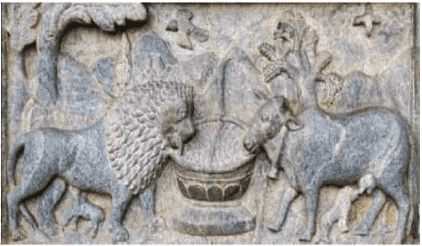 Observe the above panel (from a Jain temple in New Delhi). What is striking about it? What messages does it carry?
Ans:
- The panel depicts a lion and a cow drinking water together from the same container. This is striking because these are natural enemies, and yet they are shown in harmony.
- The panel shows that even natural enemies can live together peacefully if they are treated with compassion and respect.
- The image represents the interconnection of all living beings and the importance of living in harmony with nature.
Think About It
Page 110
Q: Have you heard or read any other story that conveyed an important message? What values did it teach you?
Ans: Yes, I have read many stories that teach important lessons. One such story is "The Boy Who Cried Wolf." In this story, a young shepherd boy tricks the villagers by pretending that a wolf is attacking his sheep, even though there is no wolf. He does this several times. But when a real wolf shows up and he calls for help, the villagers don't believe him, and the wolf attacks his sheep. This story teaches that honesty is important and that lying can have serious consequences. It shows that when you lie, people might not trust you anymore, even when you're telling the truth. The lesson is about being truthful and how your actions can affect trust with others.
FAQs on NCERT Solutions: India's Cultural Roots
| 1. What are the main sources of India's cultural roots and how did they develop over time? |  |
| 2. How did Buddhism and Jainism change Indian culture and society during ancient times? | |
| 3. What role did Sanskrit and regional languages play in preserving India's ancient knowledge and traditions? | |
| 4. How did the caste system develop as part of India's social structure and what does it tell us about ancient Indian society? | |
| 5. Why are epics like the Ramayana and Mahabharata considered central to understanding India's cultural identity? | |