NCERT Solutions: Unity in Diversity, or 'Many in the One'

The Big Questions
Page 126
Q1: What is meant by 'unity in diversity' in the Indian scenario?
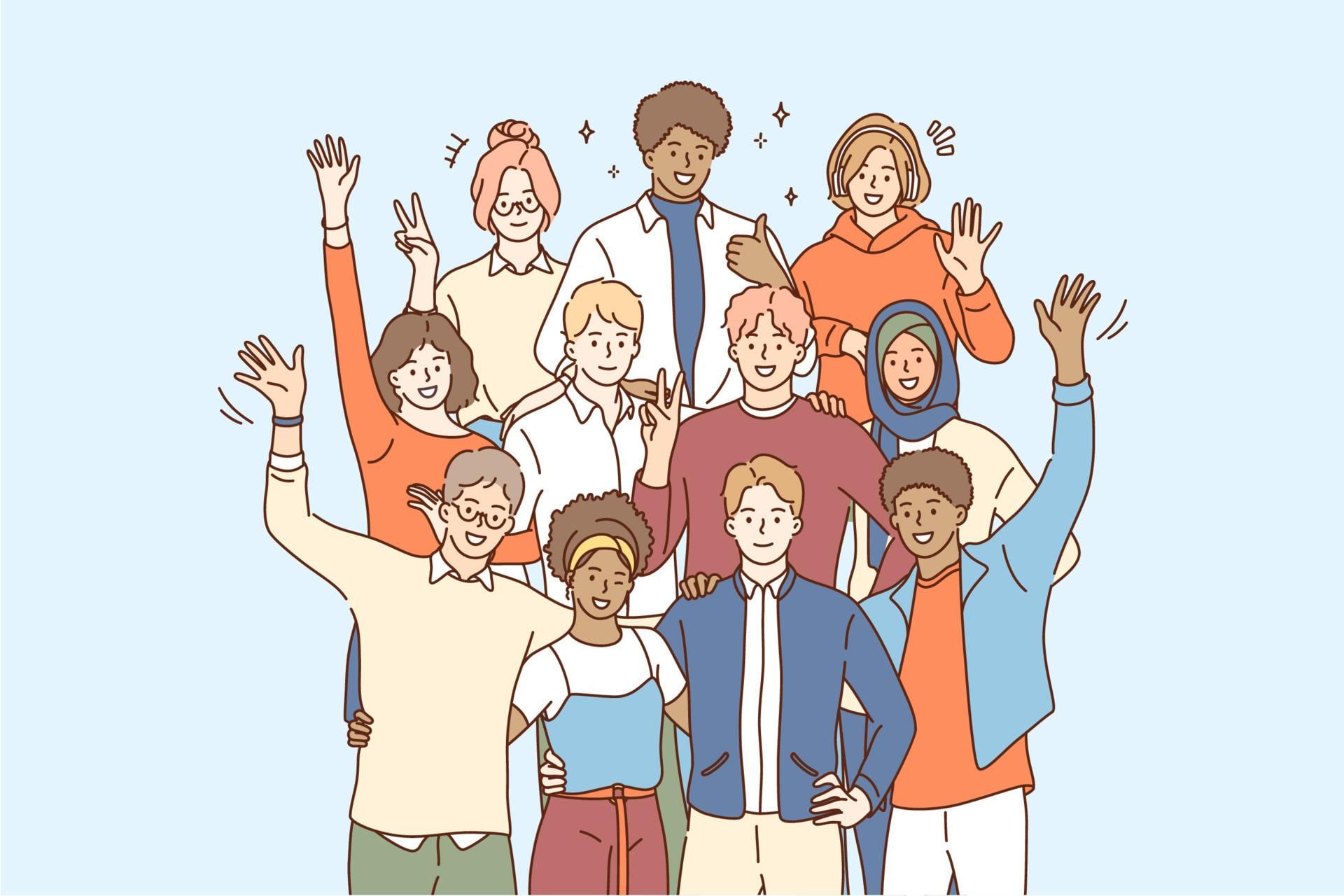
Ans: Unity in diversity in the Indian scenario means that people from many different religions, languages, regions and cultures live together and form one nation. Although Indians practise different customs, follow different faiths and speak many languages, they share common ideas, mutual respect and a sense of belonging to the same country. Institutions such as schools, courts and the Constitution, national symbols like the flag and anthem, and shared celebrations and public life help bring people together and keep the nation united.
Q2: What aspects of India's diversity are the most striking?
Ans: The most striking aspects of India's diversity are its many languages and dialects, the variety of festivals and rituals, the range of clothing styles and cuisines, and rich regional arts and crafts. One can also see diversity in music, dance forms, architecture and food habits. Despite these differences, common features such as respect for elders, joint family ties in many places, and shared public institutions link people across regions.
Q3: How do we make out the unity underlying the diversity?
Ans: We see unity underlying diversity in several ways. Shared stories and epics like the Ramayana and Mahabharata, national symbols such as the flag and anthem, and common civic institutions give people a sense of belonging. Daily life also shows unity: people from different parts of India use the same transport systems, attend the same schools, work together in offices and markets, and celebrate some festivals together. Values like mutual respect and the practice of helping one another also strengthen national unity.
Let's Explore
Page 126
Q: As a class activity, make lists of (1) the birthplaces of at least 5 classmates and the birthplaces of their parents; (2) the students' mother tongues and other languages known to them. Discuss the results in terms of diversity.
Ans: Birthplaces
Raghav:
Birthplace: Mumbai, Maharashtra
Mother Tongue: Marathi
Other Languages: Hindi, English, Bengali
Mother's Birthplace: Kolkata, West Bengal
Father's Birthplace: Chennai, Tamil Nadu
Naveen:
Birthplace: Bengaluru, Karnataka
Mother Tongue: Kannada
Other Languages: Telugu, Hindi, English
Mother's Birthplace: Hyderabad, Telangana
Father's Birthplace: Pune, Maharashtra
Tanya:
Birthplace: Delhi
Mother Tongue: Hindi
Other Languages: English, Punjabi
Mother's Birthplace: Jaipur, Rajasthan
Father's Birthplace: Lucknow, Uttar Pradesh
Deepak:
Birthplace: Ahmedabad, Gujarat
Mother Tongue: Gujarati
Other Languages: Malayalam, English, Hindi
Mother's Birthplace: Kochi, Kerala
Father's Birthplace: Bhubaneswar, Odisha
Sonam:
Birthplace: Kolkata, West Bengal
Mother Tongue: Bengali
Other Languages: Assamese, Hindi, English
Mother's Birthplace: Guwahati, Assam
Father's Birthplace: Patna, Bihar
Discussion on Diversity:
- Regional Diversity: The birthplaces of classmates and their parents cover many parts of India - North, South, East and West - showing how people from different regions live and study together.
- Linguistic Diversity: The variety of mother tongues and other languages known by students shows the multilingual nature of Indian society. Many students speak more than one language.
- Cultural Integration: These mixes of birthplaces and languages show how families and communities mix and learn from each other, creating a rich cultural exchange in the classroom.
- Unity in Diversity: Even with different regional and linguistic backgrounds, students share common school routines, celebrations and friendships, which shows how unity exists alongside diversity.
This activity shows how different elements combine to form a single social life in school, reflecting the wider idea of 'unity in diversity' in India.

Page 128
Q1: As a class activity, make a list of ingredients (grains, spices, etc.) that are used in your home.
Ans: Homes across India use many kinds of grains, pulses and spices. Common grains are rice, wheat, barley, bajra, jowar and ragi. Pulses include moong dal, chana dal, toor dal, urad dal, masoor dal and rajma. Spices often used are turmeric, cumin, coriander, cardamom, cloves, black pepper, mustard seeds and fenugreek. Other kitchen staples are rice flour, wheat flour, besan, ghee, different cooking oils, jaggery and tamarind. These ingredients show both regional tastes and shared cooking practices that are common to many Indian homes.
Q2: Take any one vegetable and think of the number of different dishes you can prepare with it.
Ans: The potato is a good example because it is used in many dishes across India and beyond. Examples include: Aloo Paratha (stuffed flatbread), Aloo Gobi (potato with cauliflower), Aloo Matar (potatoes with peas in gravy), Aloo Tikki (spiced potato patties), Jeera Aloo (potatoes with cumin), Mashed Potatoes and French Fries, Potato Salad, Dum Aloo (baby potatoes in a rich gravy) and Aloo Pakora (potato fritters). This variety shows how one vegetable can be used in different ways to make many tasty dishes.
Page 129
Q: Explain how the example of the sari reflects both unity and diversity (in 100-150 words).
Ans: The sari illustrates unity and diversity together. It is a single garment worn by women across India, which shows unity because so many people share this tradition. At the same time, the sari appears in many regional styles and fabrics, showing diversity. For example, it can be draped in the Nivi style in Andhra Pradesh, the Bengali style in West Bengal, or the Nauvari style in Maharashtra. Saris are made from different materials such as silk, cotton and synthetic fibres, and special weaves like Kanjivaram from Tamil Nadu and Banarasi from Uttar Pradesh reflect the skills of different regions. Thus, while the sari remains a common and recognised piece of clothing, the many ways it is made and worn display the rich cultural variety of India. The sari therefore connects people through a shared tradition while celebrating regional differences.
Page 130
Q1: In the above pictures, can you recognise what a sari has been used for?
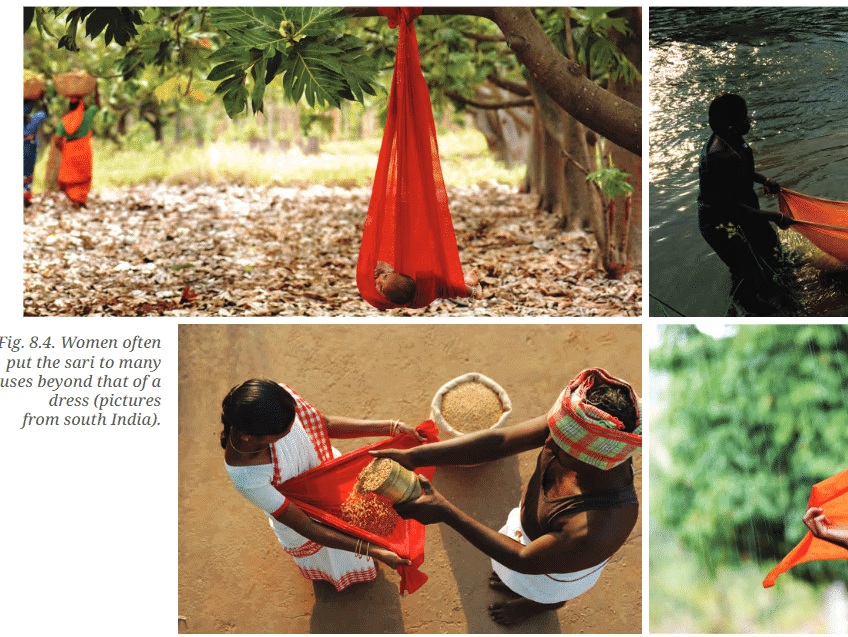
Ans: In the pictures, a sari is shown being used for many practical purposes besides being worn as clothing.
Some examples include:
- Baby Carrier: A sari can be tied to carry a baby on the back or the front, keeping the child safe and close to the mother.
- Towel or Wrap: It can be used as a towel, shawl or wrap to cover the body.
- Temporary Shelter: A sari can be spread to make shade or a quick shelter from sun or rain.
- Tying Objects: Pieces of sari cloth can be used to tie or bundle goods together for carrying.
- Mats or Blankets: A sari can be spread on the ground as a mat for sitting or as a light blanket.
Q2: Are you aware of, or can you imagine, more uses for the sari?
Ans: Apart from the uses above, saris can be used in many other ways:
- Curtains or Drapes: A sari makes a colourful curtain when hung up.
- Tablecloths: Large saris can be used to cover tables for meals or special occasions.
- Bags or Slings: With simple folding and tying, a sari can be made into a bag or sling.
- Wall Hangings: Decorative saris with fine designs are often used as wall hangings.
- Picnic Blankets: They are useful as large picnic mats when people sit outdoors.
Q3: Following the example of the sari, make a list of different styles you have seen for the dhoti - both as regards the fabric and the uses the dhoti can be put to. What conclusion can you draw?
Ans: The dhoti, like the sari, shows unity and diversity. It is a common traditional garment for men in many parts of India, yet it is worn in different regional styles and made from different fabrics.
- Panche Style: In Karnataka the dhoti is often pleated in front and tucked at the back to allow ease of movement.
- Mundu Style: In Kerala a plain white mundu is worn, usually with a matching cloth for the upper body.
- Bengali Style: The Bengali style uses distinctive pleats and a special knot at the waist.
- Tamil Style: In Tamil Nadu the dhoti is often worn tightly around the waist and may be plain or bordered.
Uses of the Dhoti:
- Formal Wear: Worn during ceremonies, weddings and festivals.
- Casual Wear: Comfortable everyday clothing in many rural and small-town settings.
- Religious Wear: Preferred attire for priests and during rituals.
- Dance and Performances: Used in classical dance and folk performances as a traditional costume.
Conclusion: The dhoti unites different regions through a shared garment, while its many styles and uses show regional creativity and cultural variation.
Page 132
Q1: What is your favourite festival and how is it celebrated in your region? Do you know whether it is celebrated in any other part of India, maybe under a different name?
Ans: My favourite festival is Diwali, which is celebrated with lights, rangoli, sweets and family gatherings. People clean and decorate their homes, light lamps, perform Lakshmi puja and often share sweets and gifts. Fireworks are also part of the celebration in many places. Diwali is celebrated across India but with different names and customs: in West Bengal it is observed as Kali Puja, while in some southern states it is called Deepavali. Local customs and rituals vary, but the general idea of celebrating light over darkness is common to many regions.
Q2: During October-November, many major festivals take place in India. Make a list of the few main ones and their various names in different parts of the country.
Ans: Major festivals in October-November:
- Diwali: Also called Deepavali in some southern states and observed as Kali Puja in West Bengal.
- Navratri/Dussehra: Known as Durga Puja in West Bengal and Odisha, and as Vijayadashami in Karnataka and Maharashtra.
- Eid-ul-Fitr: Celebrated by Muslims across India with prayers and feasts.
- Bhai Dooj: Called Bhai Phonta in West Bengal and Bhau Beej in parts of Maharashtra.
These festivals show how similar ideas are celebrated in different ways across the country, combining unity of feeling with regional variety.
Page 134
Q: In a class discussion, try to identify the episode depicted in the painting shown in Fig. 8.6 above and important details associated with it.
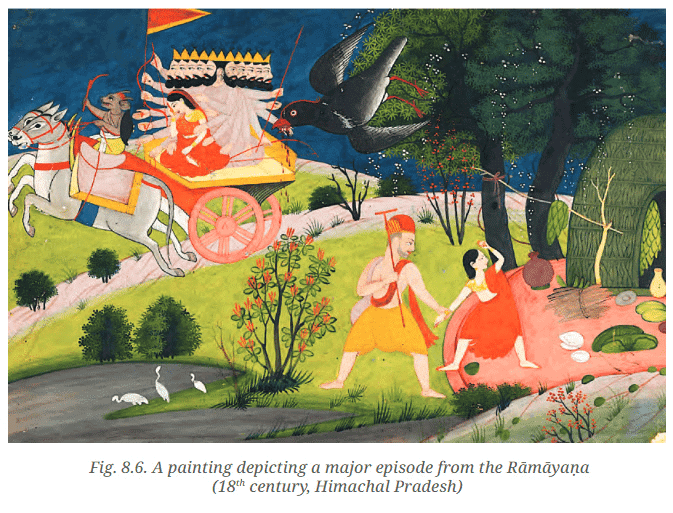
Ans: The painting depicts a well-known episode from the Ramayana in which Sita is taken away by Ravana. Important details of this episode include:
- Ravana's Deception: Ravana uses a trick to draw Sita out of the safety set by Lakshmana, often described as a disguise that makes him appear harmless.
- The Flying Chariot: Ravana takes Sita away in his magical chariot called the Pushpaka Vimana.
- Jatayu's Attempt to Help: The brave bird Jatayu fights Ravana to try to rescue Sita and shows great loyalty and courage.
- Sita's Plight: Sita resists the abduction and calls for help, which starts Rama's long journey to rescue her.
This episode sets in motion the main events of the Ramayana, including Rama's search for Sita and the final battle with Ravana.
Questions, Activities and Projects
Q1: Conduct a class discussion on the two quotations at the start of the chapter.
Ans: Quotation 1: "Oh, grant me my prayer, that I may never lose the bliss of the touch of the one in the play of the many." - Rabindranath Tagore
Discussion Points: This quotation asks us to find a single deep feeling or connection while living among many different people and experiences. In class, students can discuss how friendships, shared customs or festivals give a common feeling even when everyone's background is different. The quote encourages noticing the unity that exists within variety.
Quotation 2: "The principle of unity in diversity which has always been normal to [India] and its fulfillment the fundamental course of her being and its very nature, the Many in the One, would place her on the sure foundation of her Swabhava and Swadharma." - Sri Aurobindo
Discussion Points: This quotation explains that India's strength comes from holding together many different groups as one nation. In discussion, students can think of examples - such as different languages and festivals - that yet form a single national identity. The quotation can lead to talk about how respecting different customs and working for the common good helps the nation stay strong.
Q2: Read the National Anthem and its translation in the preliminary pages of this textbook. Where do you see the diversity? And where the unity? Write two or three paragraphs on this.
Ans: Diversity in the National Anthem: The National Anthem, "Jana Gana Mana," mentions many regions, rivers and cultural features of India, showing the country's wide geographic and cultural range. The lines refer to places and people from different parts of India, and this reflects the many languages, customs and landscapes found across the nation.
Unity in the National Anthem: Although it mentions diverse regions, the anthem brings all these elements together into a single message of respect and pride for the country. It aims at the whole nation and calls people from different backgrounds to feel united. The same melody and words are known and sung by people across India, which creates a sense of shared identity and belonging.
Paragraphs: The National Anthem highlights India's variety by naming different places and cultural images, which shows how many different lives make up the country. Each part mentioned in the anthem adds to the picture of a large and varied nation.
At the same time, the anthem unites these parts by speaking for the whole nation. When people stand and sing together, it strengthens a feeling that despite differences, everyone belongs to one country and shares common pride and responsibilities.
Q3: Select a few stories from the Pañchatantra and discuss how their message is still valid today. Do you know of any similar stories from your region?
Ans: Story 1: The Monkey and the Crocodile
Message: This story warns about blind trust and the harm that can come from betrayal. Today it teaches us to choose friends carefully and to be aware of others' intentions.
Story 2: The Tortoise and the Geese
Message: This tale teaches the value of keeping sensible silence and not speaking unnecessarily. In a world of many voices, thinking before speaking is still useful advice.
Similar Stories: Many regions have similar folk tales. For example, a local story about a clever rabbit outwitting a stronger animal has the same lesson as some Pañchatantra fables. These stories help children learn about cleverness, caution and good behaviour.
Q4: Collect a few folk tales from your region and discuss their message.
Ans: Folk Tale 1: The Legend of King Bhoja and the Vetala
Message: This tale shows that wisdom and clever thinking help to solve difficult problems. It teaches the value of using one's mind rather than force.
Folk Tale 2: The Story of the Charitable Banyan Tree
Message: This tale praises generosity and selfless help to others. It shows how kindness benefits the whole community.
Discussion Points: Folk tales often carry lessons about honesty, courage, kindness and cleverness. These lessons are still useful today because they help people understand right conduct and social values.
Q5: Is there any ancient story that you have seen being depicted through a form of art? It could be a sculpture, a painting, a dance performance, a movie ... Discuss with your classmates.
Ans:Ancient Stories Depicted Through Art: Many ancient stories are shown through art. For example, episodes from the Mahabharata and Ramayana are performed in dance forms such as Kathakali and Bharatanatyam, and are carved as sculptures in temples. These performances and artworks keep the stories alive and help people learn moral lessons. They also teach local culture and history to new generations.
Discussion Points: Talk about how such art forms help people remember old tales, learn about values and enjoy cultural performances. These arts make the stories part of everyday life and school learning.
Q6. Discuss in class the following quotation by India's first prime minister, Jawaharlal Nehru, when he travelled to many parts of India before Independence:
"Everywhere I found a cultural background which had exerted a powerful influence on their lives. ... The old epics of India, the Ramayana and the Mahabharata and other books, in popular translations and paraphrases, were widely known among the masses, and every incident and story and moral in them was engraved on the popular mind and gave a richness and content to it. Illiterate villagers would know hundreds of verses by heart and their conversation would be full of references to them or to some story with a moral, enshrined in some old classic."
Ans: Nehru's observation shows how deeply epics and classical stories influenced people's lives. Even when people could not read, they remembered verses and stories by heart. These tales shaped values, taught moral lessons and became part of everyday speech and thought. The quotation points to a strong oral tradition in India where stories, songs and verses were shared widely and helped to build a common cultural background across different regions.
FAQs on NCERT Solutions: Unity in Diversity, or 'Many in the One'
| 1. What does unity in diversity mean and how does it apply to India? |  |
| 2. How do different religions in India practice unity in diversity in daily life? | |
| 3. Why is language diversity important for understanding unity in India? | |
| 4. What role do cultural traditions play in maintaining unity despite diversity in Indian society? | |
| 5. How do constitutional values support unity in diversity for CBSE Class 6 Social Studies? | |