NCERT Solutions: Family and Community

Questions, Activities and Projects
Q1: What are some of the rules you follow in your family and neighbourhood? Why are they important?
Ans: Family Rules:
- Respecting Elders: Always greet and listen to elders.
- Chores Rotation: Share household chores on a rotating basis.
- Meal Times: Eat dinner together as a family every night.
- Study Time: Set specific hours for studying each day.
- Importance: These rules help family members live together peacefully. They teach respect for others, encourage cooperation, make responsibilities clear, and create time for family bonding. Such rules also make daily life organised and reduce conflicts.
Neighbourhood Rules:
- Quiet Hours: Maintain silence after 10 PM.
- Community Cleanliness: Residents take turns cleaning common areas.
- Parking Regulations: Adhere to designated parking spots.
- Importance: These rules keep the area peaceful and clean. They prevent disputes, make the neighbourhood safe, and ensure that public spaces are usable by everyone. Following these rules improves the quality of life for all residents.
Q2: Do you think some rules are unfair to a few people in the family or community? Why?
Ans: Some rules may seem unfair to certain people.
- For example, chore rotations can be hard for family members who are ill or very busy.
- Quiet hours can be difficult for people who work night shifts and sleep during the day.
- Rules are usually made to help most people, but they may not suit everyone's situation.
- To make rules fairer, families and communities should talk openly, listen to special needs, and allow exceptions or changes when required.
- Fairness comes from understanding individual problems and adjusting rules so that everyone is treated with care and respect.
Q3: Describe several situations that you have observed where community support makes a difference. You can draw or write about these.
Ans: Situations Highlighting Community Support:
- Health Crisis: When a neighbour fell seriously ill, people organised meal deliveries and a schedule to help the family. This support reduced stress and ensured the patient and family received care and companionship.
- Natural Disaster: After a severe storm damaged houses, community members worked together to clear debris and help with repairs. Their cooperation helped families return to normal life more quickly and lowered repair costs.
- Educational Support: Volunteers offered free tutoring to children from poor families. This improved the children's school performance and gave them confidence and better future prospects.
The Big Questions
Q1: Why is the family unit important?
Ans: The family unit is important because it is the basic social group that looks after a person's needs. It gives emotional support, care, and security. Families teach children values, help with education and health, share responsibilities, and provide financial help when needed. They create a sense of belonging and help members become responsible citizens.
Q2: What is a community and what is its role?
Ans: A community is a group of people who live in the same place or share common interests. Its role is to provide support, share resources, and solve problems together. Communities organise festivals and events, help members in times of need, maintain order, and work together for the welfare of everyone.
Let's Explore
Page 138
Q1: What types of families do you see in your neighbourhood? List the type with the number of households for each type.
Ans: There are a few different family structures found in many societies in my Neighbourhood:
- Nuclear Family: This is the most common type in many societies, consisting of parents (usually a married couple) and their children. There are around 40-50 nuclear families in our apartment society.
- Joint Family: Multiple generations living together, including parents, children, and grandparents. There are around 10-15 such families in our apartment society.
- Single-parent Family: A household with one parent and their children. This can be due to divorce, separation or the death of a partner. There are around 4-5 such families in our apartment society.
- Childless Family: A family with two partners who do not have children. There are around 10-18 such families in our apartment society.
Q2: What types are more frequent? Why do you think this is so?
Ans: The frequency of family types depends on where people live.
- Nuclear Family: Nuclear families are common in cities. People move for jobs and need smaller homes, so nuclear families are practical. This is why nuclear families are increasing in urban areas.
- Joint Family: Joint families are more common in villages and smaller towns. Here, several generations live together for support, shared work, and to keep family traditions alive.
Q3: As a class activity, compare with your classmates' findings and discuss.
Ans: Reena's Findings:
- Joint families: 3 households
- Nuclear families: 15 households
- Single-parent families: 2 households
Observations: Reena found more nuclear families, with fewer joint and single-parent households.
Reasons: This could be because Reena lives in an urban area where space and jobs favour nuclear families.
Discussion: Nuclear families are common in cities due to work-related moves and the need for privacy.
Mayank's Findings:
- Joint families: 8 households
- Nuclear families: 7 households
- Single-parent families: 1 household
Observations: Mayank found more joint families than nuclear ones, showing local differences.
Reasons: This may reflect cultural preference for living with extended family, especially in traditional or rural areas.
Discussion: Joint families share work and expenses and offer stronger emotional support.
Comparative Analysis:
- Family Types: Nuclear families are more common in urban areas; joint families are more frequent where traditional values and joint ownership of property remain strong.
- Impact of Setting: City life favours nuclear families for economic and space reasons, while rural life often supports joint family living for shared labour and care of elders.
Class Discussion: Students can discuss how jobs, housing, and culture affect family types, and compare benefits and challenges of each kind of family.
Page 139
Q1: Make a list of all the members of your family you can think of, including a few distant relatives. List their terms in your mother tongue or regional language and try to find the equivalent in English. Two examples are below for Hindi:
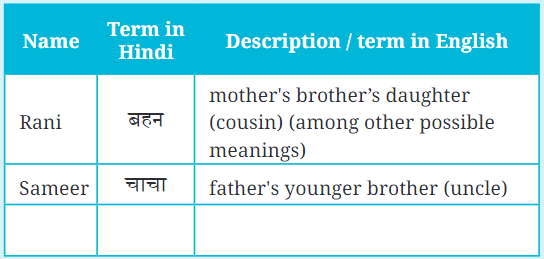
Ans: This example shows how family relationships are described with more specific terms in different regional languages, compared to English, where the terms are more general. Here are examples in Hindi, Tamil, and Bengali:
Hindi Example
- Rani: mother's brother's daughter (cousin)
- Sameer: father's younger brother (uncle)
- Anil: father's elder brother (uncle)
- Rekha: mother's brother's wife (aunt)
- Sunita: father's sister (aunt)
Tamil Example
- Ravi: father's elder brother (uncle)
- Lakshmi: father's elder brother's wife (aunt)
- Kumar: father's younger brother (uncle)
- Meena: father's younger brother's wife (aunt)
- Siva: mother's brother (uncle)
- Rani: mother's brother's wife (aunt)
- Mala: mother's sister (aunt)
- Raju: father's sister's husband (uncle)
Bengali Example
- Ramesh: father's elder brother (uncle)
- Sita: father's elder brother's wife (aunt)
- Shankar: father's younger brother (uncle)
- Parvati: father's younger brother's wife (aunt)
- Suman: mother's brother (uncle)
- Reema: mother's brother's wife (aunt)
- Nisha: father's sister (aunt)
- Father's sister's husband: (uncle)
These lists show that Indian languages often have precise words for different relatives, while English uses broader terms such as "uncle" and "aunt". This difference reflects the importance of family ties in many Indian cultures.
Q2: Notice how, quite often, a single word in your mother tongue or regional language requires several words in English to give a precise definition.
Ans: In Hindi and Tamil, family terms are more specific and give exact relationships, while English uses general words. Here are examples showing the difference:
Hindi Example:
- Chacha: Means "father's younger brother" in Hindi. In English he would be called "uncle" without the extra detail.
- Bua: Means "father's sister" in Hindi. In English she is also called "aunt" and the specific relation is not clear from the single word.
Tamil Example:
- Periyappa: Means "father's elder brother" in Tamil. In English, he is simply an "uncle."
- Chinnamma: Means "father's younger brother's wife" in Tamil. In English she would also be "aunt" without the specific relation.
This contrast shows how regional languages can carry more information about family relations in a single word. Such words help people understand exactly how someone is related in the family.
Page 140
Q: Answer these questions and compare your answers with a few classmates:
→ Who in your family decides what is to be bought from the market?
→ Who cooks food in your home?
→ Who is the oldest person in your family?
→ Who cleans the floor in your home?
→ Who washes utensils in your house?
→ Who helps you to do your homework?
Ans:
→ My mother decides what is to be bought from the market.
→ My mother usually cooks food in our home.
→ My grandfather is the oldest person in our family.
→ We have a house helper who cleans the floor in our home.
→ The house helper also washes the utensils.
→ My father helps me with my homework.
Ruchika's Answers
→ My father decides what is to be bought from the market.
→ My mother and grandmother cook food together.
→ My grandmother is the oldest person in our family.
→ My mother and I take turns cleaning the floor.
→ My mother washes the utensils.
→ My elder sister helps me with my homework.
Kartik's Answers
→ My parents decide together what is to be bought from the market.
→ My father usually cooks food in our home.
→ My great-grandmother is the oldest person in our family.
→ My mother cleans the floor in our home.
→ My sister and I wash the utensils.
→ My tutor helps me with my homework.
Comparison and Discussion
- Decision Making: In different families, decisions may be taken by one person or jointly by parents. This depends on family habits and who manages the household.
- Cooking: Cooking roles vary. Some families share the work, while in others one person cooks more often. This shows that household roles can change with time and family needs.
- Oldest Member: Often a grandparent is the oldest, but some families have great-grandparents living with them, which shows a larger, multi-generation household.
- Cleaning: Cleaning may be done by family members or by hired help. Different families have different ways of managing chores.
- Washing Utensils: Some families share washing utensils, while others may have help. This depends on resources and family choices.
- Homework Help: Help with homework can come from parents, siblings, tutors, or teachers. Support may vary according to what each child needs.
Discussion: These differences show that family roles depend on culture, resources, and personal choices. Discussing them helps us understand and respect how other families live.
Page 141
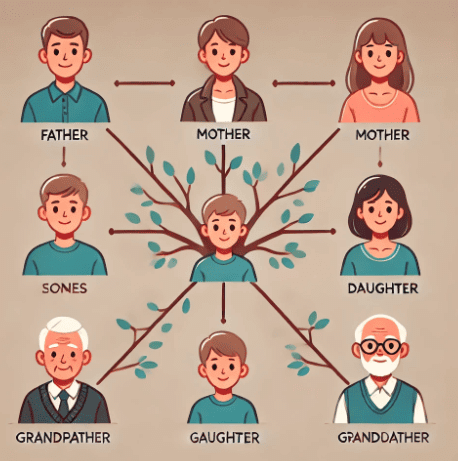
Q1: Draw a simple tree of this family of seven members.
Ans: A simple tree of a family of seven members:
Q2: Why do you think Shalini's parents bought clothes for everyone?
Ans: Shalini's parents bought clothes for everyone because her uncle (Chittappa) was facing financial difficulty and could not afford new clothes for the Onam festival. By buying clothes for all, her parents showed care and solidarity. This action ensured that everyone could celebrate together and feel included.
Q3: What would you have done if you were in Shalini's place?
Ans: If I were in Shalini's place, I would understand my parents' decision and be happy that they helped those in need. I would also feel proud that our family supported someone who was struggling, since helping others is more important than an individual gift.
Page 143
Q1: Create a story of a family somewhere in India, where we see some family values practised. Share it with your class either through writing or drawing.
Ans: The Sharma Family in Rajasthan
The Sharma family lives in a village in Rajasthan. The household includes Mr Sharma, Mrs Sharma, their children Raj and Priya, and Mr Sharma's parents, Dadaji and Dadiji. The family follows values such as respect, cooperation and the importance of education. Raj and Priya touch their grandparents' feet every morning as a sign of respect. Mrs Sharma and Dadiji share household work, Raj helps his father in the fields, and Dadaji tells moral stories every evening. During festivals the whole family prepares food and decorations together. Their regular visits to the local temple keep them connected to community traditions.
Q2: Stage a small drama with all your classmates around two or three families. The play you write could include some challenging situations that the families faced, and show how they are resolved.
Ans:Title: Strength in Unity
Characters:
- The Sharmas: Mr. Sharma, Mrs. Sharma, Raj, Priya, Dadaji, Dadiji
- The Mehtas: Mr. Mehta, Mrs. Mehta, Anjali
Scene 1: Financial Crisis
Setting: The Sharma household
(Mr. Sharma enters looking worried. The family gathers around him.)
Mr. Sharma: "Our crops failed this season, and we're short on money."
Dadaji: "Don't worry, we'll get through this together. Let's see how we can cut down on expenses."
Mrs. Sharma: "We can reduce unnecessary spending and rely on our stored grains."
(The family supports each other, planning ways to manage the crisis.)
Scene 2: The Mehtas' Dilemma
Setting: The Mehta household
(Anjali comes home crying.)
Anjali: "I failed my exams. I'm so ashamed."
Mr. Mehta: "We'll hire a tutor and help you study better."
Mrs. Mehta: "We'll all pitch in and support you. You can do it!"
(The Mehtas rally around Anjali, offering encouragement and help.)
Q3: In the stories of Shalini and Tenzing, we see examples of joint families. What do you think are the aspects of modern living that make some couples opt for a nuclear family (i.e., living apart from older generations or other relatives)? What could be some advantages as well as disadvantages of the two kinds of families?
Ans: Joint vs. Nuclear Families
Modern life brings job mobility, smaller living spaces and a desire for privacy, which often lead couples to choose nuclear families. Advantages of nuclear families include independence, quicker decision-making and privacy. Disadvantages can be less help with childcare and household work, and loneliness for elders. Joint families offer shared responsibilities, emotional support and care for elders, but they may also lead to less privacy, more conflicts over decisions, and stricter rules. Each family type has benefits and challenges, and the best choice depends on personal needs and circumstances.
Page 147
Q: Make a list of all people outside your family that are supporting you through their work in one way or another.
Ans: List of Supportive People Outside My Family:
- Teachers: They give education, guidance and help me learn new things.
- Friends: They give emotional support, help with studies, and keep me motivated.
- School Principal: They ensure the school is safe and that activities run smoothly.
- Tutors: They provide extra help in subjects I find difficult.
- Bus Driver:He safely takes me to and from school every day.
- Neighbours: They sometimes help with small tasks and keep an eye on each other.
- Doctors and Nurses:They take care of our health when we are sick.
Page 148
Q1: What types of communities are you part of?
Ans: My Communities:
- Family Community: My immediate and extended relatives who care for and support me.
- School Community: Teachers, classmates and school staff who teach and help me grow.
- Online Communities:Groups and forums where I share interests and learn new things.
- Sports Community: My local sports team and fellow players who train and compete with me.
Q2: Is there a club that you are a part of in school? How does it function?
Ans: School Club Participation: The Science Club meets weekly to carry out simple experiments, discuss ideas and work on projects. Members prepare for science fairs, invite guest speakers, and take part in environmental activities. The club helps students explore science, work in teams and build practical skills.
Think About It
Page 142
Q1: Why does Tenzing's father consult his wife for special expenses?
Ans: Tenzing's father consults his wife for special expenses because they make important decisions together. This shows a partnership where both parents share responsibility for the family's money and plan together to meet their needs. It also reflects their mutual respect and the importance of collaboration in handling unexpected needs and ensuring financial stability.
Q2: How do you feel about his participation in household chores?
Ans: Tenzing's father's help with household chores is positive. It shows that tasks at home can be shared and that men and women can work together. This sets a good example for children about equality and cooperation. His involvement in tasks such as cleaning, gardening, and helping with food preparation demonstrates his commitment to supporting his family and maintaining a balanced household.
Q3: What roles do the grandparents fulfil?
Ans: The grandparents in Tenzing's family play significant roles:
- Grandmother: She helps prepare food and tells stories that teach values and bring the family together.
- Grandfather: He helps Tenzing with his homework, takes him to the bus stop, and is active in helping others in the colony during problems like power failures.
Story-Based Questions
Page 142
Q1: Discuss this story in your class. What kind of attitude towards the community does it reveal?
Ans: The story shows a caring and responsible attitude towards the community. Kamal Parmar's work demonstrates concern for others and a wish to improve their lives. His initiative also encourages others to help and take part in community welfare.
Q2: What values get reflected in Kamal Parmar's initiative?
Ans: Kamal Parmar's initiative reflects values such as compassion, generosity and dedication. He helps children who lack resources, and the support from teachers and volunteers shows community spirit and teamwork.
Q3: Think about those underprivileged children. Do you think society has been unfair to them?
Ans: Yes. Many children are denied equal opportunities because of poverty, lack of schools, or social barriers. This makes it harder for them to learn and improve their lives.
Q4: What should society do to make sure that all children get access to education?
Ans: Society should ensure free and good-quality education for every child. This includes building schools, training teachers, providing books and uniforms, and offering financial help to poor families. Community programmes, scholarships and local volunteers can also support children who need extra help. Additionally, awareness campaigns should be conducted to emphasise the importance of education and reduce societal barriers.
FAQs on NCERT Solutions: Family and Community
| 1. What is the difference between a family and a community in social studies? |  |
| 2. How do roles and responsibilities work differently in families versus communities? | |
| 3. What are the different types of families and how do they affect community life? | |
| 4. Why is cooperation between family members and community members important? | |
| 5. How do customs, traditions, and cultural practices connect families to their communities? | |