NCERT Solutions: Grassroots Democracy — Part 1: Governance


The Big Questions (Page 149)
Q1: What is the meaning of 'governance'?
Ans: Governance means the ways in which decisions are made and put into practice for a group, organisation or a country. It includes making rules and policies, choosing how resources are used, organising public services and ensuring that those decisions are carried out. Good governance also means that decision-makers are accountable and that ordinary people can take part or give feedback on those decisions.
Q2: Why do we need a government?
Ans: We need a government to keep society running smoothly and safely. A government makes and enforces laws, protects people's rights, provides public services like schools and hospitals, manages resources such as water and roads, and resolves disagreements. Without a government, there would be confusion, unfairness and little protection for people's security and basic needs.
Q3: What is the meaning of 'democracy'? Why is it important?
Ans: Democracy is a form of government in which power rests with the people. Citizens can take part in making important decisions either directly or by voting for representatives. It is important because it gives people a voice in how they are governed, promotes equality, protects basic freedoms like free speech and fair trial, and makes leaders answerable to the public through regular elections.
Let's Explore (Page 150)
Q1: Describe the two pictures given in Fig. 10.1 on page 151 - what differences do you see between them?
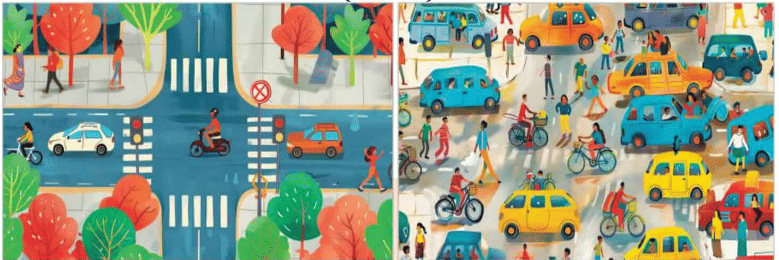
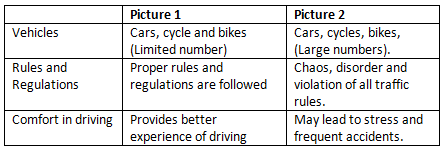
Ans: The two pictures show a clear contrast between a place where rules are ignored and one where rules are followed. In the first picture people seem to be confused and doing different things without order; there may be crowding, noise or chaos. In the second picture people are organised, following signs and instructions, and things look calm and safe. The main difference is that following rules brings order, safety and fairness, while not following rules causes confusion and problems.
Let us see the differences in Picture 1 and Picture 2:
Q2: How do you connect this with our discussion on rules?
Ans: Rules help people live together peacefully and make places work better. They prevent fights, protect people's safety, and make sure everyone knows what to do. Some rules are made to stay for a long time but can be changed when needed. We also have rules at school and at home so that learning and daily life are safe and fair for everyone.
Q3: What are some of the rules in your school? Who made them?
Ans: (i) Every school has rules for students, teachers and non-teaching staff to keep the school safe and to help learning happen smoothly. Typical rules include arriving on time, wearing the school uniform, keeping the classroom clean, not running in corridors, and respecting others.
(ii) These rules are usually made by the School Administration - the Principal, Vice-Principals and teachers - often with suggestions from the school management, parents and sometimes the student council. The aim is to make school safe, fair and friendly for all.
- Attendance: It is mandatory for students to attend school regularly.
- Discipline: Students are expected to follow certain discipline for the orderly functioning of the classes.
- Uniform: Students are expected to wear a neat school uniform and maintain proper hygiene.
- Classroom Behaviour: There are certain conduct of conduct in the classroom for a better learning process.
- No use of electronic devices like mobiles and laptops.
- Bullying, teasing, commenting, and discriminating against others are strictly not allowed.
(ii) The school rules are made by the School Administration, including the Principal and Vice-Principals, along with the suggestions from parents and teachers.
Let's Explore (Page 153)
Q1: Can you identify the categories of public service or other activities that are represented in the ten pictures in Fig. 10.2 on page 152?
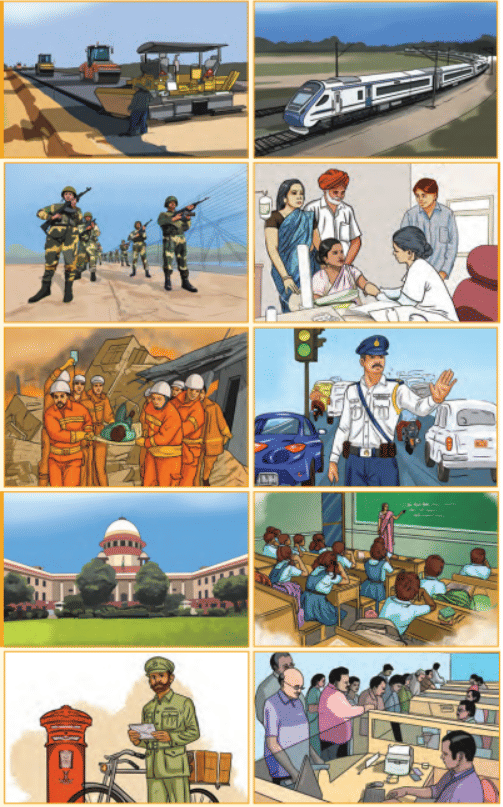
Ans:
- Picture 1: Public development and infrastructure services.
- Picture 2: Transport service.
- Picture 3: Security and safety services.
- Picture 4:Healthcare services.
- Picture 5:Disaster management and relief services.
- Picture 6: Road traffic safety (Traffic - Police).
- Picture 7: Judicial services.
- Picture 8: Educational services.
- Picture 9:Postal services.
- Picture 10:Banking services.
Q2: What role do you think the government plays in each of these activities?
Ans:
- Road construction and railway transportation: The government builds and maintains roads, bridges and railways so people and goods can move safely and quickly.
- Border security and military: The government provides defence and security to protect the country and keep citizens safe from external threats.
- Healthcare services: The government runs hospitals and health centres and organises vaccination and public health programmes so people can get medical help.
- Disaster management: The government organises rescue and relief operations during floods, earthquakes or other disasters and helps people rebuild afterwards.
- Traffic regulation: Traffic police enforce road rules, manage traffic and reduce accidents to keep roads safe for everyone.
- Judicial system: The government runs courts that apply laws, decide disputes and make sure justice is done fairly.
- Education: The government runs public schools and colleges, sets standards and works to make education available for all children.
- Postal services: The government runs the postal system to deliver letters and parcels across the country and abroad.
- Public administration: Government offices manage services such as issuing certificates, collecting taxes and implementing welfare schemes for citizens.
Q3: Can you think of other aspects of your daily life where the government plays an important role?
Ans: There are many everyday activities that depend on government action, for example:
- Checking and ensuring the quality and fair prices of food items, milk and other essentials so people get safe goods.
- Helping to preserve forests and the environment, and taking steps to reduce air and water pollution.
- Ensuring regular supply of clean water and electricity for homes and schools.
- Maintenance of parks, cleaning of roads, and provision of street lights to keep neighbourhoods safe and pleasant.
- Providing health and education services, including vaccination drives and running government schools.
Let's Explore (Page 154)
Q: Explain how the three government organs are at work in the case of the cyber criminals described above. How do they intervene?
Ans: Here's how each branch plays its role:
- Legislature: The Legislature makes laws about cybercrime, for example by passing acts that define what counts as a cyber offence and what penalties apply. These laws set the rules that everyone must follow and give the police and courts clear guidance on how to deal with cyber offences.
- Executive: The Executive includes the police and specialised cyber teams who enforce cybercrime laws. They investigate complaints, collect evidence, arrest suspects and take steps to prevent further cyber attacks. The Executive also runs public awareness campaigns to teach people how to stay safe online.
- Judiciary: The Judiciary, or the courts, hears cases against those accused of cybercrimes. Judges examine the evidence, decide whether a law has been broken and give appropriate punishment. The Judiciary also protects the rights of accused persons by ensuring a fair trial.
Let's Explore (Page 155)
Q: As a class activity, can you imagine the sort of disorder we might witness if all three organs were under the control of the same group of people? Can you describe any such real-life situation you may have heard of?
Ans: If the Legislature, Executive and Judiciary were all controlled by the same group, checks and balances would disappear and a single group could use power unfairly. Some likely problems are:
1. Loss of Checks and Balances: There would be no independent body to question or control wrong decisions. This could lead to corruption and abuse of power.
2. Unfair Laws: The ruling group could pass laws that favour themselves or silence critics, without fair debate or protection for minorities.
3. Arbitrary Law Enforcement:Authorities could target people or groups for political reasons, punish without fair cause, or ignore crimes by their supporters.
4. No Fair Trials:Courts might not act independently, causing innocent people to be punished or people to be denied proper legal protection.
Real-life note: From history and news, students may learn about periods called dictatorships or times when the separation of powers was weak; during such periods power was often concentrated and citizens had fewer protections. Discussing specific examples should be done carefully in class, using reliable sources and guidance from the teacher.
Q1: Observe the table (Fig. 10.5). Highlight the functions and responsibilities that affect your life the most.
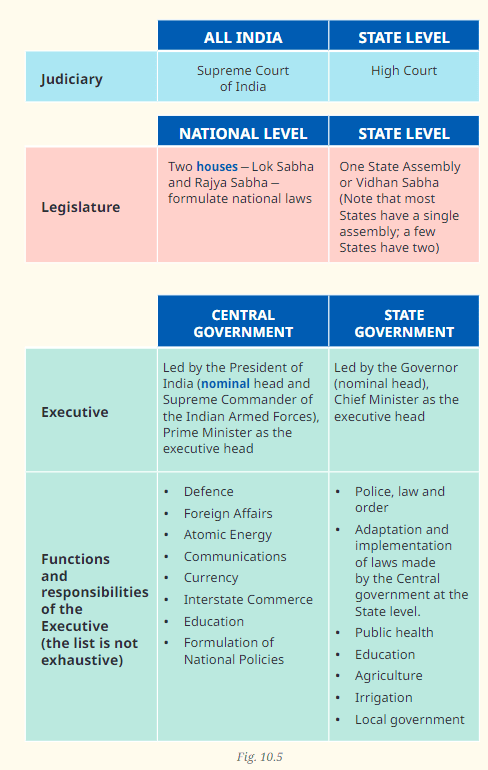
Ans: The functions and responsibilities from the table that most likely affect your life the most:
- Police, Law, and Order (State Government): They keep neighbourhoods safe, respond when there is crime, and ensure that people can go about their daily life without fear.
- Public Health (State Government): Public health services decide how hospitals and clinics work, organise vaccination drives and run health programmes that help you and your family stay healthy.
- Education (Central and State Governments): The government makes and runs schools, decides the curriculum and supports teachers so that children can go to school and learn.
- Local Government (State Government): Local bodies provide water, maintain roads, collect garbage and manage parks near your home - services you see every day.
These functions help to keep your community healthy, safe and able to grow.
Q2: Ask two or three adults about their connection or interaction with the government-at what levels does it take place and for what purpose?
Ans: Interactions with the Government (Based on Adult Responses):
- Interaction at the State Level: One adult mentioned dealing with the State Government to obtain a driving licence, which involved visiting the regional transport office (RTO) for tests and paperwork.
- Interaction at the Local Level: Another adult described engaging with the Local Government for property tax payments and seeking permission for home renovation, which required contact with the municipal office.
- Interaction at the Central Level: Some adults also deal with the Central Government for matters like applying for a passport, income tax returns or schemes run at the national level.
These examples show how people approach different levels of government depending on the kind of service or document they need.
Questions, Activities and Projects (Page 161)
Q1: Test yourself- What is the meaning of democracy? What is the difference between direct democracy and representative democracy?
Ans: Democracy means a system of government in which power rests with the people. Citizens take part in decision-making either directly or by electing representatives through free and fair elections.
1. Direct Democracy: People vote on laws and policies themselves, without choosing someone else to decide for them. Example: Ancient Athens and modern referendums where citizens vote on a single issue.
2. Representative Democracy:People elect representatives (such as MPs or MLAs) who make laws and run the government on their behalf and are accountable to the people. Examples: India, the United Kingdom and the United States.
Q2: Recall the three organs of government. What are their different roles?
Ans: The three organs of government are the Legislature, the Executive and the Judiciary. Their roles are as follows
(i) The Legislature (Law-making)
- The Legislature makes new laws and updates or removes old laws.
- It is composed of representatives who are elected by the people and who debate and vote on laws.
(ii) The Executive (Law enforcement)
- The Executive puts laws into action and runs the daily affairs of government.
- It includes the Prime Minister or Chief Minister, ministers, government departments, the police and other agencies that enforce laws and provide services.
(iii) The Judiciary (Law interpretation)
- The Judiciary interprets laws and decides if laws or government actions are fair and legal.
- Court judges decide disputes, determine guilt or innocence, and can order remedies or punishments when laws are broken.
Q3: Why do we need three tiers of government?
Ans: We need three tiers - Local, State and National - so that decisions are made at the level closest to the people affected and services can be delivered faster and more fairly.
- Local Government (city/town/village): Looks after nearby needs like sanitation, streetlights, local roads, water supply and parks so communities get quick attention.
- State Government: Manages matters that affect the whole state such as education, public health, agriculture and state transport.
- National (Union) Government: Handles country-wide issues like defence, foreign affairs, currency, national railways and the national economy.
This system helps make governance more efficient, accountable and responsive to local, state and national needs.
Q4: Project: Many of you will remember the lockdown that took place during the COVID-19 pandemic. Make a list of all the actions that were taken at that time? Which tiers of government were involved in managing the situation? What was the role of each of the organs of government?
Ans: Actions Taken:
- A nationwide lockdown and restrictions on movement were imposed to reduce the spread of the virus.
- Rules for social distancing, wearing masks and hygiene were enforced.
- Quarantine centres and temporary hospitals were set up to treat patients.
- Food, medicines and essential supplies were distributed to those in need.
- Financial relief packages and support were announced for affected workers and businesses.
- Online classes and remote learning arrangements were introduced for students.
Tiers of Government Involved
- Central Government: Coordinated nationwide policies such as travel restrictions, economic relief packages, and procurement of medical supplies.
- State Governments: Implemented health measures in their states, organised hospital facilities, and enforced lockdown rules at state level.
- Local Governments:Handled community level tasks such as distributing food, maintaining quarantine centres, conducting local surveillance and supporting local health teams.
Roles of the Three Organs
- Legislature: Passed or authorised laws and measures needed to respond to the emergency, such as special funding or rules to manage the pandemic.
- Executive:Implemented those measures - the police and health departments enforced lockdowns, ran testing and treatment facilities, and managed logistics for relief.
- Judiciary:Ensured that actions taken during the emergency were legal and fair, and resolved disputes about rights and government decisions when necessary.
FAQs on NCERT Solutions: Grassroots Democracy — Part 1: Governance
| 1. What exactly is grassroots democracy and how does it work at the local level? |  |
| 2. How is a Gram Sabha different from a Gram Panchayat in village governance? | |
| 3. What are the main responsibilities and powers of a Panchayat in CBSE Class 6 Social Studies? | |
| 4. Why do we need local government bodies like Panchayats instead of just having state and national governments? | |
| 5. How do citizens participate in grassroots democracy through Gram Sabhas and local decision-making processes? | |