CBSE Class 6  >  Class 6 Notes  >  Social Studies  >  Worksheet Solutions: Oceans and Continents

Worksheet Solutions: Oceans and Continents

Multiple Choice Questions (MCQs)

Q1: What is the largest continent on Earth?
(a) 
Africa
(b) Asia
(c) North America
(d) Antarctica
Ans: (b) Asia

Q2: Which ocean is the smallest?
(a)
Indian Ocean
(b) Arctic Ocean
(c) Atlantic Ocean
(d) Pacific Ocean
Ans: (b) Arctic Ocean

Q3: What is the main reason for seawater being salty?
(a)
Fish excretion
(b) River runoff of salt
(c) Underground springs
(d) Evaporation
Ans: (b) River runoff of salt

Q4: How many major oceans are there?
(a) 
Three
(b) Five
(c) Seven
(d) Four
Ans: (b) Five

Q5: What is the term for large, powerful waves caused by underwater earthquakes?
(a) 
Cyclones
(b) Tsunamis
(c) Tides
(d) Storm surges
Ans: (b) Tsunamis

Fill in the Blanks

Q1: The __________ Ocean is the largest ocean on Earth.
Ans: Pacific

Q2: The __________ is a massive wave typically caused by an earthquake.
Ans: Tsunami

Q3: __________ is the process by which water vapor turns into liquid water.
Ans: Condensation

Q4: The Indian Navy's motto is "Sam noh __________."
Ans: Varunah

Q5: The __________ Hemisphere has more land than the Southern Hemisphere.
Ans: Northern

True or False

Q1: The Southern Hemisphere has more land than the Northern Hemisphere.
Ans: False

Q2: Freshwater is more abundant than seawater on Earth.
Ans: False

Q3: Oceans produce more than half of the world's oxygen.
Ans: True

Q4: Greenland is the largest continent in the world.
Ans: False

Q5: The Arabian Sea is located to the east of India.
Ans: False

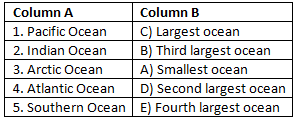
Match the Following
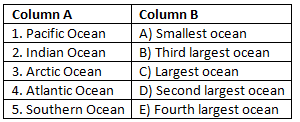
Match the FollowingAns:

Match the Following

The document Worksheet Solutions: Oceans and Continents is a part of the Class 6 Course Social Studies for Class 6.
All you need of Class 6 at this link: Class 6

FAQs on Worksheet Solutions: Oceans and Continents

1. What are the seven continents and how do I remember them for my Class 6 exam?
Ans. The seven continents are Asia, Africa, North America, South America, Europe, Australia, and Antarctica. A helpful memory trick is "AANAAA" or grouping them by size: Asia is the largest, followed by Africa, North America, South America, Europe, Australia, and Antarctica. Students can use flashcards or mind maps to visualise their locations on world maps and remember their distinctive shapes and positions.
2. How are oceans different from seas, and what are the five major oceans?
Ans. Oceans are vast bodies of saltwater covering Earth's surface, while seas are smaller and often connected to oceans or partially enclosed by land. The five major oceans are the Pacific, Atlantic, Indian, Arctic, and Southern oceans. The Pacific Ocean is the largest and deepest. Refer to visual worksheets and PPTs to understand ocean boundaries and characteristics clearly for your CBSE Social Studies curriculum.
3. Why do continents and oceans matter for geography studies in Class 6?
Ans. Understanding continental and oceanic distributions is fundamental to geography as it shapes climate, weather patterns, biodiversity, and human settlements. Continents influence how people live, trade, and develop cultures, while oceans regulate temperatures and support marine life. This knowledge forms the foundation for studying world regions, migration patterns, and natural resources in your Class 6 Social Studies course.
4. What's the difference between a continent and an island, and can I get examples for worksheet solutions?
Ans. Continents are massive landmasses surrounded by oceans, while islands are smaller pieces of land completely surrounded by water. Examples include New Zealand and Japan as islands, versus Asia and Africa as continents. Islands can be near continents or isolated. Understanding this distinction helps solve worksheet problems accurately and clarifies geographical classifications essential for CBSE exams.
5. How do I identify oceans and continents on a world map using latitude and longitude lines?
Ans. Latitude lines run horizontally (measuring distance north-south from the equator), while longitude lines run vertically (measuring east-west). Continents span multiple latitude and longitude coordinates; oceans occupy spaces between them. Using grid references, students locate continents like Europe between 35°N-71°N latitude and identify oceans like the Atlantic between 30°W-80°W longitude. Maps with coordinate systems strengthen map-reading skills essential for worksheet solutions.
Explore Courses for Class 6 exam
Get EduRev Notes directly in your Google search
Related Searches
Worksheet Solutions: Oceans and Continents, shortcuts and tricks, mock tests for examination, pdf , ppt, Worksheet Solutions: Oceans and Continents, video lectures, MCQs, Free, Objective type Questions, Previous Year Questions with Solutions, practice quizzes, Semester Notes, Worksheet Solutions: Oceans and Continents, Viva Questions, Summary, Important questions, Sample Paper, Exam, study material, Extra Questions, past year papers;