NCERT Solutions: The Value of Work

Questions, Activities and Projects
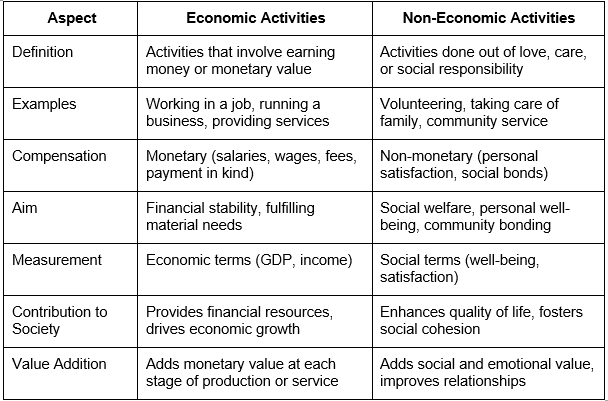
Q1: How are economic activities different from non-economic activities?
Ans:
Ans:
Q2: What kind of economic activities do people engage in? Illustrate with examples.
Ans: People engage in many kinds of economic activities. Some common types are:
- Agriculture: Farmers growing crops and selling them in markets.
- Services: Teachers earning a salary, nurses providing care for pay, and software engineers developing applications for companies.
- Trade and Retail: Shopkeepers buying goods wholesale and selling them in their shops.
- Manufacturing: Workers in factories producing clothes, toys or tools for sale.
All these activities create goods or services that others buy, and they usually bring money to the people who do them.
Q3: There is great value attached to people who are engaged in community service activities. Comment on this statement.
Ans: Community service activities are very valuable because they improve life for many people. Such activities include teaching children for free, helping the elderly, organising cleanliness drives and arranging community kitchens. They build trust and cooperation among people, strengthen social bonds and make local neighbourhoods better places to live. Even when there is no money involved, these services create social benefits: they help the needy, teach responsibility, and often inspire others to help too. In short, community service adds social value and improves the quality of life for everyone.
Q4: What are the various ways in which people are compensated for various economic activities? Give some examples.
Ans: People are paid in different ways depending on the work they do. Common forms of compensation are:
- Salaries: Regular monthly pay for jobs like teachers, government employees and office workers.
- Wages: Daily or hourly pay for labourers, construction workers and farmhands.
- Fees: Payments for professional services, for example doctors, lawyers and private tutors charge fees.
- Profit: Business owners earn profit when they sell goods for more than the cost of making or buying them.
- Commission: Salespeople may get a percentage of the sales they make.
- Payment in kind: Instead of money, workers might receive goods - for example, farm workers given grain or fruits.
- Rent, interest and pension: Owners of property receive rent, lenders receive interest, and retired people may get a pension.
These different methods show that compensation can be money, goods or regular payments depending on the nature of the work.
The Big Questions
Q1: What are the different types of activities that people engage in?
Ans: People carry out mainly two broad types of activities:
- Economic activities: Activities done to earn money or produce goods and services for others. Examples: farming, teaching for pay, running a shop, carpentry.
- Non-economic activities: Activities done out of love, duty or social responsibility without expecting money. Examples: helping family members, volunteering, religious or cultural duties.
Q2: What is their contribution to our everyday lives?
Ans: Both types of activities are important:
- Economic activities provide income, food, shelter and the goods and services we need every day. They keep markets and public services working.
- Non-economic activities build strong family ties, teach values such as care and cooperation, and support those who cannot earn for themselves. They improve emotional well-being and social cohesion.
Together they make daily life secure, comfortable and caring.
Let's Explore
Page 185
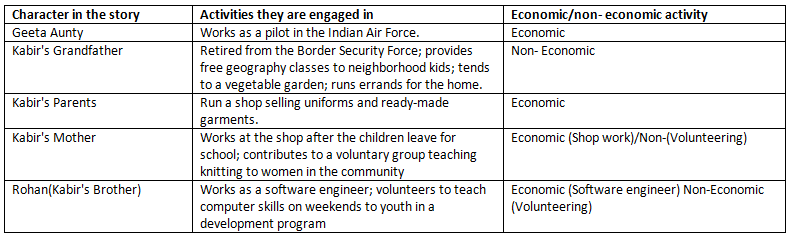
Q: What activities did the people in Anu's and Kabir's story engage in? Mention them in the table given below:
Ans:
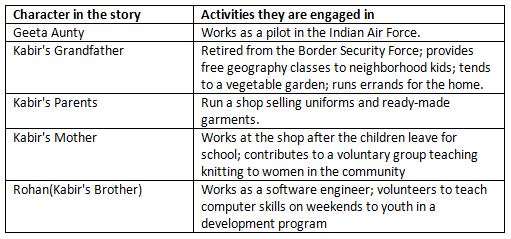
Page 187
Q: In the table given on page 185, did you notice the third empty column? Label this column 'economic / non-economic activity'. Now classify them according to the nature of activity.
Ans:
Page 191
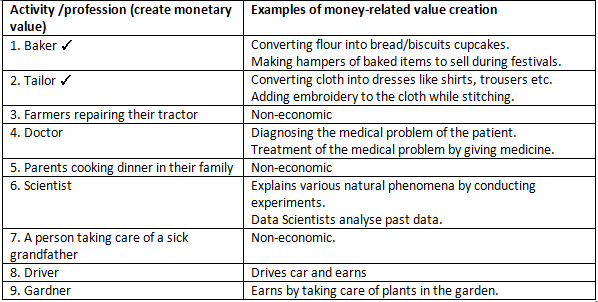
Q: Put a ✓ against those activities/professions that you think, create monetary value. Can you add two activities and examples of money related value creation to the empty rows at the end?
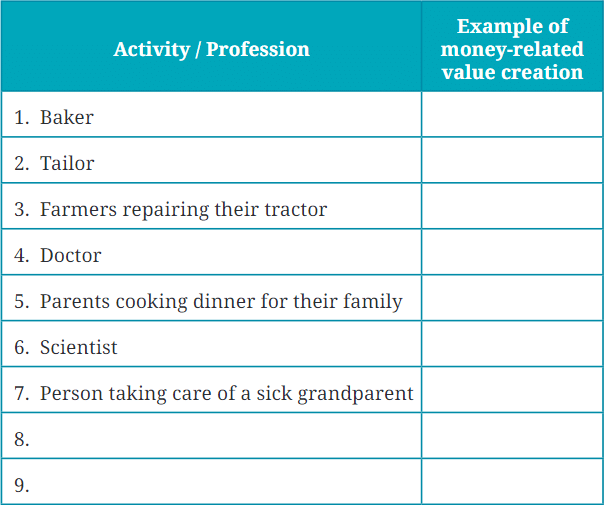
Ans:
Think About It
Page 187
Q1: When Kabir's grandfather voluntarily teaches the neighbourhood kids for free, is that an economic activity or a non-economic activity? How is it different from your teachers teaching you at school? Discuss with your classmates.
Ans: When Kabir's grandfather teaches neighbourhood children without taking money, it is a non-economic activity because his motive is to help and share knowledge, not to earn. It is usually informal and done out of goodwill.
Teaching in school by a trained teacher who receives a salary is an economic activity. The school teacher gives lessons as part of a paid job; the work is formal, regular and part of an exchange where the teacher's time and skill are rewarded with payment.
Q2: What are some non-economic activities that are important to you and your family? Why are they valuable?
Ans: Many non-economic activities matter a great deal to families. Examples include:
- Parents cooking meals and taking care of children (shows love and keeps the family healthy).
- Family members caring for the elderly (ensures safety and emotional support).
- Helping each other with daily tasks like cleaning, shopping or homework (builds cooperation).
- Celebrating festivals and special occasions together (strengthens traditions and relationships).
These activities are valuable because they create trust, provide emotional support, teach responsibility and preserve cultural values. They keep families strong even though they do not bring money.
Page 189
Q: On your way from home to school today, can you recall the various economic activities that people are engaged in? In what ways do you think those people are paid?
Ans: Way from home to school, lots of economic and non-economic activities can be seen:
- Traffic policeman regulating traffic. (Paid a salary by the government)
- Labour working at the construction site. (Paid daily wages)
- Hawker selling vegetables. (Earns cash or digital payments from buyers)
- Vendor selling ice-cream. (Earns cash or digital payments from buyers)
- Shopkeeper selling grocery. (Earns cash or digital payments from buyers)
Each of these people provides a service or sells goods. The police officer is a government employee who receives a regular salary. Labourers usually get wages paid daily or weekly. Small sellers earn money when customers buy their goods, and they may also accept payments through mobile apps today.
Page 193
Q1: Many communities in India have similar practices that involve community participation. Can you identify a few from your area?
Ans: Some common community participation activities are:
- Meditation or yoga sessions organised in a local park.
- Helping to arrange weddings or birthday celebrations.
- Joining or attending religious festivals and rituals.
- Community kitchens or langars at Gurudwaras where people share free meals.
- Volunteering for local schools, resident welfare associations or cleanliness drives.
These activities bring people together, encourage cooperation and help solve local problems.
Q2: We celebrate many festivals in India. During these festivals, people gather to organise all the various activities. They decorate the place together and share the food that they cook. Are these non-economic activities? Why do you think they still hold value?
Ans: Yes, festival activities are usually non-economic because they are done to celebrate, remember traditions and bring people together, not to make money. They hold great value because they preserve culture, create a sense of belonging, strengthen friendships and family ties, and teach children about community values. Sharing food and helping with decorations also shows generosity and builds trust among neighbours.
Q3: Can you identify community programmes that have been undertaken by your school or in your locality? What did you observe during these programmes?
Ans: My School has undertaken various community programmes:
- The Environment Club: The Environment Club organises activities such as cleaning nearby localities, planting trees, and keeping gardens and riverbanks clean. Students learn the importance of cleanliness and protecting nature.
- The Interact Club: The Interact Club involves students in social service activities. It teaches empathy and teamwork. Students take part in visits to old-age homes, blood donation drives and awareness campaigns, learning to serve others and act responsibly.
FAQs on NCERT Solutions: The Value of Work
| 1. What does "the value of work" actually mean in Class 6 Social Studies? |  |
| 2. Why do different types of work have different pay if all work is valuable? | |
| 3. How does understanding work's importance help us respect all workers in society? | |
| 4. What are the main differences between skilled work and unskilled work explained in this chapter? | |
| 5. How can I remember the key concepts about work's value for my Class 6 exams? | |