CBSE Class 6  >  Class 6 Notes  >  Social Studies  >  Worksheet: Landforms and Life

Worksheet: Landforms and Life

Multiple Choice Questions (MCQs)

Q1: What is a landform?
(a) 
A type of tree
(b) A natural feature on the Earth's surface
(c) A man-made structure
(d) A type of animal

Q2: Which mountain is known as the highest peak in the Himalayas?
(a) 
Kanchenjunga
(b) Mount Kilimanjaro
(c) Mount Everest
(d) Mont Blanc

Q3: What type of farming is commonly practiced in mountainous regions?
(a) 
Terrace farming
(b) Aquaculture
(c) Urban farming
(d) Hydroponics

Q4: Which of the following is a characteristic of plateaus?
(a) 
They are always covered with snow
(b) They have a flat top
(c) They are lower than the surrounding land
(d) They are formed by erosion

Q5: What is the Tibetan Plateau commonly referred to as?
(a)
The Roof of the World
(b) The Valley of the Gods
(c) The Desert of the East
(d) The Mountain Range

Fill in the Blanks

Q1: A __________ is a natural feature on the Earth's surface, such as mountains or plains.

Q2: The __________ is the highest mountain in South America.

Q3: __________ farming is practiced on steep slopes by cutting steps into the land.

Q4: The __________ Plateau is known for its rich mineral resources.

Q5: The __________ is a large area of flat or gently rolling land.

True or False

Q1: Mountains are always covered with snow.

Q2: The Himalayas are considered young mountains because they formed recently in Earth's history.

Q3: The Tibetan Plateau is the largest and highest plateau in the world.

Q4: Floodplains are formed by the deposition of sediments by rivers.

Q5: The term 'avalanches' refers to the sudden fall of rocks from a mountainside.

Match the Following
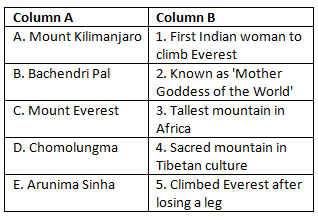
Match the Following

You can access the solutions to this worksheet Worksheet Solutions: Landforms and Life.

The document Worksheet: Landforms and Life is a part of the Class 6 Course Social Studies for Class 6.
All you need of Class 6 at this link: Class 6

FAQs on Worksheet: Landforms and Life

1. What are the different types of landforms and how do they affect where people live?
Ans. Landforms like mountains, plateaus, plains, and valleys shape human settlement patterns. Mountains create barriers but provide resources; plains offer fertile soil for agriculture; plateaus enable trade routes; and valleys concentrate populations near water sources. Each landform type influences housing, farming practices, and community development differently based on terrain and climate conditions.
2. How do mountains and plains support different ways of life in CBSE Class 6 Social Studies?
Ans. Mountains support terraced farming, pastoralism, and tourism due to steep slopes and cooler temperatures. Plains enable large-scale agriculture, urbanisation, and dense populations because of flat, fertile land. Mountain communities develop vertical settlements and seasonal migration patterns, while plains societies build organised cities and extensive transportation networks suited to accessible terrain.
3. Why do rivers and water bodies play such an important role in human settlement?
Ans. Rivers and water bodies provide fresh water for drinking and irrigation, support fishing economies, enable transportation and trade, and deposit fertile soil through flooding. Historically, civilisations developed near Nile, Indus, Ganges, and Yellow Rivers. Water accessibility determines agricultural productivity, settlement density, and economic activities in different landform regions across the world.
4. What's the difference between how people live in coastal areas versus inland regions?
Ans. Coastal populations depend on fishing, maritime trade, and tourism; they build ports and develop seafaring skills. Inland communities rely on agriculture, pastoral activities, and land-based commerce. Coastal areas experience salt spray and cyclones, requiring specific architecture; inland regions face different climate challenges. Coastal economies integrate global trade networks, while inland areas develop regional markets and self-sufficient farming systems.
5. How do deserts and forests as landforms create unique lifestyles and challenges for people?
Ans. Desert dwellers practise nomadic pastoralism, oasis agriculture, and water conservation techniques due to scarce rainfall and extreme heat. Forest communities practise shifting cultivation, hunting, gathering, and logging. Deserts require specialised clothing and shelter; forests demand disease management and flood adaptation. Both environments develop sustainable resource-use practices shaped by their distinctive terrain, vegetation, and climate patterns.
Explore Courses for Class 6 exam
Get EduRev Notes directly in your Google search
Related Searches
practice quizzes, study material, mock tests for examination, ppt, Extra Questions, shortcuts and tricks, Worksheet: Landforms and Life, Worksheet: Landforms and Life, Important questions, Free, Exam, Sample Paper, pdf , Semester Notes, video lectures, Objective type Questions, MCQs, Worksheet: Landforms and Life, Viva Questions, Summary, Previous Year Questions with Solutions, past year papers;