NCERT Solutions: Methods of Separation in Everyday Life

Let us enhance our learning
Q1: What purpose does handpicking serve in the process of separation?
(i) Filtration
(ii) Sorting
(iii) Evaporation
(iv) Decantation
Ans: (ii) Sorting
Q2: Which of the following substances are commonly separated using the churning method?
(i) Oil from water
(ii) Sand from water
(iii) Cream from milk
(iv) Oxygen from air
Ans: (iii) Cream from milk
Q3: Which factor is usually essential for the filtration?
(i) Apparatus size
(ii) Presence of air
(iii) Pore size
(iv) Temperature of the mixture
Ans: (iii) Pore size
Q4: State with reason(s) whether the following statements are True [T] or False [F]. Also, correct the False statement(s).
(i) Salt can be separated from salt solution by keeping it under the Sun. [T]
Reason: The water will evaporate leaving the salt behind.
(ii) Handpicking should be used only when the quantity of one component is less. [T]
Reason: It is easier to handpick small quantities.
(iii) A mixture of puffed rice and rice grains can be separated by threshing. [F]
Correction: This mixture can be separated by handpicking or winnowing.
(iv) A mixture of mustard oil and lemon water can be separated by decantation. [T]
Reason: The oil and water will form separate layers which can be decanted.
(v) Sieving is used to separate a mixture of rice flour and water. [F]
Correction: Filtration is used to separate a mixture of rice flour and water.
Q5: Match the mixtures in Column I with their method of separation in Column II.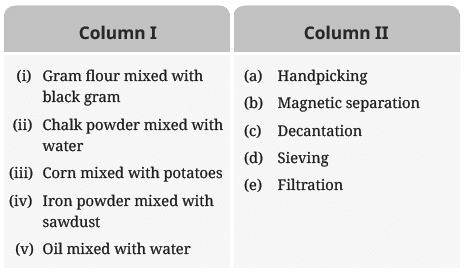
Ans: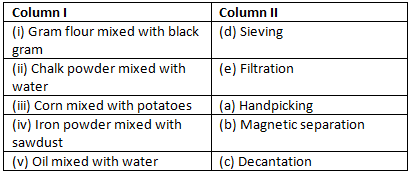
Q6: In what situations would you use decantation instead of filtration to separate solids from liquids?
Ans: Decantation is used when the solid particles are heavy and settle down at the bottom of the container, allowing the clear liquid to be poured off without disturbing the solid sediment. For example, separating sand from water.
Q7: Can you relate the presence of nasal hair to any separation process?
Ans: Nasal hair acts like a filter, trapping dust and other particles from the air we inhale, similar to how a filter paper traps solid particles from a liquid.
Q8: During the COVID-19 pandemic, all of us wore masks. Generally, what material are they made of? What is the role of these masks?
Ans: Masks are generally made of materials like cotton, synthetic fibers, or polypropylene. Their role is to filter out airborne particles, including viruses and bacteria, to prevent their inhalation and spread.
Q9: A mixture containing potatoes, salt, and sawdust has been given to you. Outline a stepwise procedure for separating each component from this mixture.
Ans:
- Step 1: Handpick the potatoes.
- Step 2: Add water to the remaining mixture to dissolve the salt.
- Step 3: Decant the water to separate the sawdust.
- Step 4: Evaporate the water to recover the salt.
Q10: Read the following story titled 'Intelligent Leela' and tick the most appropriate options. Provide a suitable title of your choice for the paragraph.
Leela was working in the farm with her father when she realised that they left their drinking water at home. Before her father felt thirsty/hungry, she went to the nearby pond to fetch some water/grains. After obtaining some water in the container, she noticed that the water was muddy and fit/unfit for drinking. To purify the water, she kept it for some time and then she filtered/churned the muddy water using a piece of paper/muslin cloth. Leela, then, cooled/boiled the water for about 10 minutes in a covered pan. After cooling/boiling, she filtered/churned it again and made it fit/unfit for drinking. She served this water to her father while having food, who blessed her and appreciated her efforts.
Ans:
- Thirsty
- Water
- Unfit
- Filtered
- Muslin cloth
- Boiled
- Filtered
- Fit
Suitable Title: "Leela's Clever Solution for Clean Water"
Intext Question
Q1. A small amount of puffed rice is mixed with chana dal. Can you think of separating the mixture by any method other than handpicking? (Page 165)Ans: Yes, the other method is winnowing.
Q2. Valli is unable to separate husk from rice in a closed room. How can you help her? (Page 166)
Ans: We can help her by placing a fan over the light husk.
Ans: Yes, large sieves are used for such a purpose.
Q4. Have you ever observed white patches on the dark coloured clothes you wear during hot summers? How are these patches formed? (Page 168)
Ans: Yes, these patches are formed due to evaporation of water from sweat leaving behind salt.
FAQs on NCERT Solutions: Methods of Separation in Everyday Life
| 1. What are the main methods of separation used in everyday life for Class 6? |  |
| 2. How does filtration work as a method of separation and when should I use it? | |
| 3. Why is evaporation important for obtaining salt and other dissolved substances? | |
| 4. What's the difference between sieving and filtration for separating mixtures? | |
| 5. How can I identify which separation method to use for different everyday situations? | |