Worksheet: Timeline and Sources of History

1. Multiple Choice Questions (MCQs)
Q1: Who studies the physical features of the Earth?
(a) Archaeologists
(b) Anthropologists
(c) Geologists
(d) Palaeontologists
Q2: Which calendar is most widely used today?
(a) Gregorian Calendar
(b) Hindu Calendar
(c) Chinese Calendar
(d) Jewish Calendar
Q3: How long is a millennium?
(a) 100 years
(b) 1000 years
(c) 2000 years
(d) 10 years
Q4: What is a pañchānga?
(a) A type of ancient tool
(b) A method of storytelling
(c) A traditional Indian calendar
(d) A historical document
Q5: Which source is NOT commonly used by historians for recent history?
(a) Fossils
(b) Electronic media
(c) Newspapers
(d) Television
2. Fill in the Blanks
Q1: A _______ is a period of 100 years.
Q2: The study of ancient inscriptions is done by _______.
Q3: The _______ Age was a time when much of the Earth was covered with ice.
Q4: _______ are impressions of plants or animals found in layers of soil.
Q5: _______ refers to a life that begins after death.
3. True or False
Q1: The Gregorian calendar is used primarily for religious purposes.
Q2: A millennium is 100 years long.
Q3: Archaeologists study ancient artefacts and remains.
Q4: The 21st century CE includes the years from 2001 to 2100.
Q5: Early humans lived in permanent structures and did not move around.
4. Match the Following
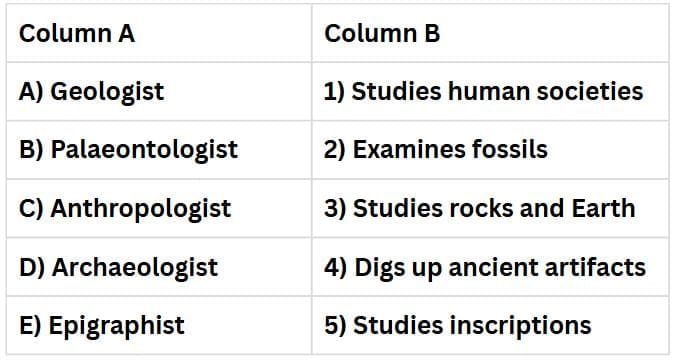
You can access the solutions to this worksheet here.
FAQs on Worksheet: Timeline and Sources of History
| 1. What's the difference between primary and secondary sources in history? |  |
| 2. How do I arrange events correctly on a historical timeline for Class 6 CBSE? | |
| 3. What types of sources should I study to understand ancient Indian history better? | |
| 4. How can timeline skills help me score better marks in Social Studies exams? | |
| 5. Why do historians use multiple sources instead of just one to study the past? | |