NCERT Solutions: Beyond Earth

Let us enhance our learning
Q1: Match the column: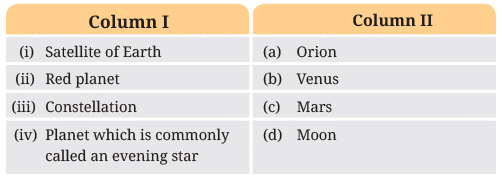 Ans:
Ans: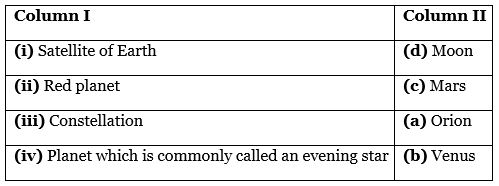
Q2: (i) Solve the following riddle.
My first alphabet is in MAN but not in CAN (M)
My second alphabet is in ACE and also in FAN (A)
My third alphabet is in RAT and not in CAT (R)
My fourth alphabet is in SUN but not in FUN (S)
I am a planet that moves around the Sun. (MARS)
Ans: MARS
(ii) Make two similar riddles by yourself.
(a) My first alphabet is in VAN but not in PAN → V
My second alphabet is in NET and also in PEN → E
My third alphabet is in NUT but not in CUT → N
My fourth alphabet is in SUN but not in FUN → U
My last alphabet is in BUS but not in BUG → S
I am a planet that moves around the Sun.
Ans: VENUS
(b) My first alphabet is in EAT but not in BAT → E
My second alphabet is in ANT and also in CAT → A
My third alphabet is in RAT but not in CAT → R
My fourth alphabet is in TOP and also in POT → T
My fifth alphabet is in HAT but not in BAT → H
I am a planet that moves around the Sun.
Ans: EARTH
Q3: Which of the following is not a member of our Solar System?
(i) Sirius
(ii) Comets
(iii) Asteroids
(iv) Pluto
Ans: (i) Sirius
Q4: Which of the following is not a planet of the Sun?
(i) Jupiter
(ii) Pluto
(iii) Neptune
(iv) Saturn
Ans: (ii) Pluto
Q5: Which is the brighter star, the Pole Star or Sirius?
Ans: Sirius
Q6: An artist's representation of the Solar System is given in Fig. 12.12. Is the order of the planets correct? If not, write the correct order in the boxes in the figure.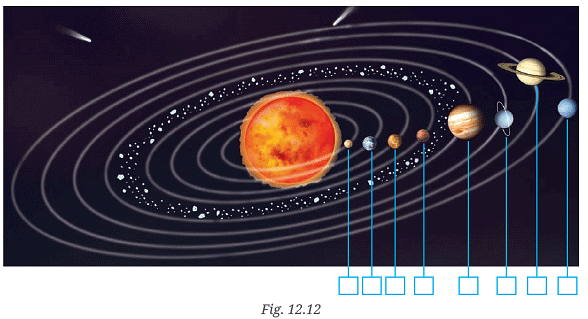 Ans: The order of the planets in the figure is not correct. The correct order from the Sun is: Mercury, Venus, Earth, Mars, Jupiter, Saturn, Uranus and Neptune.
Q7: A portion of night sky with stars is shown in Fig. 12.13. Look carefully and identify the groups of stars that form the patterns-the Big Dipper and the Little Dipper. Draw lines to connect the stars for these patterns and label them. Also, identify and label the Pole Star. You may refer to Fig. 12.4 for help.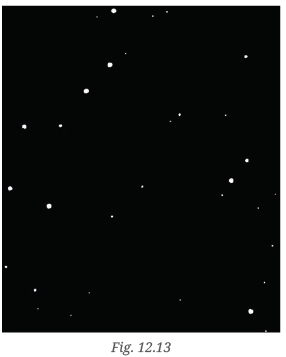 Ans:
Ans: 
Q8: A portion of the night sky is shown in Fig. 12.14. Draw lines to connect the stars for Orion and label the star Sirius. You may refer to Fig. 12.3.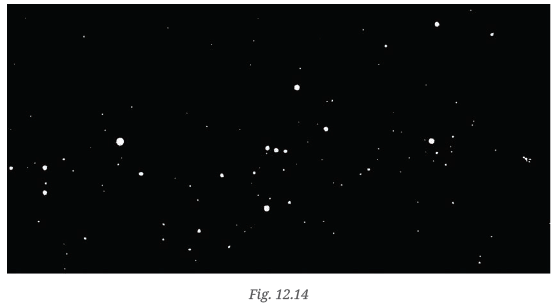 Ans:
Ans:
Q9: You can see stars fading away at dawn and appearing at dusk. During the day we do not see the stars. Explain why.
Ans: During the day, the Sun's bright light outshines the stars, making them invisible to our eyes. The atmosphere scatters the sunlight, creating the blue sky and masking the faint light of the stars.
Q10: During a clear night, try to observe the Big Dipper 3-4 times at an interval of 2 to 3 hours. Also try to locate the Pole Star each time. Does the Big Dipper appear to move? Draw a rough sketch to illustrate this, mentioning the time in each case.
Ans: The Big Dipper appears to move around the Pole Star due to the rotation of the Earth. Over a few hours, its position changes, making it seem as if it is rotating around the Pole Star.
Q11: Think about the night sky and write a poem or a story on it.
Ans:
Poem
In the quiet of the night,
Stars twinkle with delight.
Patterns in the sky unfold,
Stories of the ancients told.
Orion, the mighty hunter bold,
With his belt of stars, a sight to behold.
The Dippers, big and small,
Guide us north through it all.
The Pole Star, steadfast and bright,
Holds its place, a beacon of light.
In the vast, dark sky so high,
Dreams and wonders lie.
Story
On a clear, moonless night, young Sonu and Monu stood outside their village in BharatX, eyes fixed on the heavens. The sky was a canvas of glittering stars, each telling a story. Sonu pointed to Orion, the great hunter, with his three-star belt gleaming. "Look," he said, "that's Orion, and there's Sirius, his loyal dog." Monu traced the Big Dipper with her finger, imagining it as a celestial ladle scooping up dreams from the night. The Pole Star, always reliable, shone brightly, guiding travellers and wanderers alike. As the night deepened, the siblings felt a deep connection to the universe, knowing that the same stars had watched over their ancestors for generations.
FAQs on NCERT Solutions: Beyond Earth
| 1. What are the main celestial bodies we study in Beyond Earth for Class 6 science? |  |
| 2. Why does the Moon appear to change shape if it doesn't actually change? | |
| 3. How many planets are in our solar system and what makes them different from stars? | |
| 4. What's the difference between a meteor, meteoroid, and meteorite in Beyond Earth topics? | |
| 5. How far is the Sun from Earth and why does this distance matter for life? | |