CBSE Class 6  >  Class 6 Notes  >  Social Studies  >  Worksheet: The Beginnings of Indian Civilisation

Worksheet: The Beginnings of Indian Civilisation

Multiple Choice Questions (MCQs)

Q1: Which river is known for providing water to the fields in Punjab and Sindh?
(a) 
Ganges
(b) Indus
(c) Nile
(d) Sarasvati

Q2: What was the primary material used to construct the Great Bath in Mohenjo-daro?
(a)
Stone
(b) Brick
(c) Natural bitumen
(d) Wood

Q3: Which ancient civilization is referred to as the Harappan civilization?
(a) 
Mesopotamian Civilization
(b) Indus Valley Civilization
(c) Egyptian Civilization
(d) Mesoamerican Civilization

Q4: What role did trade play in Harappan society?
(a)
It was not important.
(b) It was limited to local exchanges.
(c) It involved both local and long-distance exchanges.
(d) It only involved barter.

Q5: Which of the following crops did the Harappans NOT cultivate?
(a) 
Wheat
(b) Rice
(c) Cotton
(d) Sugarcane

Fill in the Blanks

Q1: The ancient cities of __________ and __________ were the first to be discovered in the Indus Valley Civilization.

Q2: The __________ River is now recognized as a seasonal river that flows only during the rainy season.

Q3: The Harappans were known for their advanced __________ management systems.

Q4: Harappa was the first city excavated that belongs to the __________ civilization.

Q5: The Harappans were the first in Eurasia to grow __________.

True or False

Q1: The Great Bath was likely used for public bathing by all citizens of Mohenjo-daro.

Q2: The Harappans relied heavily on trade with other civilizations.

Q3: The Sarasvati River is mentioned in the Rig Veda.

Q4: The Indus Valley Civilization was primarily known for its military prowess.

Q5: The decline of the Harappan civilization was largely due to climatic changes.

Match the Following
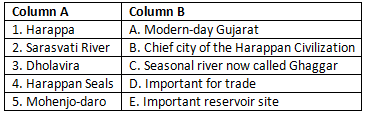
Match the Following

You can access the solutions to this worksheet here.

The document Worksheet: The Beginnings of Indian Civilisation is a part of the Class 6 Course Social Studies for Class 6.
All you need of Class 6 at this link: Class 6

FAQs on Worksheet: The Beginnings of Indian Civilisation

1. What were the main features of the Indus Valley Civilisation that made it so advanced?
Ans. The Indus Valley Civilisation featured planned cities with advanced drainage systems, standardised weights and measures, and sophisticated urban planning. Cities like Harappa and Mohenjo-daro had brick buildings, public baths, and granaries. Their seals and pottery suggest trade networks across Mesopotamia. This civilisation flourished around 2300-1750 BCE in the Indian subcontinent.
2. How did early humans in ancient India transition from hunting to farming during the Neolithic period?
Ans. Early humans shifted from nomadic hunter-gatherer lifestyles to settled agricultural communities by domesticating plants like wheat and barley and animals like cattle and sheep. This transition occurred during the Neolithic age, enabling permanent settlements near river valleys. Farming allowed population growth, food storage, and the development of organised societies in the Indian subcontinent over thousands of years.
3. Why did the Indus Valley Civilisation suddenly disappear around 1750 BCE?
Ans. Scholars propose multiple theories for the decline of Indus Valley culture: climate change caused river flooding or drought, invasions by Aryan groups from Central Asia, or internal social collapse. Archaeological evidence suggests environmental shifts affected agriculture and trade routes. The civilisation's end marked a transition to Vedic culture and new settlement patterns across the Indian subcontinent during the Iron Age.
4. What can we learn about Indus Valley people from their seals and undeciphered script?
Ans. Indus seals bearing pictographic symbols reveal the civilisation's trade practices, religious beliefs, and administrative systems, though the script remains undeciphered. Seals depict animals, deities, and standardised marks suggesting a structured society with commerce and religious rituals. These artefacts indicate sophisticated communication methods and social organisation in one of the world's earliest urban civilisations during the Bronze Age.
5. How do archaeologists use excavation techniques to study the Beginnings of Indian Civilisation?
Ans. Archaeologists employ stratigraphic excavation, studying soil layers to date artefacts chronologically. They analyse pottery, tools, bones, and structural remains from sites like Harappa and Mohenjo-daro to reconstruct daily life, trade, and settlement patterns. Carbon dating and comparative studies with Mesopotamian artefacts establish timelines. These scientific methods reveal how early Indian societies developed agriculture, urbanism, and complex social structures.
Explore Courses for Class 6 exam
Get EduRev Notes directly in your Google search
Related Searches
Objective type Questions, MCQs, Sample Paper, shortcuts and tricks, Previous Year Questions with Solutions, Summary, mock tests for examination, Important questions, ppt, pdf , past year papers, Worksheet: The Beginnings of Indian Civilisation, Free, Viva Questions, Extra Questions, study material, practice quizzes, Worksheet: The Beginnings of Indian Civilisation, Semester Notes, video lectures, Exam, Worksheet: The Beginnings of Indian Civilisation;