CBSE Class 6  >  Class 6 Notes  >  Social Studies  >  Worksheet: India's Cultural Roots

Worksheet: India's Cultural Roots

Multiple Choice Questions (MCQs)

Q1: Which of the following is the oldest of the four Vedas?
(a) 
Yajur Veda
(b) Atharva Veda
(c) Rig Veda
(d) Sama Veda

Q2: What does the word "Veda" mean?
(a)
Truth
(b) Knowledge
(c) Power
(d) Wisdom

Q3: Who are the composers of the Vedic hymns?
(a)
Kings
(b) Rishis and Rishikas
(c) Common people
(d) Priests only

Q4: Which deity is primarily associated with fire in Vedic rituals?
(a)
Indra
(b) Agni
(c) Varuna
(d) Sarasvati

Q5: Which philosophical school emerged from the Vedas around the 1st millennium BCE?
(a)
Jainism
(b) Buddhism
(c) Yoga
(d) Materialism

Fill in the Blanks

Q1: The four Vedas are Rig Veda, Yajur Veda, ________ Veda, and Atharva Veda.

Q2: The Vedic hymns were passed down ________ for many generations.

Q3: The concept of ________ refers to the divine essence present in every being.

Q4: The principle of ________ is crucial in Jain teachings, emphasizing non-violence.

Q5: The Upanishads introduced the concept of ________, which is the cycle of being born again.

True or False

Q1: The Upanishads reject the idea of rebirth and karma.

Q2: Vedic chanting was recognized by UNESCO in 2008.

Q3: The early Vedic society was organized into small families only.

Q4: Jainism emphasizes the principle of non-possessiveness.

Q5: The Vedas were written down immediately after they were composed.

Match the Following
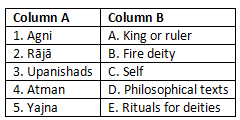
Match the Following

You can access the solutions to this worksheet here.

The document Worksheet: India's Cultural Roots is a part of the Class 6 Course Social Studies for Class 6.
All you need of Class 6 at this link: Class 6

FAQs on Worksheet: India's Cultural Roots

1. What are the main sources of Indian culture and where do they come from?
Ans. India's cultural roots stem from ancient civilisations like the Indus Valley Civilisation and Vedic traditions, shaped by Hinduism, Buddhism, Jainism, and Islam over millennia. These diverse spiritual and philosophical traditions merged with local customs, creating a unique syncretic heritage. Geography, trade routes, and migrations continuously influenced India's cultural identity, blending indigenous practices with external influences to form what defines Indian society today.
2. How did Vedic traditions shape India's cultural identity and society?
Ans. Vedic traditions, originating around 1500 BCE, established foundational concepts of dharma, karma, and social hierarchy through the Vedas and Upanishads. These ancient texts introduced rituals, philosophical thought, and the caste system that structured Indian society for centuries. The Vedic period's emphasis on knowledge, sacrifice, and spiritual inquiry became central to Hindu philosophy and continue influencing Indian cultural values, festivals, and daily practices across generations.
3. What role did the Indus Valley Civilisation play in developing India's cultural heritage?
Ans. The Indus Valley Civilisation (2300-1750 BCE) established urban planning, trade networks, and artistic traditions that influenced later Indian cultures. Archaeological evidence reveals sophisticated seals, pottery, and town layouts reflecting advanced social organisation. Though its script remains undeciphered, this civilisation's emphasis on standardisation, commerce, and aesthetic expression contributed foundational elements to India's architectural, artistic, and administrative practices visible in subsequent historical periods.
4. Why is India called a land of cultural diversity and what does this mean?
Ans. India's cultural diversity stems from multiple religions, languages, regional traditions, and historical influences coexisting within one nation. Hinduism, Buddhism, Jainism, Sikhism, Islam, and Christianity thrive simultaneously, each contributing unique festivals, art forms, cuisine, and philosophies. This pluralistic heritage means Indian culture isn't monolithic-it's a living synthesis of countless traditions, where local customs blend with pan-Indian practices, creating regional variations while maintaining shared civilisational values and interconnected histories.
5. How do ancient Indian philosophies like Buddhism and Jainism differ in their cultural impact?
Ans. Buddhism and Jainism emerged as reformation movements challenging Vedic practices, emphasising non-violence (ahimsa) and individual spiritual pursuit. Buddhism spread across Asia, fundamentally reshaping societies through monasticism and the concept of nirvana, while Jainism remained primarily rooted in India, influencing vegetarianism and ethical commerce. Both philosophies contributed distinct artistic traditions, architectural styles, and moral frameworks that enriched India's intellectual heritage and continue shaping contemporary Indian values around compassion and sustainability.
Explore Courses for Class 6 exam
Get EduRev Notes directly in your Google search
Related Searches
Viva Questions, Worksheet: India's Cultural Roots, MCQs, past year papers, mock tests for examination, ppt, Important questions, study material, Free, Extra Questions, video lectures, shortcuts and tricks, Sample Paper, Worksheet: India's Cultural Roots, Worksheet: India's Cultural Roots, Exam, pdf , practice quizzes, Previous Year Questions with Solutions, Objective type Questions, Summary, Semester Notes;