Worksheet: Unity in Diversity or 'Many in the One'

Multiple Choice Questions
Q1: Which of the following is a common staple grain in India?
(a) Corn
(b) Wheat
(c) Cotton
(d) Oats
Q2: What is the primary material used to make traditional saris?
(a) Wool
(b) Silk
(c) Cotton
(d) Jute
Q3: Which festival marks the beginning of the harvest season in India?
(a) Diwali
(b) Makara Sankranti
(c) Holi
(d) Eid
Q4: The Panchatantra is originally written in which language?
(a) Hindi
(b) Bengali
(c) Sanskrit
(d) Tamil
Q5: Which of these is NOT a type of silk sari?
(a) Banarasi
(b) Kanjivaram
(c) Chintz
(d) Mysore
Fill in the Blanks
Q1: The ________ is a long piece of cloth traditionally worn by women in India.
Q2: Common spices used in Indian cooking include ________, cumin, and ginger.
Q3: The two great Indian epics are the ________ and the Mahabharata.
Q4: Indian textiles were historically famous for producing ________ cotton.
Q5: The ________ project surveyed 4,635 communities across India.
True or False
Q1: The sari is an unstitched garment.
Q2: All Indian languages use the same script.
Q3: The Panchatantra has been adapted into many languages.
Q4: Chintz was popular in 17th-century Europe.
Q5: The Mahabharata is a short story.
Match the Following
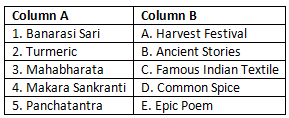
You can access the solutions to this worksheet here.
FAQs on Worksheet: Unity in Diversity or 'Many in the One'
| 1. What does unity in diversity mean and how does it apply to India? |  |
| 2. How do different religions in India contribute to the idea of many in the one? | |
| 3. What role do different languages play in India's unity in diversity? | |
| 4. How do regional cultures and traditions support the concept of many in the one in CBSE curriculum? | |
| 5. What are practical examples of unity in diversity that students can observe in their daily lives? | |