CBSE Class 6  >  Class 6 Notes  >  Social Studies  >  Worksheet Solutions: Unity in Diversity or 'Many in the One'

Worksheet Solutions: Unity in Diversity or 'Many in the One'

Multiple Choice Questions

Q1: Which of the following is a common staple grain in India?
(a)
Corn
(b) Wheat
(c) Cotton
(d) Oats
Ans: (b) Wheat

Wheat - It is one of India's main staple grains, especially in northern states. Corn is grown but is not as widely consumed.

Q2: What is the primary material used to make traditional saris?
(a)
Wool
(b) Silk
(c) Cotton
(d) Jute
Ans: (b) Silk

Silk - Traditional saris are often made from silk, prized for its shine and softness. Cotton and wool saris exist but are less formal.

Q3: Which festival marks the beginning of the harvest season in India?
(a) 
Diwali
(b) Makara Sankranti
(c) Holi
(d) Eid
Ans: (b) Makara Sankranti

Makara Sankranti - This festival marks the harvest season in India, celebrated in January with regional variations.

Q4: The Panchatantra is originally written in which language?
(a)
Hindi
(b) Bengali
(c) Sanskrit
(d) Tamil
Ans: (c) Sanskrit

Sanskrit - The Panchatantra, a collection of animal fables with moral lessons, was originally written in Sanskrit.

Q5: Which of these is NOT a type of silk sari?
(a)
Banarasi
(b) Kanjivaram
(c) Chintz
(d) Mysore
Ans: (c) Chintz

Chintz - Chintz is a printed cotton fabric, not a silk sari; Banarasi, Kanjivaram, and Mysore are well-known types of silk saris.

Fill in the Blanks

Q1: The ________ is a long piece of cloth traditionally worn by women in India.
Ans: sari

Q2: Common spices used in Indian cooking include ________, cumin, and ginger.
Ans: turmeric

Q3: The two great Indian epics are the ________ and the Mahabharata.
Ans: Ramayana

Q4: Indian textiles were historically famous for producing ________ cotton.
Ans: best

Q5: The ________ project surveyed 4,635 communities across India.
Ans: People of India

True or False

Q1: The sari is an unstitched garment.
Ans: True

Q2: All Indian languages use the same script.
Ans: False

Q3: The Panchatantra has been adapted into many languages.
Ans: True

Q4: Chintz was popular in 17th-century Europe.
Ans: True

Q5: The Mahabharata is a short story.
Ans: False

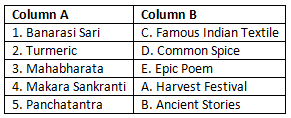
Match the Following
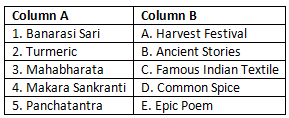
Match the FollowingAns:
Match the Following

The document Worksheet Solutions: Unity in Diversity or 'Many in the One' is a part of the Class 6 Course Social Studies for Class 6.
All you need of Class 6 at this link: Class 6

FAQs on Worksheet Solutions: Unity in Diversity or 'Many in the One'

1. What does unity in diversity mean and how does it apply to India?
Ans. Unity in diversity refers to India's ability to maintain cohesion despite its many religions, languages, castes, and cultures coexisting together. This concept emphasizes that despite significant differences, Indians share common values, constitutional principles, and national identity. The phrase "many in the one" captures how multiple distinct groups function as a single unified nation, making India's pluralistic society its greatest strength.
2. How do different religions in India contribute to the idea of many in the one?
Ans. Hinduism, Islam, Christianity, Sikhism, Buddhism, and Jainism all practise freely in India, each maintaining unique beliefs and rituals while respecting others' faiths. Religious diversity strengthens India's social fabric through interfaith cooperation and mutual tolerance. Citizens celebrate festivals across religions-Diwali, Eid, Christmas, Holi-collectively, demonstrating how spiritual plurality reinforces national unity rather than creating division within the framework of many in the one.
3. Why is linguistic diversity considered important in understanding India's unity?
Ans. India recognises 22 official languages and hundreds of regional dialects, yet maintains unified communication through Hindi and English. Linguistic diversity reflects India's regional identities while the three-language formula in education ensures national cohesion. This multilingual approach demonstrates how language differences strengthen rather than weaken unity in diversity, allowing communities to preserve cultural heritage whilst participating in broader Indian society and governance.
4. What role do constitutional values play in maintaining unity despite India's diversity?
Ans. The Indian Constitution guarantees fundamental rights, equality before law, and freedom of religion to all citizens regardless of caste, creed, or region. These secular constitutional principles create a binding framework that protects minority rights whilst promoting social harmony. Values like justice, liberty, and equality embedded in the Preamble form the foundation of unity in diversity, ensuring that India's "many in the one" concept remains legally safeguarded and practically implemented across all communities.
5. How do regional cultures and traditions coexist with national identity in India?
Ans. Regional cultures-Punjabi, Bengali, Tamil, Marathi, Gujarati-maintain distinct arts, cuisines, and customs whilst contributing to India's composite national identity. Citizens proudly celebrate regional festivals and languages alongside national symbols like the tricolour and Constitution. This balance between local heritage and pan-Indian belonging exemplifies unity in diversity, where regional pride strengthens rather than threatens national unity, creating a unique pluralistic society where "many in the one" becomes lived reality.
Explore Courses for Class 6 exam
Get EduRev Notes directly in your Google search
Related Searches
video lectures, Semester Notes, Worksheet Solutions: Unity in Diversity or 'Many in the One', Summary, Important questions, Free, MCQs, Extra Questions, pdf , shortcuts and tricks, practice quizzes, Previous Year Questions with Solutions, Exam, Sample Paper, ppt, past year papers, Objective type Questions, mock tests for examination, Worksheet Solutions: Unity in Diversity or 'Many in the One', Worksheet Solutions: Unity in Diversity or 'Many in the One', Viva Questions, study material;