CBSE Class 6  >  Class 6 Notes  >  Social Studies  >  Worksheet Solutions: Family and Community

Worksheet Solutions: Family and Community

Multiple Choice Questions (MCQs)

Q1: What type of family includes several generations living together?
(a) 
Nuclear family
(b) Joint family
(c) Extended family
(d) Single-parent family
Ans: (b) Joint family

Q2: What is the primary role of parents in a family?
(a) 
To make money
(b) To provide education
(c) To help children grow into happy individuals
(d) To discipline children
Ans: (c) To help children grow into happy individuals

Q3: In Indian languages, which of the following terms refers to 'aunt'?
(a) 
Chacha
(b) Bua
(c) Nana
(d) Mausa
Ans: (b) Bua

Q4: What does 'dharma' refer to in Indian culture?
(a) 
Happiness
(b) Duty
(c) Family
(d) Religion
Ans: (b) Duty

Q5: Who helped Kamal Parmar in teaching the children?
(a) 
His friends
(b) Teachers from a nearby school
(c) Government officials
(d) Local businesses
Ans: (b) Teachers from a nearby school

Fill in the Blanks

Q1: Shalini lives in __________ with her family.
Ans: Kerala

Q2: Tenzing's father runs a small __________ store.
Ans: grocery

Q3: In many Indian languages, there is no specific word for __________.
Ans: cousin

Q4: Families often share their resources, showing __________ and commitment.
Ans: love

Q5: The Bhil community took action to help the environment and their __________.
Ans: community

True or False

Q1: A nuclear family consists of a couple and their children.
Ans: True

Q2: Kamal Parmar provided free tuition classes only during the day.
Ans: False

Q3: In Indian culture, families are not usually interconnected.
Ans: False

Q4: Shalini received a fancy silk dress for the festival of Onam.
Ans: False

Q5: The Bhil community planted trees to help with water conservation.
Ans: True

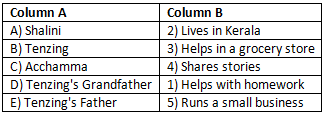
Match the Following
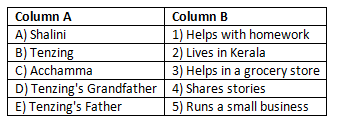
Match the FollowingAns:
Match the Following

The document Worksheet Solutions: Family and Community is a part of the Class 6 Course Social Studies for Class 6.
All you need of Class 6 at this link: Class 6

FAQs on Worksheet Solutions: Family and Community

1. What are the different types of families and how do they function in Indian society?
Ans. Families in India exist in various structures: nuclear families (parents and children), joint families (multiple generations living together), and extended families (including aunts, uncles, cousins). Each type has distinct responsibilities and decision-making patterns. Joint families emphasize collective welfare and shared resources, while nuclear families focus on individual family units. Understanding these family structures helps explain social dynamics and community relationships in Class 6 Social Studies.
2. How does family influence a child's values, behavior, and social development?
Ans. Family serves as the primary agent of socialization, shaping children's values, beliefs, and behaviour through daily interactions and teachings. Parents and elders model conduct, enforce rules, and transmit cultural traditions. This early learning foundation affects how children interact with peers, respect authority, and participate in communities. Family support builds confidence and emotional security, essential for healthy development during adolescence.
3. What is the difference between family responsibilities and community responsibilities?
Ans. Family responsibilities involve caring for household members, maintaining the home, and supporting relatives emotionally and financially. Community responsibilities extend beyond the family to include helping neighbours, participating in local activities, and contributing to public welfare. While families focus on kinship bonds, communities address broader social needs like cleanliness, safety, and collective well-being in residential areas and societies.
4. How do traditions and customs strengthen family and community bonds?
Ans. Traditions and customs create shared identity and continuity across generations, reinforcing family values and cultural heritage. Festivals, rituals, and celebrations bring families and communities together, fostering belonging and mutual support. Regular observances build trust and predictability within social groups. These practices transmit knowledge, strengthen emotional connections, and establish common goals that unite people across different backgrounds in a community.
5. What role do different family members play in household decision-making and daily functions?
Ans. In traditional household structures, parents typically handle major decisions regarding finances, education, and family planning, while children contribute age-appropriate responsibilities. Grandparents offer guidance and wisdom; older siblings support younger ones. Modern families increasingly involve all members in discussions. Distributing roles-cooking, earning, childcare, education-ensures smooth functioning. Understanding these dynamics helps explain family organization and interdependence in CBSE Class 6 curricula.
Explore Courses for Class 6 exam
Get EduRev Notes directly in your Google search
Related Searches
shortcuts and tricks, mock tests for examination, Previous Year Questions with Solutions, video lectures, ppt, Important questions, Summary, Objective type Questions, Viva Questions, Extra Questions, Worksheet Solutions: Family and Community, Semester Notes, Worksheet Solutions: Family and Community, Worksheet Solutions: Family and Community, Sample Paper, practice quizzes, Exam, pdf , MCQs, study material, Free, past year papers;