CBSE Class 6  >  Class 6 Notes  >  Social Studies  >  Worksheet: The Value of Work


Worksheet: The Value of Work

Worksheet: The Value of Work

Multiple Choice Questions (MCQs)

Q1: What type of activity is the construction of a highway?
(a) 
Non-economic activity
(b) Economic activity
(c) Both A and B
(d) None of the above

Q2: Which of the following is considered a non-economic activity?
(a) 
Teaching in a school
(b) Volunteering at a community center
(c) Selling goods
(d) Working in a factory

Q3: What is 'payment in kind'?
(a) 
Payment made in cash
(b) Payment made through goods instead of cash
(c) Payment for services rendered
(d) None of the above

Q4: Who is an example of a person engaged in daily wage work?
(a) A teacher
(b) A farm laborer
(c) A carpenter
(d) A doctor

Q5: What is the purpose of the Swachh Bharat Abhiyan?
(a) To promote economic growth
(b) To maintain cleanliness in surroundings
(c) To celebrate trees
(d) To provide free meals

Fill in the Blanks

Q1: Economic activities help people earn __________.

Q2: A __________ is a fixed regular payment made by an employer to an employee.

Q3: Non-economic activities are often driven by __________, care, or a sense of duty.

Q4: The act of cooking for family without any expectation of payment is an example of __________ activity.

Q5: __________ is a practice of selfless service seen in many places of worship.

True or False

Q1: Economic activities involve tasks that are unpaid.

Q2: Non-economic activities can create emotional and social value.

Q3: Payment in kind refers to receiving cash for work performed.

Q4: Volunteering is an example of an economic activity.

Q5: Both economic and non-economic activities are important for a fulfilling life.

Match the Following
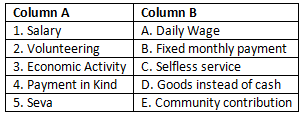
Match the Following

You can access the solutions to this worksheet here.

The document Worksheet: The Value of Work is a part of the Class 6 Course Social Studies for Class 6.
All you need of Class 6 at this link: Class 6

FAQs on Worksheet: The Value of Work

1. What does "value of work" mean and why is it important for Class 6 students?
Ans. The value of work refers to the worth and significance of labour in society-both its economic contribution and personal dignity. Work provides income, develops skills, builds self-respect, and helps communities function. Understanding this concept teaches students that all honest work deserves respect, whether manual or intellectual, and that productive effort shapes individual and social progress.
2. How does work contribute to a person's self-esteem and character development?
Ans. Engaging in meaningful work builds confidence, responsibility, and discipline in individuals. Completing tasks successfully creates a sense of achievement and self-worth. Regular work habits develop perseverance, time management, and problem-solving abilities. For Class 6 learners, recognising how work shapes character helps them understand that effort invested today-whether in studies or chores-strengthens their personality and prepares them for future challenges.
3. What's the difference between skilled work and unskilled work, and are both equally valuable?
Ans. Skilled work requires specific training or expertise (carpentry, teaching, nursing), while unskilled work requires minimal formal training (cleaning, farming basics). Both are essential and equally valuable to society-skilled workers provide specialised services; unskilled workers perform vital tasks that keep communities functioning. The value of work depends on its contribution to society, not its classification. Every occupation deserves respect and fair compensation.
4. Why should students understand the relationship between work, income, and daily needs?
Ans. Work directly provides the income necessary for food, shelter, education, and healthcare-fundamental human needs. Understanding this link helps students grasp why adults work regularly and why financial literacy matters. It also teaches responsibility: recognising that money doesn't appear automatically but results from labour. For Class 6 learners, this awareness builds appreciation for family efforts and motivates academic commitment.
5. How can I identify different types of work in my community and understand their importance?
Ans. Observe professions around you: teachers, shopkeepers, farmers, doctors, plumbers, and sanitation workers. Each performs essential services that maintain community health, safety, and development. Document how different occupations interconnect-farmers provide food; doctors ensure health; teachers build knowledge. This observation exercise develops respect for workforce diversity. Use mind maps or flashcards to categorise occupations by skills, income levels, and social contributions for deeper comprehension.
Explore Courses for Class 6 exam
Get EduRev Notes directly in your Google search
Related Searches
MCQs, Worksheet: The Value of Work, practice quizzes, pdf , Exam, Worksheet: The Value of Work, Extra Questions, video lectures, Summary, ppt, Viva Questions, Objective type Questions, mock tests for examination, Free, past year papers, Previous Year Questions with Solutions, shortcuts and tricks, Important questions, Sample Paper, study material, Worksheet: The Value of Work, Semester Notes;