Worksheet Solutions: Beyond Earth

Multiple Choice Questions (MCQs)
Q1: What is the main function of stars in ancient navigation?
(a) They provide heat.
(b) They help travelers find their way.
(c) They create light pollution.
(d) They are used for decoration.
Ans: (b) They help travelers find their way.
Explanation: Stars helped travellers find their way at night because their positions in the sky are steady and could be used as reference points. For example, the North Star (Polaris) points roughly to north, so it was used to determine direction.
Q2: Which constellation is known as "The Hunter"?
(a) Canis Major
(b) Orion
(c) Taurus
(d) Ursa Major
Ans: (b) Orion
Explanation: The constellation Orion is called "The Hunter" because the pattern of its bright stars resembles a human figure with a belt and sword. Its bright stars, such as Betelgeuse and Rigel, make the shape easy to recognise.
Q3: What do you call the star that remains in the same position in the night sky?
(a) Sirius
(b) Polaris
(c) Betelgeuse
(d) Vega
Ans: (b) Polaris
Explanation: Polaris is the star nearly aligned with the north celestial pole, so it appears almost fixed in the night sky. For this reason it has been used for finding the direction of north.
Q4: How many official constellations are recognized by the International Astronomical Union (IAU)?
(a) 88
(b) 100
(c) 72
(d) 50
Ans: (a) 88
Explanation: The International Astronomical Union has divided the sky into 88 official constellations to standardise the naming and mapping of star patterns across the whole sky.
Q5: What is the closest star to Earth after the Sun?
(a) Alpha Centauri
(b) Proxima Centauri
(c) Sirius
(d) Betelgeuse
Ans: (b) Proxima Centauri
Explanation: Proxima Centauri is the nearest known star to the Sun and therefore the closest star to Earth after the Sun. It is part of the Alpha Centauri star system and lies just over four light years away.
Fill in the Blanks
Q1: The imaginary lines that connect stars to form patterns are called __________.
Ans: constellations
Q2: The __________ is the star at the center of our Solar System.
Ans: Sun
Q3: __________ pollution makes it difficult to see stars in big cities.
Ans: Light
Q4: The __________ is known as the Red Planet.
Ans: Mars
Q5: The __________ takes about 27 days to orbit around the Earth.
Ans: Moon
True or False
Q1: Stars do not emit their own light.
Ans: False
Explanation: Stars produce and emit their own light and energy, so the statement is false.
Q2: The Big Dipper is part of the constellation Ursa Major.
Ans: True
Explanation: The Big Dipper is an asterism made of bright stars that form part of the larger constellation Ursa Major.
Q3: The Milky Way Galaxy contains only our Solar System.
Ans: False
Explanation: The Milky Way contains billions of stars and many planetary systems; our Solar System is only one of them.
Q4: Asteroids are mostly found between the orbits of Earth and Mars.
Ans: False
Explanation: Most asteroids in our Solar System are found in the main asteroid belt, which lies between the orbits of Mars and Jupiter, not between Earth and Mars.
Q5: The Sun is the closest star to Earth.
Ans: True
Explanation: The Sun is the star at the centre of our Solar System and is closer to Earth than any other star, so the statement is true.
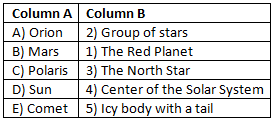
Match the Following
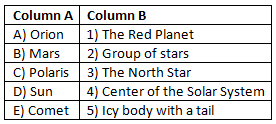
Ans:
FAQs on Worksheet Solutions: Beyond Earth
| 1. What are the different layers of Earth's atmosphere and how do they affect us? |  |
| 2. How do planets in our solar system differ from Earth in terms of size, distance, and conditions? | |
| 3. What exactly is a satellite and how does it stay in orbit around Earth? | |
| 4. Why can't humans breathe in space and what makes Earth's atmosphere special for life? | |
| 5. What are constellations and asteroids, and why do scientists study them? | |