Overview: Circle

Sector
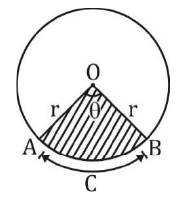
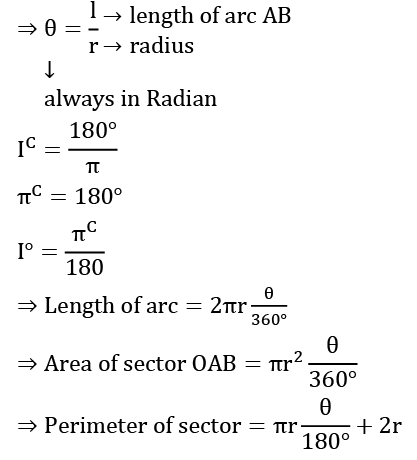
Segment
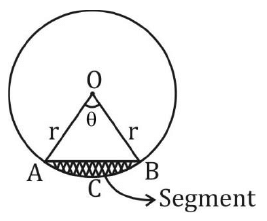
The segment of a circle is the region bounded by a chord and the corresponding arc. There are two related concepts often used:
- Area of a segment = area of the corresponding sector - area of the triangle formed by the two radii and the chord.
- Perimeter of a segment = length of the arc + length of the chord.
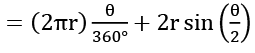
Q1. Find the area of a segment of a circle with a central angle of 120 degrees and a radius of 8 cm.
Sol.


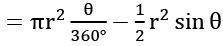
The area of a segment = area of sector with central angle θ - area of triangle formed by two radii and the chord.
\( \)
\( \text{Sector area} = \dfrac{\theta}{360^\circ}\pi r^{2} \)
\( \text{Triangle area} = \dfrac{1}{2} r^{2} \sin\theta \)
Apply with \( \theta = 120^\circ \) and \( r=8 \).
\( \text{Sector area} = \dfrac{120}{360}\pi\times 8^{2} \)
\( \text{Sector area} = \dfrac{1}{3}\pi\times 64 = \dfrac{64\pi}{3} \)
\( \text{Triangle area} = \dfrac{1}{2}\times 8^{2}\times\sin 120^\circ \)
\( \text{Triangle area} = \dfrac{1}{2}\times 64\times \dfrac{\sqrt{3}}{2} = 16\sqrt{3} \)
\( \text{Segment area} = \dfrac{64\pi}{3} - 16\sqrt{3} \)
Numerical value (approx):
\( \dfrac{64\pi}{3} \approx 67.0206 \)
\( 16\sqrt{3} \approx 27.7128 \)
\( \text{Segment area} \approx 39.3078\ \text{cm}^2 \)
Q2. Find the area of a sector with an arc length of 30 cm and a radius of 10 cm.
Sol.
Length of an arc \( s = r\theta \) where \( \theta \) is in radians.
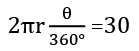
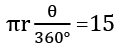
\( \theta = \dfrac{s}{r} = \dfrac{30}{10} = 3\ \text{radians} \)
Area of sector \( = \dfrac{1}{2} r^{2}\theta \)
\( \text{Area} = \dfrac{1}{2}\times 10^{2}\times 3 = 150\ \text{cm}^2 \)
Q3. In a circle of radius 21 cm and arc subtends an angle of 72 at centre. The length of arc is?
Sol.
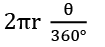
Arc length \( s = r\theta \) with \( \theta \) in radians.
\( \theta = 72^\circ = \dfrac{72\pi}{180} = \dfrac{2\pi}{5} \ \text{radians} \)
\( s = 21\times \dfrac{2\pi}{5} = \dfrac{42\pi}{5} \ \text{cm} \)
\( \dfrac{42\pi}{5} \approx 26.389\ \text{cm} \)
Important Properties of a Circle
Perpendicular from the centre to a chord bisects the chord.
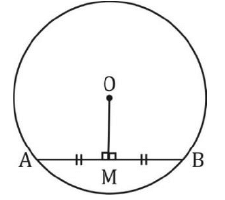
So if OM is perpendicular to chord AB at M, then AM = MB.
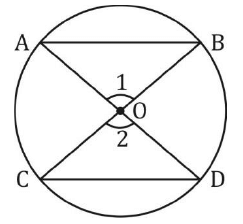
Equal arcs subtend equal chords, and equal chords subtend equal angles at the centre.
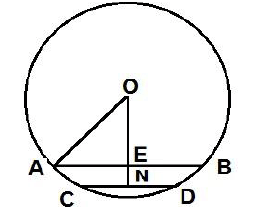
If two arcs are equal then their corresponding chords are equal, and if two chords are equal then the angles subtended by them at the centre are equal.
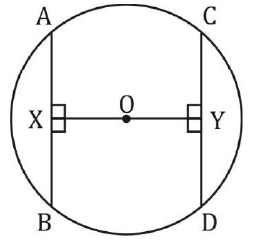
Equal chords are equidistant from the centre.
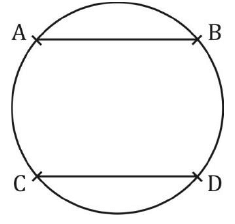

If AB = CD then distances from centre to chords are equal.
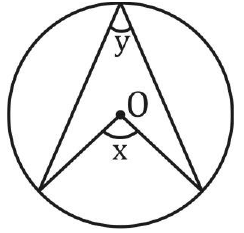
Angle subtended by an arc at the centre is double the angle subtended at any point on the remaining part of the circle.
If an arc subtends angle x at the centre and angle y at a point on circumference on the same side, then \( x = 2y \).
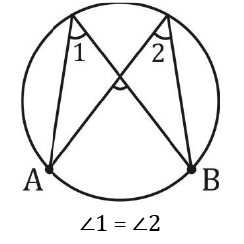
Angles in the same segment of a circle are equal.
Angle in a semicircle is a right angle.
Q1. AB = 8 cm and CD = 6 cm are two parallel chords on the same side of the center of the circle. The distance between them is 1 cm. Find the length of the radius?
Sol.
Let the distance from centre O to chord CD be \( x \). Then the distance from O to chord AB is \( x-1 \) (since the chords are on the same side and separated by 1 cm).
For chord AB of length 8, half chord = 4, so \( r^{2} = 4^{2} + (x-1)^{2} \).
For chord CD of length 6, half chord = 3, so \( r^{2} = 3^{2} + x^{2} \).
Equate the two expressions:
\( 16 + (x-1)^{2} = 9 + x^{2} \)
\( 16 + x^{2} - 2x + 1 = 9 + x^{2} \)
\( 17 - 2x = 9 \)
\( 2x = 8 \Rightarrow x = 4 \)
Now compute \( r^{2} = 9 + x^{2} = 9 + 16 = 25 \).
\( r = 5\ \text{cm} \)
The angle subtended by equal chords at the centre are equal, and equal chords are equidistant from the centre.
Angle subtended by an arc at the centre is twice the angle subtended at the circumference on the same side of the arc.
If \( x \) is the central angle and \( y \) is the angle at the circumference on the same side, then \( x = 2y \).
Q1. The length of chord of a circle is equal to the radius of the circle. The angle which this chord subtends in the major segment of the circle is equal to?
Sol.
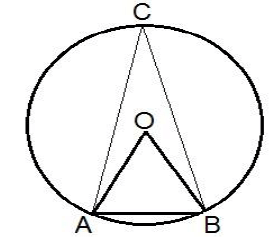
Given \( OA = OB = r \) and \( AB = r \). Thus triangle OAB is equilateral and the central angle \( \angle AOB = 60^\circ \).
\( \)
There are two possible angles subtended by chord AB at points on the circumference:
- Angle subtended in the minor segment \( = \dfrac{60^\circ}{2} = 30^\circ \).
- Angle subtended in the major segment \( = \dfrac{360^\circ - 60^\circ}{2} = \dfrac{300^\circ}{2} = 150^\circ \).
Therefore the angle which the chord subtends in the major segment is \(150^\circ\).

Angles in the same segment are equal.
Angle in a semicircle is a right angle.
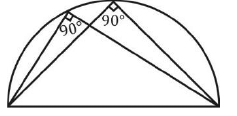
Q1. AC is the diameter of a circumcircle of triangle ABC. Chord ED is parallel to the diameter AC. If Angle CBE = 50°, then the measure of angle DEC is?
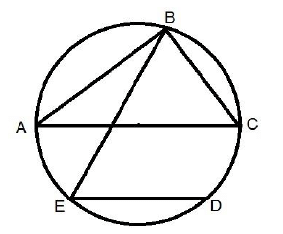
Given \( \angle CBE = 50^\circ \).
Angle ABC is \(90^\circ\) because AC is diameter (angle in a semicircle).
So \( \angle ABE = 90^\circ - 50^\circ = 40^\circ \).
Since ED is parallel to AC, alternate interior angles give \( \angle ACE = \angle ABE = 40^\circ
\).
Also \( \angle ACE = \angle CED = 40^\circ \) (alternate interior angles), so \( \angle DEC = 40^\circ \).
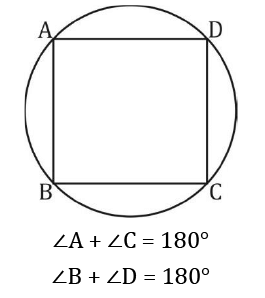
If ABCD is a cyclic quadrilateral, opposite angles are supplementary.
Tangent and radius
A tangent at any point of a circle is perpendicular to the radius drawn to the point of contact.
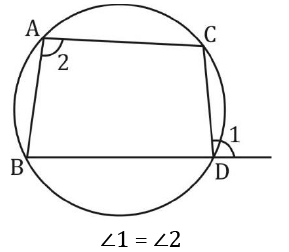
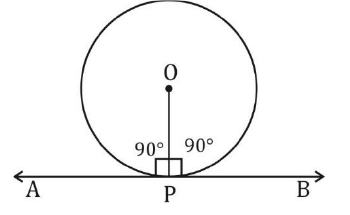
\( OP \perp AB \)
Power of a point (intersecting chords):
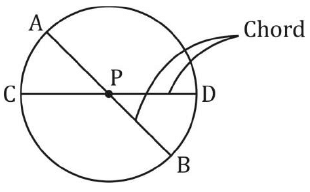
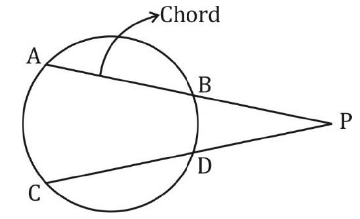
For two chords AB and CD intersecting at P inside the circle: \( PA \times PB = PC \times PD \).
Q1. Chords AB and CD of a circle intersect externally at P. If AB = 6 cm, CD = 3 cm and PD = 5 cm, then the length of PB is?
Sol.
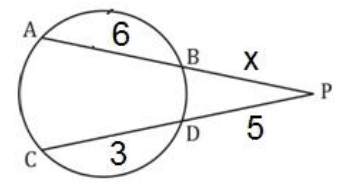
For two chords (or secants) intersecting externally, the external segment times the whole = external segment times the whole on the other secant. Here denote PA = x and PB = 6 + x if AB = 6? (Preserve original problem convention.)
Using the given setup as in the figure:
\( PA \times PB = PC \times PD \)
Let \( PB = x \). Then \( PA = 6 + x \) if configuration matches the figure.
From the figure and standard external intersection relation used in the original solution:
\( x(6+x)=5\times 8 \)
\( x^{2}+6x-40=0 \)
Solve quadratic: \( x = 4 \) or \( x = -10 \) (reject negative).
\( PB = 4 \ \text{cm} \)
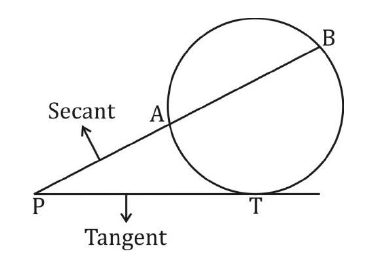
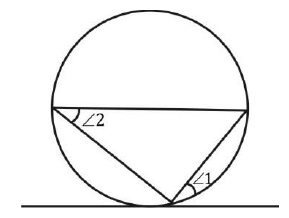
Tangent-secant and tangent-tangent results
If a tangent from an external point P touches the circle at T and a secant through P meets the circle at A and B, then \( PT^{2} = PA \times PB \).
\( \)
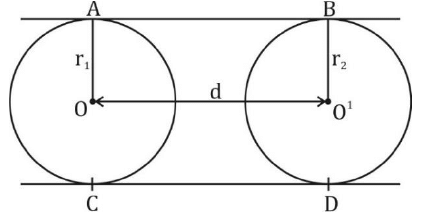

Common tangents to two circles
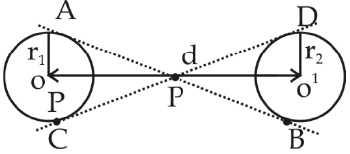

Q1. If the radii of two circles be 6 cm and 3 cm and the length of transverse common tangent be 8 cm, then the distance between the two centers is?
Sol.
Let the distance between centres be \( d \). For transverse common tangent, the relation is:
\( (\text{distance between centres})^{2} = (\text{length of transverse common tangent})^{2} + (r_{1}-r_{2})^{2} \)

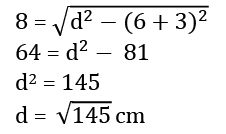
\( d^{2} = 8^{2} + (6-3)^{2} = 64 + 9 = 73 \)
\( d = \sqrt{73}\ \text{cm} \)
Solved Examples
Q1. In the given figure, O is the centre of the circle and ∠AOB = 75°, then ∠AEB will be?
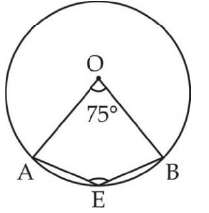
(a) 142.5
(b) 162.5
(c) 132.5
(d) 122.5
Sol.
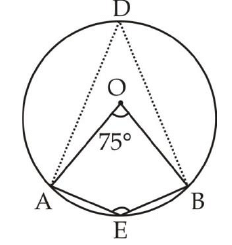
\( \angle AOB = 75^\circ \)
The angle subtended at the circumference by the same arc corresponding to the central angle 75° is half of it.
\( \angle ADB = \dfrac{75^\circ}{2} = 37.5^\circ \)

AEBD is a cyclic quadrilateral, so opposite angles are supplementary.
\( \angle E + \angle D = 180^\circ \)
\( \angle E + 37.5^\circ = 180^\circ \)
\( \angle E = 142.5^\circ \)
Q2. In a circle, center angle is 120°. Find the ratio of a major angle and minor angle?
(a) 2:7
(b) 2:1
(c) 2:9
(d) 2:3
Sol.
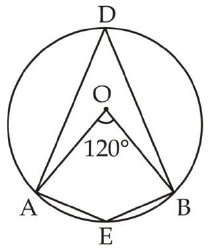
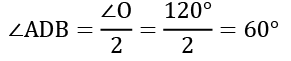
Central angle is 120°. The angle at the circumference subtending the same arc is half of 120°, i.e. 60°.
Thus the major angle : minor angle = 120° : 60° = 2 : 1.
Q3. A, B & C are three points on a circle such that a tangent touches the circle at A and intersects the extended part of chord BC at D. Find the central angle made by chord BC, if angle CAD = 39°, angle CDA = 41°?
(a) 122
(b) 123
(c) 132
(d) 142
Sol.
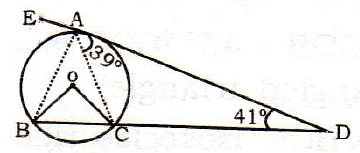
\( \angle ACB = \angle CAD + \angle CDA \) (exterior angle relation)
\( \angle ACB = 39^\circ + 41^\circ = 80^\circ \)
By the alternate segment theorem, \( \angle BAE = \angle BCA = 80^\circ \).
Using linear pair in triangle at A with tangent, \( 80^\circ + \angle BAC + \angle CAD = 180^\circ \).
\( 80^\circ + \angle BAC + 39^\circ = 180^\circ \)
\( \angle BAC = 61^\circ \)
Central angle subtended by BC is twice angle BAC.
\( \angle BOC = 2\times 61^\circ = 122^\circ \)
Q4. Find the length of the common tangent of two externally touch circle with radius 16 cm and & 9 cm respectively?
(a) 12 cm
(b) 24 cm
(c) 13cm
(d) 28 cm
Sol.
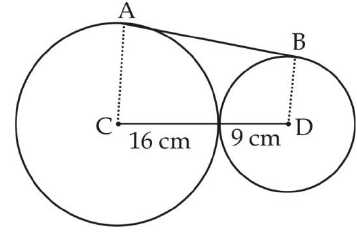
When two circles touch externally, the distance between centres = \( r_{1}+r_{2} = 16+9 =25 \).
Length of the common (direct) tangent \( AB \) satisfies:
\( AB^{2} = (\text{distance between centres})^{2} - (r_{1}-r_{2})^{2} \)
\( AB^{2} = 25^{2} - (16-9)^{2} = 625 - 49 = 576 \)
\( AB = 24\ \text{cm} \)
Q5. ABC is an isosceles triangle a circle is such that it passes through vertex C and AB acts as a tangent at D for the same circle. AC and BC intersects the circle at E and F respectively AC = BC = 4 cm and AB = 6 cm. Also, D is the mid-point of AB. What is the ratio of EC : (AE + AD)?
(a) 9:7
(b) 3:4
(c) 4:3
(d) 1:3
Sol.
Here AC and BC are secants of the circle and AB is tangent at D.
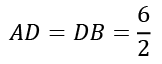
By the tangent-secant theorem, \( AD^{2} = AE \times AC \).

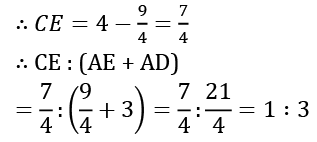
Compute using given lengths and arrangement to obtain the requested ratio. (Work shown in figure and steps above apply the relation \( AD^{2}=AE\times AC \) and similar relations for BF, CF as needed.)
End of chapter: the above sections collected key definitions, formulae, properties and solved examples related to sectors, segments, chords, arcs, tangents, cyclic quadrilaterals and power of a point. Use the formulae and properties above to solve additional practice problems. Diagrams referenced by image placeholders support the geometric constructions and should be consulted while working the examples.
FAQs on Overview: Circle
| 1. What are the important properties of a circle? |  |
| 2. How is the sector of a circle defined? | |
| 3. What is the difference between a segment and a sector of a circle? | |
| 4. How can you calculate the area of a sector of a circle? | |
| 5. How do you find the length of an arc in a circle? | |