Population of Bihar - 2


Population of Bihar
- Bihar, a prominent Indian state located in the northern part of the country, is home to about 130 million people (2023 estimate). It has the highest population density among Indian states-about 1,106 persons per sq km (Census 2011); only the Union Territory of Delhi is higher. Despite various efforts to manage its rapidly growing population, results have been less than optimal.
- The 2011 Census revealed that Bihar had the third-largest population in India, with a growth rate of 25%, surpassing the national average of around 17%. As of 2023, multiple official estimates put Bihar's population around 127-131 million (e.g., NITI Aayog projection ~127 million; Bihar survey ~130.7 million).
Bihar Sex Ratio
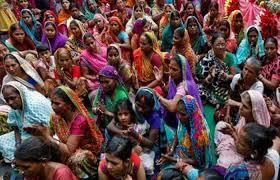
- In Bihar, the most recent census from 2011 shows that there are 918 females for every 1000 males, which is below the national average of 940. In 2001, it was 919 females per 1000 males (not "more females than males"). Latest household survey (NFHS-5, 2019-21) indicates a sex ratio of the total population around 1,050 and a sex ratio at birth around 899-figures are not strictly comparable to the decennial census.
Bihar Literacy Rate
- The Census 2011 recorded Bihar's literacy rate at 61.80% (male 71.20%, female 51.50%). Recent PLFS 2023-24 data places overall literacy around 74% (age 7+), though definitions differ from the census.
- Bihar has a total of 52,504,553 literates (Census 2011), comprising 31,608,023 males and 20,896,530 females. District highs/lows such as Rohtas 75.59% and Purnia 52.49% are also Census 2011 values.
Bihar Religion wise Population
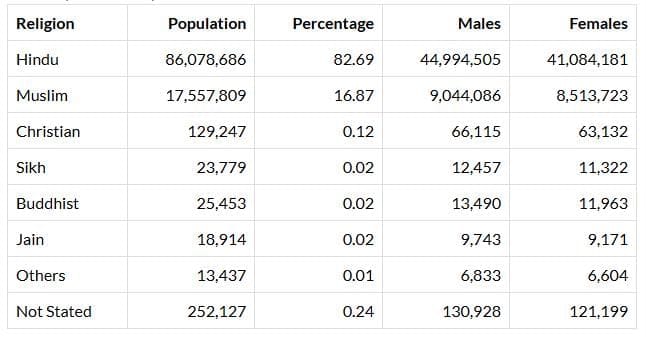
Census 2011: Hinduism 82.69%, Islam 16.87%, Christianity 0.12%, Buddhism 0.02%, Jainism 0.02%, Sikhism 0.02% (others each <1%).
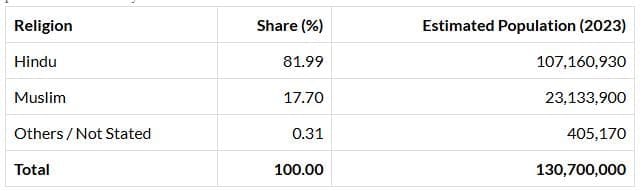
Recent state survey (2023): Hindus ~81.99%, Muslims ~17.70% (others each <1%).
Official (Census 2011)
Update (Bihar Caste Survey, Oct 2023) - shares & estimated population
Total population assumed ≈ 130.7 million (state estimate). Male/female splits by religion are not officially published in this survey.
District-wise population in Bihar
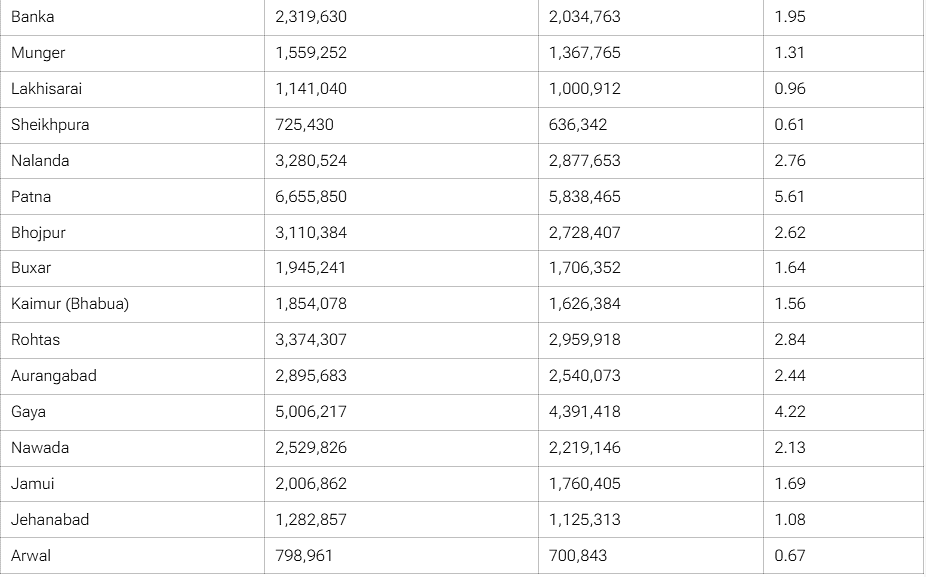
Bihar has 38 districts (as of 2025). District population figures commonly cited are from the 2011 Census. For example, Patna (2011): 6,099,000+ and Sheikhpura (2011): ~636,000-713,000 (depending on sub-district aggregation). Updated official district-wise counts will follow the next census.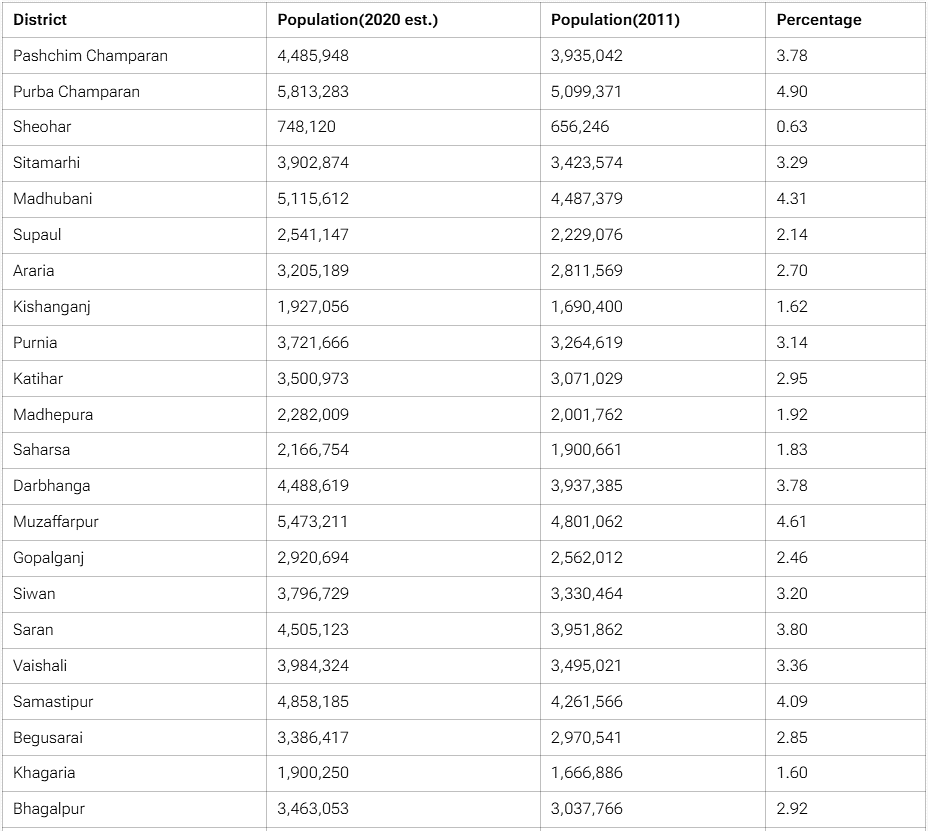
Languages Spoken in Bihar
Official languages: Hindi and Urdu. Mother-tongue shares (Census 2011, approx.): Hindi ~25.5%, Bhojpuri ~24.9%, Maithili ~12.6%, Magahi ~10.9%, Urdu ~8.4%, Surjapuri ~1.8%, others <2%.
Hindi remains the administrative lingua franca across the state, with these major mother tongues concentrated by district.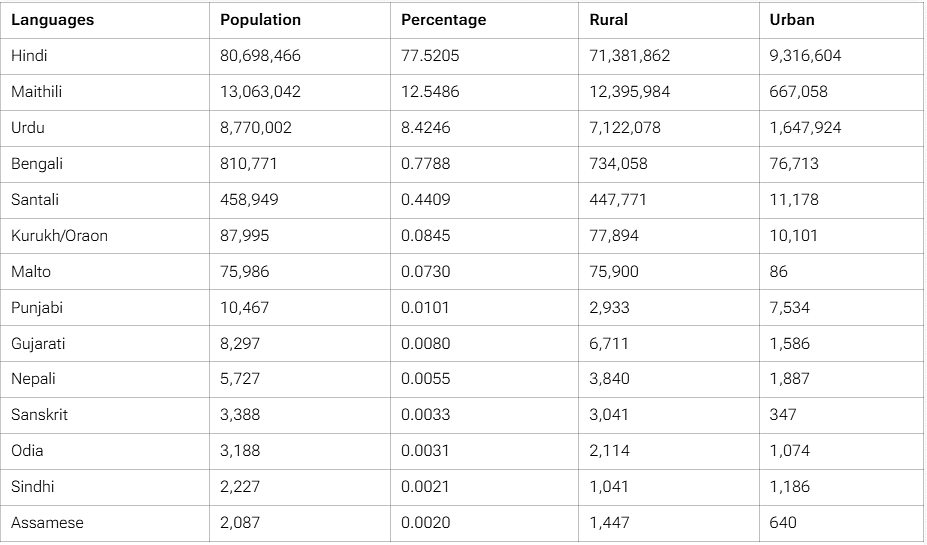 In 1901, during the first census under British rule, Bihar's population was 21.24 million. By 1951, the first census after India gained independence recorded a population of 29 million. The 2001 census showed a significant increase, with Bihar's population nearly tripling to 82 million over the previous 50 years. The most recent census in 2011 recorded a population of 104 million, marking a 25% growth from the previous count. The next decennial census is now scheduled in two phases with a reference date of March 1, 2027 (October 1, 2026 in snow-bound regions).
FAQs on Population of Bihar - 2
| 1. What is the current population of Bihar and how does it compare to previous census data? |  |
| 2. What is the sex ratio in Bihar and why is it important? | |
| 3. What is the literacy rate in Bihar and how has it evolved over the years? | |
| 4. How is the population of Bihar distributed among different religions? | |
| 5. What languages are predominantly spoken in Bihar? | |