GPSC (Gujarat) Exam > GPSC (Gujarat) Notes > Gujarat State PSC (GPSC) Preparation: All subjects > Gujarat: Vegetation
Gujarat: Vegetation

Forest and Wildlife in Gujarat
- Gujarat has only 11.04% of its geographical area designated as forest, which is significantly below the national average. The combined forest and tree cover amounts to 11.74% of the state's total area, with 7.48% classified as forest cover and 4.26% as tree cover outside forests (TOF).
- The state's unique features include diverse climatic and geomorphologic conditions, such as the longest coastline in the country, the saline deserts of the Rann, grasslands, and wetlands. These factors contribute to the rich biodiversity of flora and fauna in Gujarat. Notably, the state is home to the last remaining populations of the Asiatic lion and the wild ass.
- The Forests & Environment Department of Gujarat is responsible for formulating policies for the conservation of forests, wildlife protection, and environmental preservation. Gujarat has four national parks, 23 sanctuaries, and one conservation reserve.
Distribution of Forests in Gujarat
- The hills of Gujarat, which receive more rainfall than the low-lying plains, are where most of the state's forests are located. However, the hills of Kutch are an exception, as they receive little rainfall.
- Gujarat has just under 2 million hectares of land under forest cover. The southern part of the state is rich in deciduous vegetation, including teak. In contrast, the Kutch region is dominated by thorny forests, featuring species such as Acacia Arabica, Acacia Leucophloea, Zizyphus Mauratiana, and Capparis Ophylla.
Flora and Fauna in Gujarat
- Gujarat's diverse climatic conditions support a wide variety of flora, with more than 400 species recorded. The state hosts one of the largest dry deciduous forests in western India, which includes trees like teak, Boswellia serrata, Anogeissus latifolia, and Diospyros.
- Due to the arid climate, Gujarat also has a significant presence of xerophytic vegetation, including species such as Acacia arabica, Acacia leucophloea, Capparis ophylla, and Zizyphus mauratiana.
Forest Cover by District
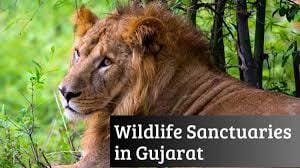
- The Dangs district has the largest area under forest cover in Gujarat. The state is the only place outside Africa where Asiatic lions are found in their natural habitat, primarily in the Gir Forest National Park located in the southwest of the state. Besides lions, leopards are also found across the large plains of Saurashtra and the mountains of South Gujarat.
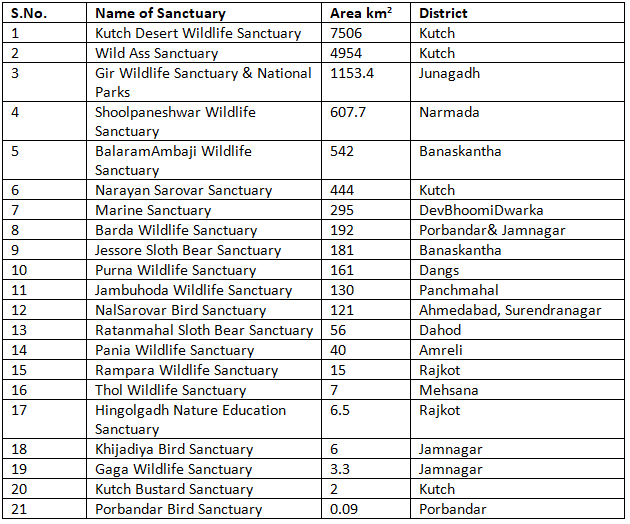
- Other notable national parks include Vansda National Park, Blackbuck National Park in Velavadar, and the Narara Marine National Park in the Gulf of Kutch, Jamnagar. Wildlife sanctuaries in the state include the Wild Ass Wildlife Sanctuary, Nal Sarovar Bird Sanctuary, Porbandar Bird Sanctuary, Kutch Desert Wildlife Sanctuary, Kutch Bustard Sanctuary, Narayan Sarovar Sanctuary, Jessore Sloth Bear Sanctuary, Anjal, Balaram-Ambaji, Barda, Jambughoda Wildlife Sanctuary, Khavda, Paniya, Purna, Rampura, Ratanmahal, and Shoolpaneshwar Wildlife Sanctuary.
Major Mountain Ranges in Gujarat
- Gujarat is home to some of India's major mountain ranges, including the Aravalli, Sahyadri (Western Ghats), Vindhya, and Saputara ranges. Additionally, Gir hills, Barda, Jessore, and Chotila are situated in various parts of the state.
MULTIPLE CHOICE QUESTIONTry yourself: Which district in Gujarat has the largest area under forest cover?
Major National parks and wildlife sanctuaries of Gujarat
National Parks of Gujarat
Wildlife sanctuaries of Gujarat
The document Gujarat: Vegetation is a part of the GPSC (Gujarat) Course Gujarat State PSC (GPSC) Preparation: All subjects.
All you need of GPSC (Gujarat) at this link: GPSC (Gujarat)
FAQs on Gujarat: Vegetation
| 1. What are some common types of vegetation found in Gujarat? |  |
Ans. The common types of vegetation found in Gujarat include thorn forests, scrublands, grasslands, and mangrove forests.
| 2. What is the significance of the flora and fauna of Gujarat? | |
Ans. The flora and fauna of Gujarat play a crucial role in maintaining the ecological balance of the region, supporting biodiversity, and providing habitats for various species.
| 3. How does the vegetation in Gujarat contribute to the state's economy? | |
Ans. The vegetation in Gujarat contributes to the state's economy through activities such as agriculture, horticulture, forestry, and eco-tourism, which generate income and employment opportunities.
| 4. What are some of the endangered species of flora and fauna in Gujarat? | |
Ans. Some of the endangered species of flora and fauna in Gujarat include the Asiatic lion, Indian wild ass, Indian pangolin, and various species of vultures.
| 5. How is the government of Gujarat working to conserve the flora and fauna of the state? | |
Ans. The government of Gujarat has implemented various conservation programs, wildlife sanctuaries, and protected areas to preserve the flora and fauna of the state, along with promoting sustainable development practices.
About this Document

4.62/5 Rating

Apr 21, 2026 Last updated
Related Exams
Document Description: Gujarat: Vegetation for GPSC (Gujarat) 2026 is part of Gujarat State PSC (GPSC) Preparation: All subjects preparation. The notes and questions for Gujarat: Vegetation have been prepared according to the GPSC (Gujarat) exam syllabus. Information about Gujarat: Vegetation covers topics like and Gujarat: Vegetation Example, for GPSC (Gujarat) 2026 Exam. Find important definitions, questions, notes, meanings, examples, exercises and tests below for Gujarat: Vegetation.
Introduction of Gujarat: Vegetation in English is available as part of our Gujarat State PSC (GPSC) Preparation: All subjects for GPSC (Gujarat) & Gujarat: Vegetation in Hindi for Gujarat State PSC (GPSC) Preparation: All subjects course. Download more important topics related with notes, lectures and mock test series for GPSC (Gujarat) Exam by signing up for free. GPSC (Gujarat): Gujarat: Vegetation
Description
Gujarat: Vegetation of Gujarat State PSC covers all the important topics, helping you prepare for the GPSC (Gujarat) exam on EduRev. Start for free!
Information about Gujarat: Vegetation
In this doc you can find the meaning of Gujarat: Vegetation defined & explained in the simplest way possible. Besides explaining types of Gujarat: Vegetation theory, EduRev gives you an ample number of questions to practice Gujarat: Vegetation tests, examples and also practice GPSC (Gujarat) tests



Related Searches
Sample Paper, Previous Year Questions with Solutions, ppt, Gujarat: Vegetation, Free, Gujarat: Vegetation, MCQs, Viva Questions, study material, shortcuts and tricks, practice quizzes, past year papers, Extra Questions, Gujarat: Vegetation, Exam, Objective type Questions, Summary, mock tests for examination, video lectures, Important questions, Semester Notes, pdf ;