Gujarat: Human Development Index

Introduction
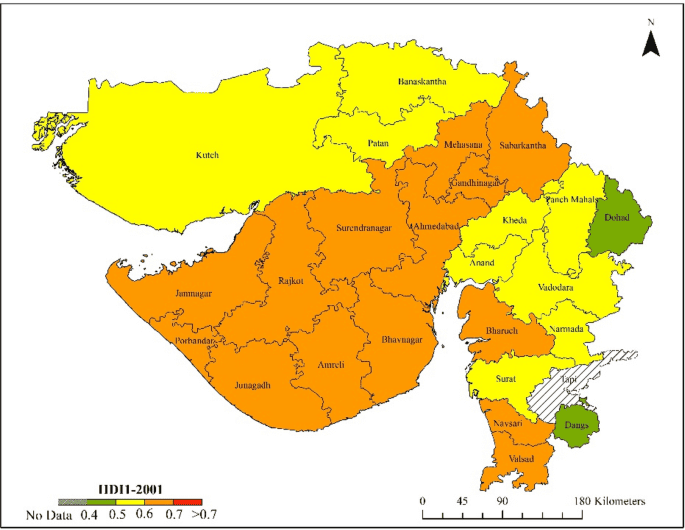
- The Human Development Index (HDI) is a composite measure used to assess the average achievement in key dimensions of human development, which include a long and healthy life, access to knowledge, and a decent standard of living. The HDI is calculated as the geometric mean of normalized indices for each of these three dimensions.
- The index was developed by Mahbub-ul-Haque, in collaboration with Amartya Sen, and has been used by the United Nations Development Programme (UNDP) in their annual Human Development Reports since 1990. The primary goal of the HDI is to place people at the center of the development process, focusing on economic debate, policy, and advocacy. The report ranks countries based on their HDI scores.
HDI Dimensions and Indicators
- Health (A long and healthy life): The HDI measures health through life expectancy. Estimates of life expectancy for major Indian states are derived from SRS Based Abridged Life Tables (2002-2006), which also provide data on inequality and mortality profiles across age intervals.
- Education (Access to knowledge): Education is measured using the mean years of schooling for the adult population (aged 25 years and above), estimated from NSS data on educational status and training in India. School life expectancy is also calculated using NSS unit record data.
- Income (Decent standard of living): The HDI uses the Gross National Income (GNI) per capita (PPP US$) for India from the Human Development Report (HDR) 2010. State-level per capita income estimates are computed using NSS estimates of per capita personal consumer expenditure for 2004-05, assuming that income distribution across states mirrors NSS consumer expenditure distribution.
Gujarat's Human Development Index
In 2015, Gujarat's HDI value was 0.616, placing it in the middle-income category and ranking it 11th among Indian states. The performance of the social sectors, closely linked to the wellbeing of the population, is key to improving Gujarat's Human Development Index.
Gujarat's Human Development Focus
Gujarat aims to become a model state in all aspects of human development. The state's vision is that every person, regardless of gender, caste, or creed, will:
- Be literate and healthy
- Have access to shelter and a clean environment
- Have safe drinking water and sanitation facilities
- Be gainfully employed
- Live without fear
- Have equal opportunities
12th Five-Year Plan (2012-17)
The 12th Five-Year Plan emphasized economic wellbeing through a Human Development Approach. The Gujarat government prioritized social sector development, which directly impacts human development, by allocating approximately 47.09% of the total budget to social sectors in 2016-17.
Flagship and Mission Mode Programmes
To address the needs of underprivileged societies and regions, the state government launched several "Flagship Programmes," including:
- Sagarkhedu Sarvangi Vikas Yojana
- Vanbandhu Kalyan Yojana
- Garib Samruddhi Yojana
- 49 Developing Talukas
In addition, various "Mission Mode Programmes" are being implemented to improve the HDI, such as:
- Kanya Kelavani
- Gunotsav
- Krishi Mahotsav
- Nirmal Gujarat
- Skill Development
- Nirogi Bal
- Bal Sakha Yojana
- Balbhog Yojana
- Mamata Abhiyan
- e-Mamta
- MA (Mukhyamantri Amrutum)
- Mukhyamantri Amrutum Vatsalya Yojana
- e-MPOWER
- Chiranjeevi Yojana
- Kaushalya Vardhan Kendra
- Mukhyamantri Yuva Swavalamban Yojana
Education Initiatives
The Government of Gujarat is committed to achieving total literacy by strengthening various educational programs across Primary, Secondary, Higher Secondary, and Technical Education.
Notable initiatives include:
- Vidya Deep Insurance
- Vidya Laxmi Bond
- Distribution of Cost-Free Textbooks
- Kanya Kelavani Mahotsav
- Gunotsav Programme
- Free Bicycles for Girls
- CM Scholarship Scheme
Gujarat Social Infrastructure Development Society (GSIDS)
- To improve the overall living standards of the people, the Gujarat government has established the Gujarat Social Infrastructure Development Society (GSIDS), an autonomous body.
- GSIDS has a Governing Body of 10 members, chaired by the Principal Secretary (Planning) of the General Administration Department. The Society's mission is to enhance human development outcomes across the state.
District Human Development Report (DHDR)
The Gujarat Social Infrastructure Development Society (GSIDS) has undertaken the preparation of District Human Development Reports (DHDR) for all 33 districts in the state.
Published DHDR Reports
- During the year 2015-16, DHDRs for the following 8 districts were published: Banaskantha, Sabarkantha, Jamnagar, Dang, Surendranagar, Bharuch, Tapi, and Kheda.
- In 2016-17, DHDRs for 10 additional districts were published: Porbandar, Ahmedabad, Narmada, Navsari, Mahesana, Patan, Kachchh, Surat, Junagadh, and Panchmahal.
Planned DHDR Reports
- The Gujarat State Institute of Development Studies (GSIDS) has undertaken the preparation of District Human Development Reports (DHDR) for all 33 districts in the state.
- During 2015-16, DHDRs were published for eight districts: Banaskantha, Sabarkantha, Jamnagar, Dang, Surendranagar, Bharuch, Tapi, and Kheda. In 2016-17, reports were released for ten districts: Porbandar, Ahmedabad, Narmada, Navsari, Mahesana, Patan, Kachchh, Surat, Junagadh, and Panchmahal.
- Additionally, DHDRs for eight more districts-Vadodara, Dahod, Rajkot, Bhavnagar, Amreli, Gandhinagar, Anand, and Valsad-are planned for publication by the end of 2016-17. The DHDRs for seven newly created districts are currently being prepared and are expected to be completed in 2017-18.
Human Development Towards Bridging Inequalities (HDBI)
- Since 2013, the Government of Gujarat (GoG) has been involved in the 'Human Development: Towards Bridging Inequalities' (HDBI) project initiated by the former Planning Commission-UNDP (now NITI Aayog).
- A steering committee led by the Hon. Principal Secretary (Planning) oversees this initiative.
From DHDR to DHDPs (District Human Development Plans)
- Building on gap analyses from District Human Development Reports (DHDRs), focus areas are identified and District Human Development Plans (DHDPs) are being prepared.
- DHDPs for Bharuch, Kheda, Narmada, Navsari, Sabarkantha, Tapi, and Mahesana have been finalized, with plans to complete the remaining 26 districts by March 2017.
Incorporating Human Development in Academia
- To promote the development of Human Development courses in academic institutions, the state has organized three workshops/seminars at Sardar Patel University-Anand, NICMGandhinagar, and CHARUSAT-Changa, in collaboration with the Higher and Technical Education Department.
District Human Development Profile
- The District Human Development Profile provides a taluka-wise overview of social sectors with 100 indicators, including demographics, health, education, and livelihood. GSIDS has prepared these profiles for all 33 districts in Gujarat.
Taluka Development Plan (TDP)
- Gujarat is preparing Taluka Development Plans (TDPs) for one taluka per district (33 talukas) to promote a taluka-centric approach and decentralized district planning.
Impact Evaluation of Flagship Schemes
- An impact evaluation of the flagship scheme for developing talukas is being conducted to assess the utilization of funds and progress in achieving key indicators in the respective talukas.
Empanelment of Subject Specialists/Consultants
- The Government of Gujarat has empanelled 22 subject specialists/consultants to carry out third-party evaluations of various government schemes and programs, assessing their efficiency and effectiveness.
FAQs on Gujarat: Human Development Index
| 1. What is the Human Development Index (HDI) and how is it calculated? |  |
| 2. What is the significance of the Impact Evaluation of Flagship Schemes of Developing Talukas? | |
| 3. How are Subject Specialists/Consultants empaneled in Gujarat for Human Development initiatives? | |
| 4. What is the objective of the Human Development towards Bridging Inequalities (HDBI) program? | |
| 5. How does the Gujarat Public Service Commission (GPSC) contribute to Human Development Index in Gujarat? | |