Trends in FDI

Trends in Foreign Direct Investment
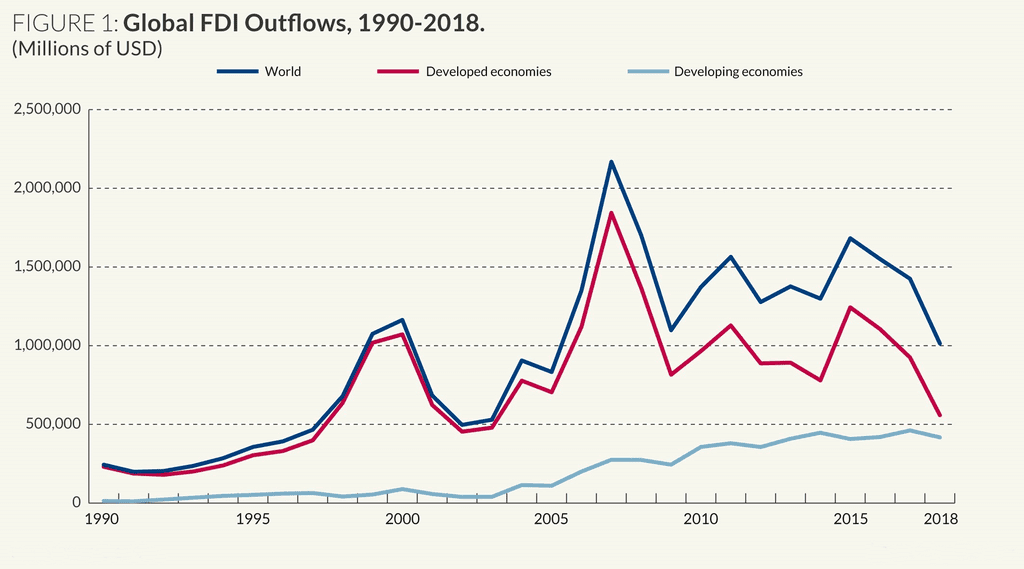
Foreign direct investment (FDI) is a long‐term cross‐border investment by a resident entity of one economy in an enterprise resident in another economy with the objective of obtaining a lasting interest and a degree of influence over management. FDI is a key channel for capital flows, international trade, technology transfer, managerial know‐how, and integration into global value chains. Over recent decades the volume, direction and composition of FDI have undergone important changes driven by economic liberalisation, technological advances, changing firm strategies and geopolitical developments.
Key Trends in FDI
Rising global FDI volumes: Global FDI inflows and outflows rose markedly in recent decades, increasing from about $59 billion in 1990 to roughly $1.5 trillion in 2019. Growth has been uneven across regions and years but the long‐term trajectory shows an overall expansion of cross‐border direct investment.
Shift towards services: Historically concentrated in manufacturing, FDI has shifted strongly into the services sector - finance, telecommunications, business services, logistics, healthcare and real estate. This reflects the growing weight of services in world GDP and trade, and the tradability and digitalisation of many services.
Role of cross‐border mergers and acquisitions (M&A): Cross‐border M&A have become a dominant channel of FDI, enabling firms to acquire market access, established brands and advanced technologies rapidly. Large, mega‐deals among multinational firms have shaped ownership patterns in many industries.
Rise of South-South FDI: Investment flows between developing and emerging economies - often labelled South-South FDI - have grown substantially. Notable examples include Chinese investments in Africa and Latin America, and intra‐Asia investment linkages.
Intra‐firm investment and global value chains: An increasing share of FDI takes place within multinational enterprise groups to optimise production networks, locate complementary activities and exploit scale and scope economies across borders.
FDI into high‐tech and knowledge‐intensive sectors: Biotechnology, software, semiconductors, telecommunications, clean energy and research‐intensive manufacturing attract growing FDI, reflecting the premium on intangible assets and innovation‐led competitiveness.
Sustainability and ESG considerations: Environmental, social and governance (ESG) factors increasingly influence investment decisions. Sustainable FDI - projects aligned with climate goals, renewable energy and socially responsible practices - has become a growing segment.
Greenfield projects vs acquisitions: There has been an observable increase in new Greenfield FDI projects (establishing new facilities) in many host economies, signalling investor confidence in long‐term prospects. At the same time, acquisitions remain important for rapid market entry.
Intangible assets and strategic assets: A rising proportion of FDI targets brands, patents, proprietary technology and managerial expertise rather than only physical capital. This trend contributes to concentration of market power in certain sectors.
Focus on emerging markets: Large emerging economies such as China, India, Brazil and Indonesia attract substantial FDI because of expanding domestic markets, improving infrastructures and policy reforms.
Automation, robotics and Industry 4.0: FDI increasingly supports facilities that employ robotics, artificial intelligence and advanced automation, reflecting productivity priorities and changing comparative advantages.
Digital platforms and e‐commerce: The international expansion of e‐commerce platforms and digital service providers is reshaping trade and investment patterns, enabling cross‐border delivery of services and digital goods and creating new FDI opportunities in logistics, data centres and fintech.
Strategic and screened investment: Governments increasingly use FDI policy to achieve strategic aims - protecting sensitive technologies, securing critical resources and supporting priority sectors - while also screening investments on national‐security grounds.
Interest in frontier markets: Some investors explore smaller or frontier markets seeking higher growth and potential outsized returns; these investments carry higher political and economic risk but can diversify investor portfolios.
Modes of FDI and Their Implications
Greenfield investment: A foreign firm builds a new operation from the ground up in the host country. Greenfield projects typically generate new jobs, transfer technologies and create linkages with local suppliers.
Brownfield investment and acquisitions (M&A): A foreign investor acquires an existing domestic firm. M&A permit fast market access and access to established distribution, but may also lead to ownership concentration and restructuring.
Joint ventures and strategic alliances: Foreign and local partners form new enterprises to combine complementary strengths, share risks and meet regulatory or local‐knowledge requirements.
Intra‐firm transfers: Transfers of finance, technology, managerial expertise and personnel within a multinational group are core to the functioning of global value chains and knowledge diffusion.
Sectoral Trends in FDI
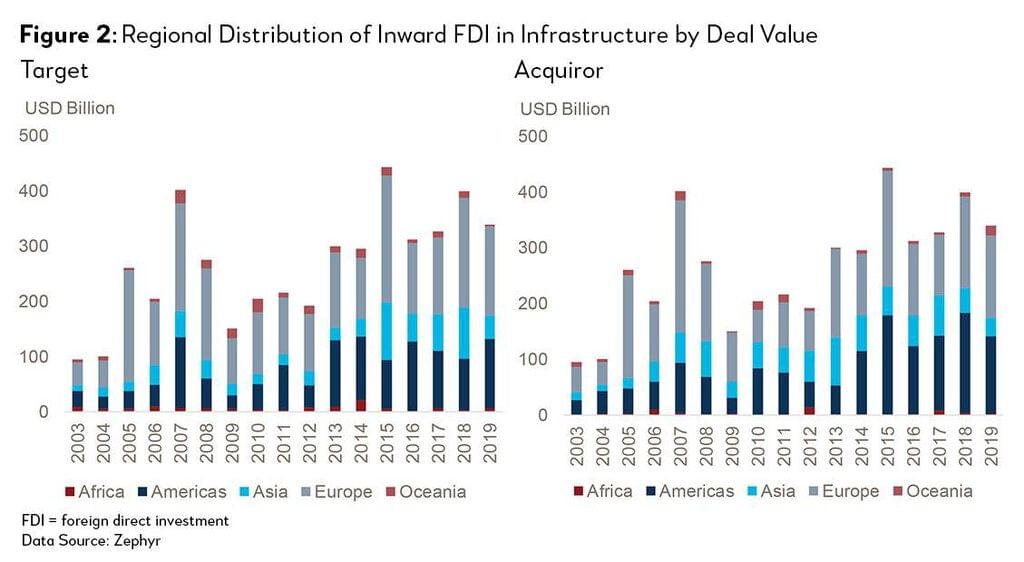
FDI distribution across sectors reflects comparative advantage, market size and regulatory conditions. Principal sectoral trends include:
Services: The services sector (finance, telecommunications, business services, real estate, logistics, healthcare and education) has become the largest recipient of global FDI. Its share rose from roughly 40% in the 1990s to over 65% in recent years, largely due to liberalisation, digitalisation and growth of tradable services.
Manufacturing: Traditional labour‐intensive manufacturing saw declines in some countries because of rising costs and relocation. High‐technology manufacturing and advanced manufacturing (electronics, automotive components, pharmaceuticals) continue to attract targeted FDI.
Natural resources: Extractive industries (mining, oil and gas) remain major recipients in resource‐rich developing countries. Such projects often involve large capital inflows but raise environmental and community governance issues.
Infrastructure: Transportation, power generation, ports, telecom towers and other infrastructure attract long‐term FDI and public‐private partnership models as governments seek private capital to meet development needs.
Agriculture and agro‐processing: Commercial farming, food processing and agribusiness have seen increasing foreign investment, with potential productivity gains as well as concerns about land rights and impacts on smallholders.
Technology and digital economy: Software, data centres, cloud services, semiconductors and fintech are fast‐growing FDI destinations. Investment in R&D and digital infrastructure is especially prominent in advanced and some emerging economies.
Real estate and retail: Commercial and residential real estate investments by foreign investors have increased in many urbanising economies. Organised retail chains and global franchises expand through FDI where policy permits.
Governments must weigh sectoral benefits - such as technology transfer, employment and tax revenues - against potential costs, including crowding out of local firms, profit repatriation and environmental externalities.
Global FDI Trends and Recent Developments

Annual FDI trends fluctuate with the global economic cycle, policy shifts and shocks such as pandemics or geopolitical tensions. Recent notable developments are:
COVID‐19 shock and recovery: FDI recorded a sharp decline during the early stages of the COVID‐19 pandemic in 2020, driven by economic contraction and uncertainty. A partial recovery occurred in 2021 as economies stabilised and investment in digital and healthcare sectors rose.
Regional shifts: Asia (including China, India and Southeast Asia) has grown as a major destination for FDI, supported by large markets and regional production networks. Africa has also attracted rising interest due to natural resources and demographic growth. North America and Western Europe continue to draw significant FDI in advanced technology and services.
Key sectors: Technology and digital industries (e‐commerce, AI, cloud computing), healthcare and renewable energy attracted substantial FDI. Renewable energy investments rose as countries and firms pursued climate commitments.
Policy changes and screening: Several countries strengthened screening mechanisms to protect sensitive sectors related to national security and critical infrastructure. At the same time, incentives such as tax breaks, investment facilitation and special economic zones were used to attract desirable FDI.
Geopolitical influence: Trade disputes and strategic rivalry among major powers (for example tensions involving major economies) have reshaped some investment decisions, supply chains and technology transfer patterns.
Multilateral and regional agreements: Trade and investment arrangements - for example the Comprehensive and Progressive Agreement for Trans‐Pacific Partnership (CPTPP) and the Regional Comprehensive Economic Partnership (RCEP) - influence investor preferences by improving market access and reducing transaction costs.
Determinants of FDI
Common determinants that influence investor location choice include:
Market size and growth: Larger and faster‐growing markets attract market‐seeking FDI.
Factor costs and productivity: Labour costs, skill availability and productivity affect cost‐sensitive manufacturing investments.
Access to resources: Natural resources, raw materials and energy sources attract resource‐seeking FDI.
Policy and regulatory environment: Investment climate, ease of doing business, trade openness, tax incentives and investment protection measures matter significantly.
Infrastructure and connectivity: Reliable transport, power, digital connectivity and logistics increase host attractiveness.
Institutional quality: Political stability, rule of law, transparency and governance reduce investment risk.
Agglomeration and clusters: Presence of industry clusters and supplier networks often attracts more FDI through agglomeration economies.
Technological and human capital: Skilled labour, R&D capacity and innovation ecosystems attract knowledge‐intensive FDI.
Impacts of FDI on Host and Home Economies
FDI produces a range of effects that vary by context and sector:
Positive impacts on host economies: FDI can increase capital formation, employment, productivity, export capacity, technology transfer and managerial skills. It can also support infrastructure development through public‐private partnerships.
Potential challenges: Large foreign ownership may crowd out domestic firms, lead to profit repatriation, worsen balance‐of‐payments if not matched by exports, or create environmental and social concerns.
Spillovers and linkages: Backward and forward linkages with local suppliers and spillovers from foreign firms to local firms are key channels for knowledge diffusion, but their magnitude depends on local absorptive capacity.
Home country effects: Outward FDI can provide firms with new markets, diversify risks and enhance competitiveness. However, relocation of production may raise employment concerns in the home country in the short term.
Policy Options and Investment Facilitation
Policymakers balance attracting desirable FDI with protecting domestic interests. Typical policy instruments include:
Investment promotion: Investment promotion agencies, special economic zones, tax holidays and streamlined approval processes to attract Greenfield FDI.
Regulatory frameworks and screening: National security reviews and sectoral restrictions to screen investments in sensitive industries while preserving open investment regimes for non‐sensitive sectors.
Local content and performance requirements: Conditions to encourage local sourcing, training and technology transfer (used selectively due to trade‐law constraints).
Competition and anti‐monopoly rules: Ensure that consolidated foreign ownership does not adversely affect market competition.
Standards for sustainability: Environmental and social safeguards, corporate social responsibility expectations and alignment with ESG goals to attract sustainable FDI.
Investment facilitation: Reducing bureaucratic hurdles, providing single‐window clearances and improving dispute‐resolution mechanisms to lower transaction costs.
Country Examples and Illustrations
Illustrative patterns observed in practice:
China: Rapid FDI inflows in manufacturing initially (1990s-2000s) shifted to services, technology and outbound investments in recent decades, including substantial South-South investments.
India: Liberalisation since the 1990s and policy reforms have increased FDI attraction in services, IT, pharmaceuticals, telecoms and renewable energy, with selective opening of retail and defence sectors.
Africa and Latin America: Resource‐seeking FDI in extractive industries coexists with growing interest in infrastructure, agribusiness and manufacturing linked to local market expansion and export potential.
Risks and Emerging Concerns
Key risks that shape recent investor and policy behaviour include:
Geopolitical risk and fragmentation: Rivalries among major powers can fragment supply chains and raise strategic screening of investments.
Climate and environmental risk: Investors and regulators increasingly assess projects for climatic vulnerability and environmental externalities.
Digital sovereignty and data localisation: Cross‐border flows of data and digital services raise policy issues relating to privacy, security and localisation requirements, affecting FDI in digital sectors.
Financial volatility: Sudden stops and global liquidity swings can affect the financing and sustainability of long‐term FDI projects.
Conclusion
FDI remains a central mechanism for global economic integration, bringing capital, technology and managerial expertise to host economies while enabling firms to access new markets and assets abroad. Contemporary trends show a strong tilt towards services, high‐technology sectors, sustainability‐oriented projects and greater intra‐firm and South-South investment. Policymakers must craft balanced strategies that attract quality FDI, protect public interest and enhance local absorptive capacity so that FDI contributes effectively to inclusive economic development and long‐term structural transformation.
FAQs on Trends in FDI
| 1. What are some key sectoral trends in Foreign Direct Investment (FDI)? |  |
| 2. How have global FDI trends evolved in recent years? | |
| 3. What factors influence trends in FDI? | |
| 4. How does the COVID-19 pandemic impact trends in Foreign Direct Investment? | |
| 5. What are some strategies that countries can adopt to attract more Foreign Direct Investment? | |