Logistics Management: Importance, Objective & Features

In today's interconnected business environment, logistics management is essential for ensuring the efficient movement of goods, services and information from their point of origin to the point of consumption. This chapter defines logistics management, explains its features, significance, objectives and main types, and describes related performance measures, technologies, challenges and strategies. Examples and practical notes are included to aid comprehension.
Logistics Management
What is Logistics Management?
According to the Council of Logistics Management, logistics involves planning, implementing and controlling the movement and storage of goods, services and related information from the point of origin to the point of consumption. This definition emphasises logistics as an integral part of the supply chain rather than a stand‐alone function.
Logistics management covers the design and operation of systems that ensure the right product reaches the right place, at the right time, in the right condition, and at the right cost. Its scope typically includes:
- Transportation: Selection of transport mode, routing and carrier management.
- Inventory management: Determination of stock levels, safety stock and reorder policies.
- Warehousing and storage: Receipt, storage, handling and dispatch of goods.
- Order processing and information flow: Order management, demand forecasting and communications between stakeholders.
- Packaging and materials handling: Protection of goods and efficient movement within facilities.
- Reverse logistics: Returns, repairs, recycling and disposal.
Example: A manufacturer coordinates procurement of raw materials, schedules production, stores finished goods in regional warehouses and uses transport partners to deliver to wholesalers and retailers. Effective logistics management minimises total cost while meeting customer service targets.
Features of Logistics Management
Key features of logistics management include:
- Efficient movement of goods: Control of material flows for raw materials, work‐in‐progress and finished goods.
- Customer service orientation: Meeting customer expectations regarding availability, quality and information.
- Timely and accurate information: Real‐time updates on demand, stock levels and shipment status.
- Timely delivery and right quantity: Ensuring products reach customers in required quantities, when needed.
- Cost-service trade‐off: Balancing high service levels with minimised logistics and distribution costs.
- Coordination across functions: Integrating procurement, production, marketing and finance to optimise resource use.
- Storage and transport management: Effective handling of warehousing, inventory quantities and transport modes.
Importance of Logistics Management
Logistics has become critical for modern organisations for several reasons:
- Rising transportation costs: Increasing fuel and freight rates make efficient routing, consolidation and mode selection vital to reduce expenses.
- Production efficiency and lean systems: High levels of production and lean manufacturing require reliable inbound logistics to avoid stockouts and production stoppages.
- Technological advancement: Technologies such as barcoding, RFID, transport management systems and GPS enable better tracking, visibility and control.
- Growth of organised retail and e‐commerce: Large retail chains and online marketplaces demand complex distribution networks and fast fulfilment capabilities.
- Globalisation: International sourcing and markets increase complexity of cross‐border transportation, customs and multi‐modal coordination.
Application note: Good logistics reduces total landed cost, improves customer satisfaction, shortens lead times and supports competitive advantage.
Objectives of Logistics Management
The principal objectives of logistics management are:
- Rapid response: Meet customer requirements quickly and reliably.
- Minimum variance: Reduce disruption such as delays, shortages or damaged goods that cause variability in service.
- Minimum inventory: Maintain the lowest possible stock while ensuring service levels and avoiding stockouts.
- Cost minimisation: Optimise total logistics cost rather than minimising a single cost element.
- Quality improvement: Continuous enhancement of logistics processes through approaches such as Total Quality Management (TQM).
- Life‐cycle support and reverse logistics: Provide after‐sales services, repairs, warranty fulfilment and environmentally responsible returns and recycling.
- Customer satisfaction: Ensure accuracy, timeliness and condition of deliveries to retain and attract customers.
Types of Logistics
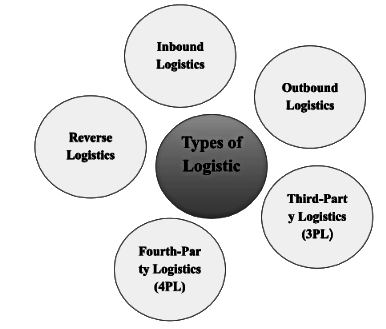
Logistics activities are commonly classified into several types according to direction, ownership and function:
- Inbound logistics: Movement, storage and procurement of inputs entering an organisation, including supplier selection, material receipt and inventory control.
- Outbound logistics: Distribution of finished products to customers through channels such as wholesalers, retailers and direct delivery; includes order fulfilment and transportation.
- Third‐Party Logistics (3PL): Outsourcing logistics functions (transport, warehousing, fulfilment) to specialised service providers to leverage expertise and economies of scale.
- Fourth‐Party Logistics (4PL): A supply‐chain integrator that designs and manages the entire logistics process, coordinating multiple 3PLs and partners on behalf of the client.
- Reverse logistics: Management of returns, remanufacturing, recycling and disposal to recover value or ensure compliant disposal of products and materials.
Example: An electronics firm may use inbound logistics to source components from suppliers, a 3PL to operate regional distribution centres, and reverse logistics to handle warranty returns and recycling of old devices.
Key Performance Indicators (KPIs) for Logistics
Common KPIs used to measure logistics efficiency and effectiveness include:
- Order fulfilment rate: Percentage of orders delivered on time and in full.
- Lead time: Time from order placement to delivery; shorter lead times indicate better responsiveness.
- Inventory turnover: Number of times inventory is sold and replaced in a period; higher turnover signals efficient inventory management.
- Transportation cost per unit: Total transport cost divided by units shipped.
- Fill rate: Proportion of customer demand met from stock on hand.
- Perfect order rate: Percentage of orders delivered without error, damage or delay and with correct documentation.
Technology and Trends in Logistics
Recent technological developments have transformed logistics operations. Key technologies include:
- Warehouse Management Systems (WMS) and Transport Management Systems (TMS) to plan, execute and monitor operations.
- Barcoding and RFID for accurate and rapid identification of items.
- Global Positioning Systems (GPS) and telematics for real‐time shipment tracking.
- Internet of Things (IoT) sensors for environmental monitoring (temperature, humidity) and equipment status.
- Artificial Intelligence (AI) and analytics for demand forecasting, route optimisation and predictive maintenance.
- Blockchain for secure, transparent documentation in multi‐party logistics and trade finance.
Application note: Using a TMS can reduce empty miles, consolidate shipments and improve carrier selection, thereby lowering transport costs and emissions.
Challenges and Strategic Responses
Typical challenges in logistics and suggested strategies include:
- Last‐mile delivery complexity: Use local distribution hubs, parcel lockers and digital delivery windows to improve efficiency.
- Reverse logistics costs: Design products for easier refurbishment, centralise returns processing and use data to reduce return rates.
- Regulatory and cross‐border issues: Employ customs specialists and comply with documentation and trade regulations to avoid delays.
- Sustainability pressures: Adopt greener transport modes, optimise packaging and consolidate loads to reduce carbon footprint.
- Coordination across partners: Build collaborative contracts, share demand forecasts and integrate IT systems with suppliers and carriers.
Practical Approaches in Logistics Management
Practitioners apply several well‐established methods to achieve logistics objectives:
- Just‐in‐Time (JIT): Reduce inventory by synchronising deliveries with production schedules.
- Safety stock and reorder point calculations: Protect against variability in demand and lead time.
- Network design and location analysis: Optimise number and location of warehouses and distribution centres for cost and service balance.
- Consolidation and cross‐docking: Reduce handling and storage by moving goods directly from incoming to outgoing transport when appropriate.
- Outsourcing logistics: Select 3PL/4PL partners when outsourcing provides cost, capability or speed advantages.
Conclusion
Logistics management is a multifaceted discipline that connects procurement, production and distribution to meet customer needs while controlling costs. Its features-efficient movement, timely information, inventory control and coordination-make it indispensable in modern supply chains. Understanding objectives, types, performance metrics and technologies enables managers to design resilient, cost‐effective logistics systems that support organisational strategy and customer satisfaction.
FAQs on Logistics Management: Importance, Objective & Features
| 1. What is the importance of logistics management in business? |  |
| 2. What are the primary objectives of logistics management? | |
| 3. What are the key features of effective logistics management? | |
| 4. How does logistics management contribute to supply chain management? | |
| 5. What role does technology play in logistics management? | |