CBSE Class 6  >  Class 6 Notes  >  Mathematics  >  Worksheet: Fractions - 1

Worksheet: Fractions - 1

Fill in the Blanks

Q1: When 4 children share 1 roti equally, each child gets ______ roti. 

Q2: A whole roti is divided into 3 equal pieces. Each piece is ______ of the roti. 

Q3: If 2 chikkis are divided equally among 6 children, each child gets ______ chikki

Q4:If 1 glass of juice is equally shared between 3 children, each child gets ______ glass of juice. 

Q5: To compare fractions with different denominators, we convert them to have the same ______. 

True or False

Q1: The fraction 1/2 is smaller than 1/4. 

Q2: When 5 children share 2 cakes equally, each child's share is 2/5 of a cake. 

Q3: The fraction 3/6 is equivalent to 1/2. 

Q4: The number line can only represent whole numbers, not fractions. 

Q5: Adding 1/4 and 2/4 results in 3/4. 

Match the Following
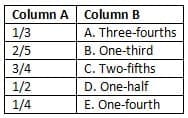
Match the Following

Answer the following Questions

Q1. Are Answer the following Questionsequivalent fractions? Why?

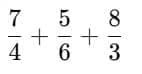
Q2. Add the following fractions and express the result as a mixed fraction:Answer the following Questions
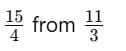
Q3. Subtract as indicated:

Answer the following Questions

Q4. Compare the following fraction and justify your answer:

Answer the following Questions

Word Problems 

Q1: Aman mixes 7/9 liters of lemon juice with 5/6 liters of orange juice to make fruit punch. What is the total volume of fruit punch he has made?

Q2: Rina's school is 11/15 km from her home. She rides her bicycle for 2/5 km from her home daily and then walks the remaining distance to reach her school. How much distance does she walk daily?

Q3: Mohan takes 5/3 minutes to complete a swimming lap, while his friend Sohan takes 8/5 minutes to do the same. Who completes the lap faster and by how much?

You can access the solutions to this worksheet here.

The document Worksheet: Fractions - 1 is a part of the Class 6 Course Mathematics for Class 6.
All you need of Class 6 at this link: Class 6

FAQs on Worksheet: Fractions - 1

1. How do I identify the numerator and denominator in a fraction?
Ans. The numerator is the top number showing how many parts you have, while the denominator is the bottom number showing total parts the whole is divided into. In the fraction 3/5, 3 is the numerator and 5 is the denominator. Understanding this basic fraction terminology helps students solve all fraction problems correctly and compare different fractional values.
2. What's the difference between proper fractions and improper fractions for Class 6?
Ans. Proper fractions have a numerator smaller than the denominator (like 2/5), meaning they're less than one whole. Improper fractions have a numerator equal to or greater than the denominator (like 5/3), meaning they equal or exceed one whole. Mixed numbers combine whole numbers with proper fractions-for example, 1 2/3. Recognising these fraction types is essential for CBSE Class 6 Mathematics.
3. Why do I need to find the equivalent fraction with the same denominator?
Ans. Converting fractions to equivalent fractions with common denominators lets you compare and add fractions accurately. When fractions share the same denominator, their numerators directly show which is larger or smaller. For instance, 1/2 and 2/4 are equivalent because multiplying numerator and denominator by the same number doesn't change the fraction's value. This skill is fundamental for worksheet problems involving fraction comparison and addition.
4. How can I simplify a fraction to its lowest terms?
Ans. Divide both the numerator and denominator by their greatest common factor (GCF) to simplify fractions. For example, 6/9 becomes 2/3 when dividing both by 3. A simplified or reduced fraction maintains the same value but uses smaller numbers, making calculations easier. Students should check if the GCF is 1-if so, the fraction is already in lowest terms.
5. What does it mean when two fractions are equivalent on a worksheet?
Ans. Equivalent fractions represent the same portion or value despite having different numerators and denominators. Multiply or divide both parts by identical numbers to create equivalent fractions-2/3 equals 4/6, 6/9, and 8/12. Visual representations using fraction models, number lines, or area diagrams help students grasp this concept. EduRev's flashcards and mind maps illustrate equivalent fractions clearly for better understanding.
Explore Courses for Class 6 exam
Get EduRev Notes directly in your Google search
Related Searches
Worksheet: Fractions - 1, ppt, Summary, Exam, Sample Paper, shortcuts and tricks, Important questions, Viva Questions, video lectures, Previous Year Questions with Solutions, practice quizzes, Worksheet: Fractions - 1, Free, MCQs, mock tests for examination, Objective type Questions, Semester Notes, past year papers, study material, pdf , Extra Questions, Worksheet: Fractions - 1;